Temporary Truce Offers Glimmer of Price Relief, But Risks Persist
The global oil market is currently navigating a complex landscape, where geopolitical developments continue to exert significant influence over price trajectories. Recent news of a two-week ceasefire between the U.S. and Iran has introduced a measure of cautious optimism, suggesting a potential easing of supply bottlenecks through the critical Strait of Hormuz. This fragile agreement has already triggered some downward pressure on crude futures and could translate into modest relief at the pump for consumers in the short term. However, our analysis suggests that while immediate gains from increased transit capacity are possible, the underlying geopolitical risk premium remains firmly embedded, preventing a swift return to pre-conflict price levels. Investors must remain vigilant, as the temporary nature of this truce means volatility is likely to persist, shaping our outlook for energy markets through the coming weeks and months.
Market Dynamics: A Fragile Easing Amid Geopolitical Tensions
The immediate market reaction to the ceasefire announcement has been notable, though nuanced. As of today, Brent Crude trades at $93.79, reflecting a slight uptick of 0.59% within a daily range of $91.39 to $94.86. Similarly, WTI Crude stands at $89.8, up 0.14% after trading between $87.64 and $91.41. This stability follows a period of more significant declines, as our proprietary data indicates Brent crude has shed over 7% in the last two weeks alone, moving from $101.16 on April 1st to $94.09 on April 21st. The initial announcement of the ceasefire saw benchmarks like WTI and Brent tumble from previous highs, signaling the market’s sensitivity to potential supply increases.
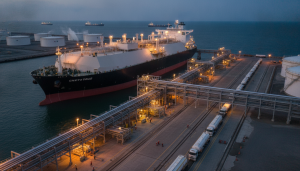
The impact on retail gasoline prices, while lagging, is beginning to materialize. The national average for gasoline currently sits at $3.12 per gallon. This is a significant decrease from the $4.16 per gallon observed on Wednesday, following the initial ceasefire news, and well below the peak of $5.01 per gallon seen in June 2022, which was largely driven by supply disruptions from the Russia-Ukraine conflict and surging demand. Even so, current prices remain considerably higher than the sub-$3 average recorded just before the onset of the Iran conflict in late February. The critical factor underpinning these shifts is the Strait of Hormuz. Prior to the conflict, approximately 130 ship transits occurred daily; by March, this number had plummeted to just six per day, severely constricting global oil flows. While the ceasefire has allowed for a slow trickle of traffic, a full restoration of normal transit volumes is far from guaranteed.
The Ceasefire’s Impact: A Short-Term Window for Supply
The two-week ceasefire agreement between the U.S. and Iran has been widely interpreted as a crucial, albeit temporary, opportunity to alleviate some of the immediate pressures on oil supply. Analysts anticipate that if the truce holds, it could facilitate increased oil tanker traffic through the Strait of Hormuz, directly impacting global crude availability. Experts like Andy Lipow, president of Lipow Oil Associates, suggest that consumers might see a decline in gasoline prices ranging from 10 to 20 cents per gallon over the next couple of weeks, with relief potentially beginning as soon as this weekend. This forecast is, of course, entirely contingent on the ceasefire’s successful implementation and extension.
The market’s anticipation reflects a belief that even a temporary opening of this vital shipping lane can bring more crude to market, alleviating some of the severe supply constraints witnessed recently. However, this is not seen as a pathway to lasting peace or a complete normalization of market conditions. The sentiment suggests that the ceasefire is merely a starting point, a short-term window to inject much-needed supply into a tight market. The true test will be whether this initial agreement can evolve into a more permanent resolution, preventing a return to the heightened tensions that previously choked off a significant portion of global maritime trade.
Navigating Forward: Key Data Points and Enduring Risks
Looking ahead, the oil market remains fraught with uncertainty, demanding a strategic approach from investors. While the ceasefire offers a brief respite, the process of normalizing supply will be protracted. Patrick De Haan, head of petroleum analysis for GasBuddy, notes that it would likely take several weeks for oil prices to fall more substantially, with gasoline prices potentially requiring a couple of months to return to more “normal” levels, assuming the Strait of Hormuz remains open long-term. Even then, Lipow cautions that the oil market is unlikely to revert to pre-conflict pricing due to the persistent geopolitical risk premium now inherent in the Middle East. The ability of Iran to disrupt the Strait once means the threat of future disruptions will continue to be priced into crude.
Investors will be closely monitoring a series of upcoming energy events for critical insights into supply and demand dynamics. The EIA Weekly Petroleum Status Reports on April 22nd and April 29th will provide up-to-date data on crude oil and refined product inventories, offering early signals of any supply adjustments. Similarly, the API Weekly Crude Inventory updates on April 28th and May 5th will offer further granularity. The Baker Hughes Rig Count reports on April 24th and May 1st will indicate production trends, while the EIA Short-Term Energy Outlook on May 2nd will provide broader forecasts for the coming months. These data points, combined with ongoing geopolitical developments, will paint a clearer picture of the market’s trajectory beyond the initial two-week ceasefire window.
Investor Sentiment: Seeking Clarity Amidst Volatility
Our proprietary reader intent data reveals a heightened level of investor anxiety and a strong focus on directional price movements in the current environment. Investors are keenly focused on understanding whether WTI and Brent crude prices are poised for further increases or declines, with many seeking predictions for crude oil prices by the end of 2026. This reflects a broader concern about the sustainability of current price levels and the long-term impact of geopolitical instability on energy markets. Questions surrounding the trajectory of specific companies, such as Repsol, further underscore the desire for actionable insights in a volatile sector.
The prevailing sentiment indicates a market grappling with contradictory signals: the short-term relief from a ceasefire versus the enduring threat of regional conflict. Investors are not just asking “what is the price today?” but “what will the price be tomorrow, next month, next year?” This forward-looking perspective highlights the importance of integrating geopolitical analysis with fundamental market data. Our platform’s ability to track these investor queries allows us to tailor our analysis to address the most pressing concerns, emphasizing that while temporary market adjustments are possible, the strategic allocation of capital in the oil and gas sector demands a clear-eyed assessment of persistent risks and long-term supply fundamentals.