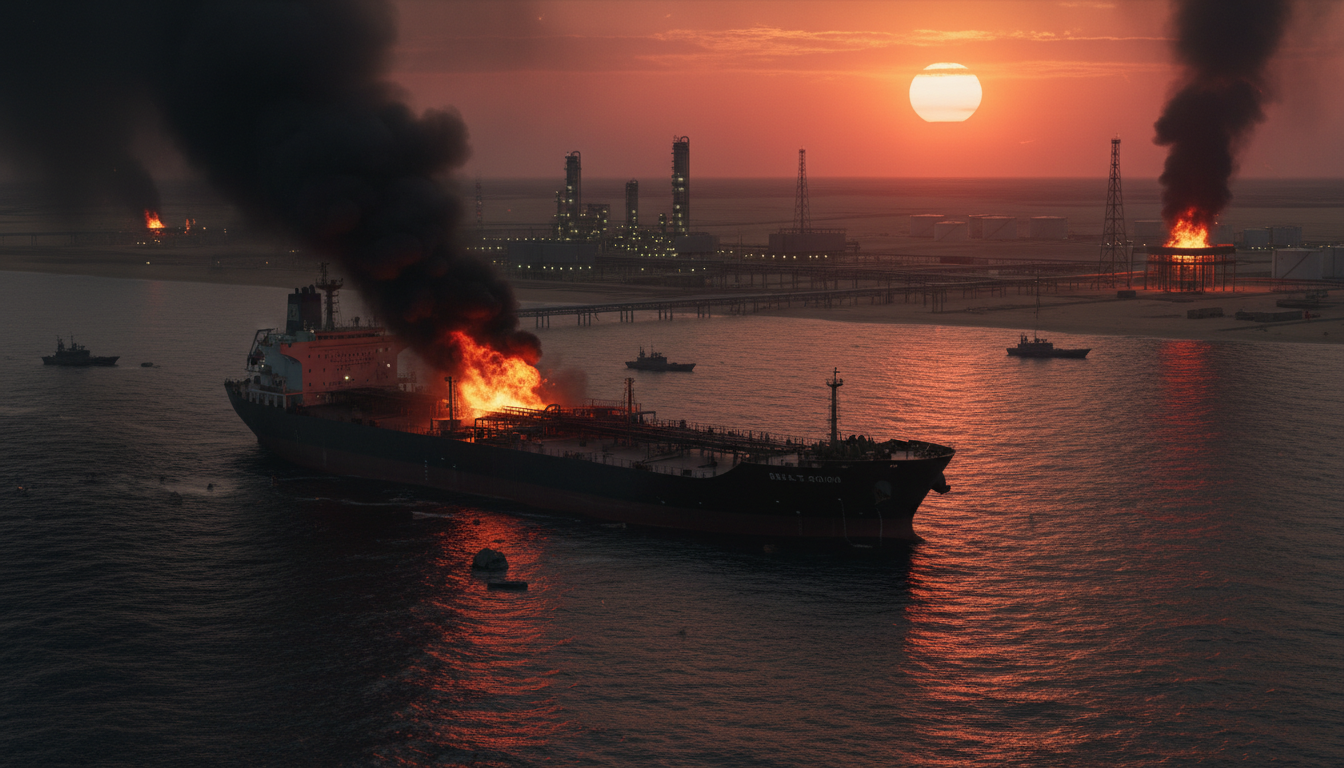
Escalating Middle East Tensions Ignite Oil Markets After Kuwaiti Tanker Strike
Global energy markets are bracing for renewed volatility after an Iranian drone successfully targeted a fully laden Kuwaiti oil tanker, the Al-Salmi, off the coast of Dubai early on Tuesday. This significant incident, marking one of the most impactful attacks on commercial shipping in the ongoing month-long conflict, immediately sent crude prices higher and intensified concerns surrounding the critically important Strait of Hormuz.
The attack, occurring just after midnight local time, struck the Kuwait-flagged Very Large Crude Carrier (VLCC) while it was anchored in Dubai’s busy port zone, merely 31 nautical miles northwest of the emirate. This area is a bustling hub for vessels awaiting passage out of the Persian Gulf. According to statements from the state-run Kuwait Petroleum Corp., the strike caused structural damage to the hull and ignited a fire aboard the colossal vessel. Swift response measures proved effective, with the Dubai Media Office confirming later on Tuesday that the blaze had been successfully extinguished and the situation brought under control, crucially with no reports of oil leakage. All 24 crew members aboard the Al-Salmi were confirmed safe, averting what could have been an environmental and human catastrophe.
Geopolitical Risks Flare as Regional Conflict Deepens
This incident serves as a stark reminder that the escalating Middle East conflict shows little sign of de-escalation, undermining any proposed peace initiatives with the harsh realities on the ground. The attack comes amidst a fifth week of intense regional strife and inconsistent messaging from Washington. Earlier, US President Donald Trump had issued strong warnings against Iranian infrastructure, including key power plants and oil facilities, concurrently bolstering American military presence in the region. Investors are now keenly watching how these intertwined threats and actions will shape the future trajectory of global energy supply and demand dynamics.
The immediate market reaction was palpable, with West Texas Intermediate (WTI) futures witnessing a sharp climb of almost 4 percent, momentarily pushing prices towards the $107 per barrel mark, before paring some of those gains. This surge underscores the market’s sensitivity to supply disruptions and geopolitical instability, particularly in a region vital to global oil flows. The added risk premium highlights a growing concern among traders and analysts regarding the potential for further escalation that could directly impact crude exports.
The Strait of Hormuz: A Critical Choke Point Under Threat
At the heart of these anxieties lies the Strait of Hormuz, the narrow maritime passage that acts as the sole gateway to the Persian Gulf. Iran’s significant operational control over this waterway grants it the capacity to severely disrupt global energy shipments. Indeed, Tehran has effectively curtailed most vessel traffic, allowing only a minimal trickle of ships through, thereby paralyzing the transit of vital energy resources and other goods. While Iran has previously targeted both ships and energy infrastructure, incidents directly impacting vessels within and around the strait had seemingly subsided in recent days, with the last reported near-miss involving a bulk carrier occurring on March 21.
This latest drone strike, however, dramatically reawakens deep-seated concerns among shipowners and energy companies. The Dubai anchorage area, where the Al-Salmi was attacked, is a customary stopping point for vessels seeking to secure crucial war-risk insurance coverage and finalize operational details before attempting to navigate the perilous narrow corridor of the Strait. Data compiled indicates that as of Tuesday morning, over 400 diverse vessels were present in or around the anchorage area where the strike took place, underscoring the immense concentration of shipping assets vulnerable to such attacks. The potential for electronic interference in reporting true ship locations in this volatile area adds another layer of complexity to maritime security assessments.
Vessel Tracking and Strategic Signaling in Contested Waters
The journey of the Al-Salmi leading up to the incident offers insights into the intricate maneuvers vessels undertake in a high-risk environment. Ship-tracking data reveals that the tanker entered the Persian Gulf in late February, subsequently calling at Saudi Arabia’s Khafji port to load crude barrels. It then proceeded to Kuwait’s Mina Al Ahmadi for additional cargo, ultimately sailing fully laden towards the United Arab Emirates, where it had been anchored off Dubai prior to the attack.
Throughout its voyage, the vessel’s signaling provided clear indications of its affiliations, a common tactic employed by shipping companies attempting to navigate heightened tensions. As it entered the Gulf, the Al-Salmi explicitly declared its Kuwaiti flag and stated its destination as Qingdao, China. At various points, its signals also indicated the presence of Chinese cargo, strategies likely intended to deter potential adversaries by associating itself with neutral or politically significant nations. This highlights the complex strategic signaling required for safe passage in zones of geopolitical contention. For investors, understanding these operational realities and the inherent risks in key shipping lanes is paramount when evaluating the stability and security of global energy supply chains and maritime logistics portfolios.


