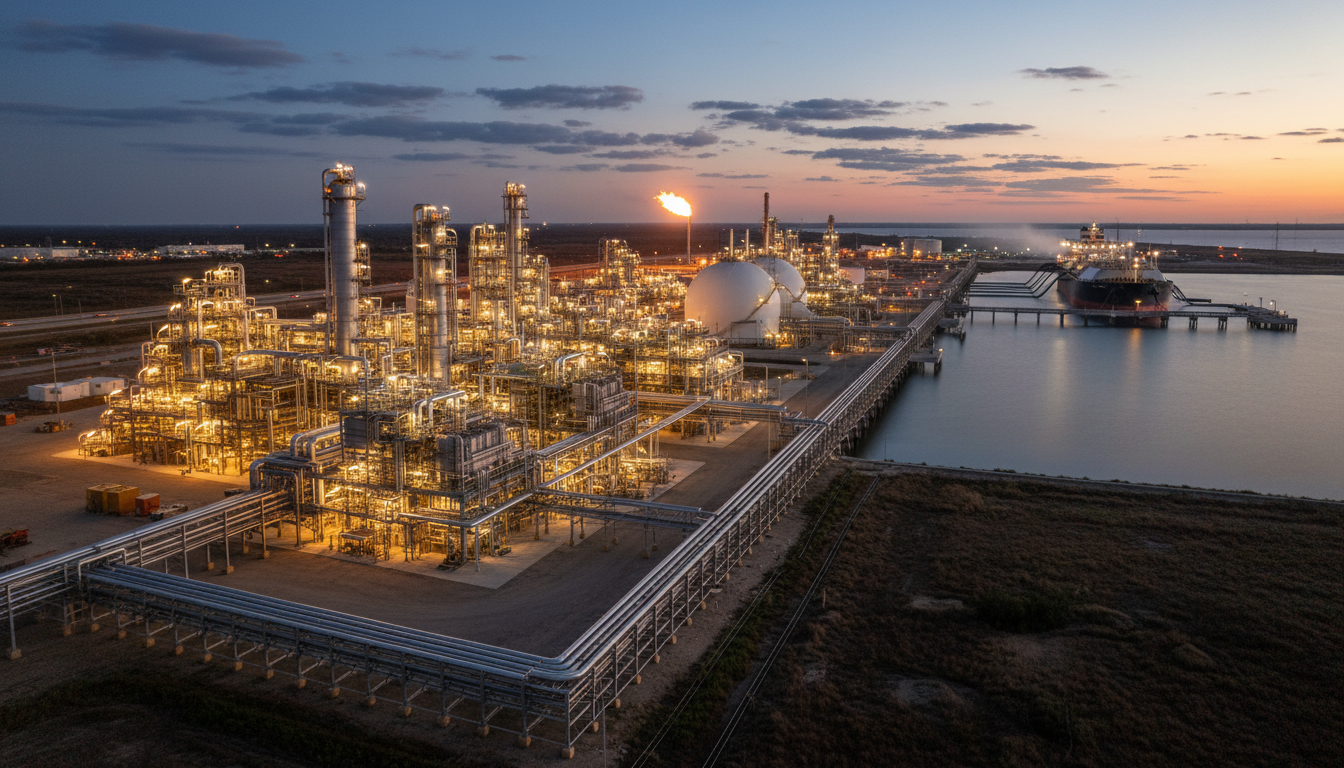
The global liquefied natural gas (LNG) market has welcomed a significant new entrant with the commencement of production at Golden Pass LNG in Sabine Pass, Texas. This landmark achievement, announced by the joint venture between QatarEnergy and Exxon Mobil Corp, marks a pivotal moment for both companies and for international energy security, despite navigating a path fraught with delays and escalating costs.
Anticipation builds as Train 1, the first of three planned liquefaction units, prepares to dispatch its inaugural cargo during the second quarter. This operational milestone is more than just a project delivery; it represents one of the most substantial single investment decisions ever made in the U.S. LNG sector. As geopolitical dynamics continue to shape global energy policies, the timely market entry of Golden Pass LNG arrives when ensuring reliable and diversified energy supplies remains a paramount concern for nations worldwide.
QatarEnergy’s Strategic Vision and U.S. Investment
For QatarEnergy, the majority stakeholder with a 70% ownership, Golden Pass LNG is a tangible outcome of a comprehensive international investment strategy cultivated over the past decade. Saad Sherida Al-Kaabi, QatarEnergy’s president and CEO and also Qatar’s energy minister, underscored the project’s importance, aligning it directly with the company’s 2018 commitment to inject $20 billion into the U.S. energy landscape. This strategic foresight is now yielding its first fruits, solidifying QatarEnergy’s global footprint beyond its domestic North Field resources.
ExxonMobil, holding the remaining 30% stake, partnered with QatarEnergy on this colossal undertaking, reaching a final investment decision in 2019. The initial operational target was set for 2024, a timeline that, while adjusted, now sees the project ready to contribute substantial volumes to the global gas trade.
Capacity and Market Reach
Golden Pass LNG holds the regulatory permissions to export an impressive volume of natural gas, equivalent to 937 billion cubic feet annually, or 18.1 million metric tons per annum (MMtpa) of LNG. These authorizations, which have seen amendments since their initial issuance in April 2017 for free trade agreement (FTA) countries and September 2017 for non-FTA nations, equip the facility to serve a broad spectrum of international buyers. This expansive reach is crucial for market diversification and enhancing energy security for various importing regions.
Navigating Construction Headwinds and Contractor Challenges
The path to production at Golden Pass was not without its hurdles. The project encountered various delays and significant cost escalations, factors that often challenge large-scale infrastructure developments. These complexities led to amendments in the engineering, procurement, and construction (EPC) terms for all three liquefaction trains.
Initially, a consortium comprising Yokohama-based Chiyoda Corp, Houston-based McDermott International Ltd, and San Antonio-based Zachry Holdings Inc (ZHI) was contracted in 2019. However, ZHI filed for Chapter 11 bankruptcy in May 2024, explicitly citing the Golden Pass project’s budget and schedule overruns as contributing factors. Following a court-approved settlement, ZHI exited the contract, necessitating adjustments and new agreements to maintain project momentum. Amendments to the EPC terms for Train 1 were announced by Chiyoda in November 2024, with further revisions for the second and third trains finalized in November 2025.
Qatar’s Expanding Global LNG Dominance
The inauguration of Golden Pass significantly contributes to Qatar’s ambitious goal of more than doubling its total LNG production capacity to 160 MMtpa, a target announced in 2024. This expansion integrates directly with the massive North Field projects in Qatar itself, solidifying the nation’s position as a powerhouse in global LNG supply. In 2024, Qatar ranked as the world’s second-largest LNG exporter, shipping 106.9 billion cubic meters (3.78 trillion cubic feet), a testament to its formidable capabilities in the sector, as highlighted by the Energy Institute’s “Statistical Review of World Energy.”
Geopolitical Resilience and Supply Chain Diversification
The strategic importance of projects like Golden Pass is further amplified by recent geopolitical events impacting energy supplies. In March 2026, QatarEnergy reported substantial damage to its domestic LNG infrastructure from missile strikes, projecting up to five years for repairs and an estimated annual revenue loss of $20 billion. Such disruptions underscore the critical need for diversified supply sources to ensure stability for importing nations in Asia and Europe.
Golden Pass LNG offers a vital additional source, enhancing the resilience of the global LNG supply chain. For investors, the commencement of operations at Golden Pass represents not only the realization of a massive capital investment but also a strengthened foothold in a market increasingly defined by energy security imperatives and the ongoing global demand for natural gas. The project’s successful commissioning, despite past challenges, signals robust execution by its partners and provides a crucial supply injection into an evolving and often volatile energy landscape.


