Oil India Unleashes Record Production in Thar Desert, Boosting India’s Energy Security
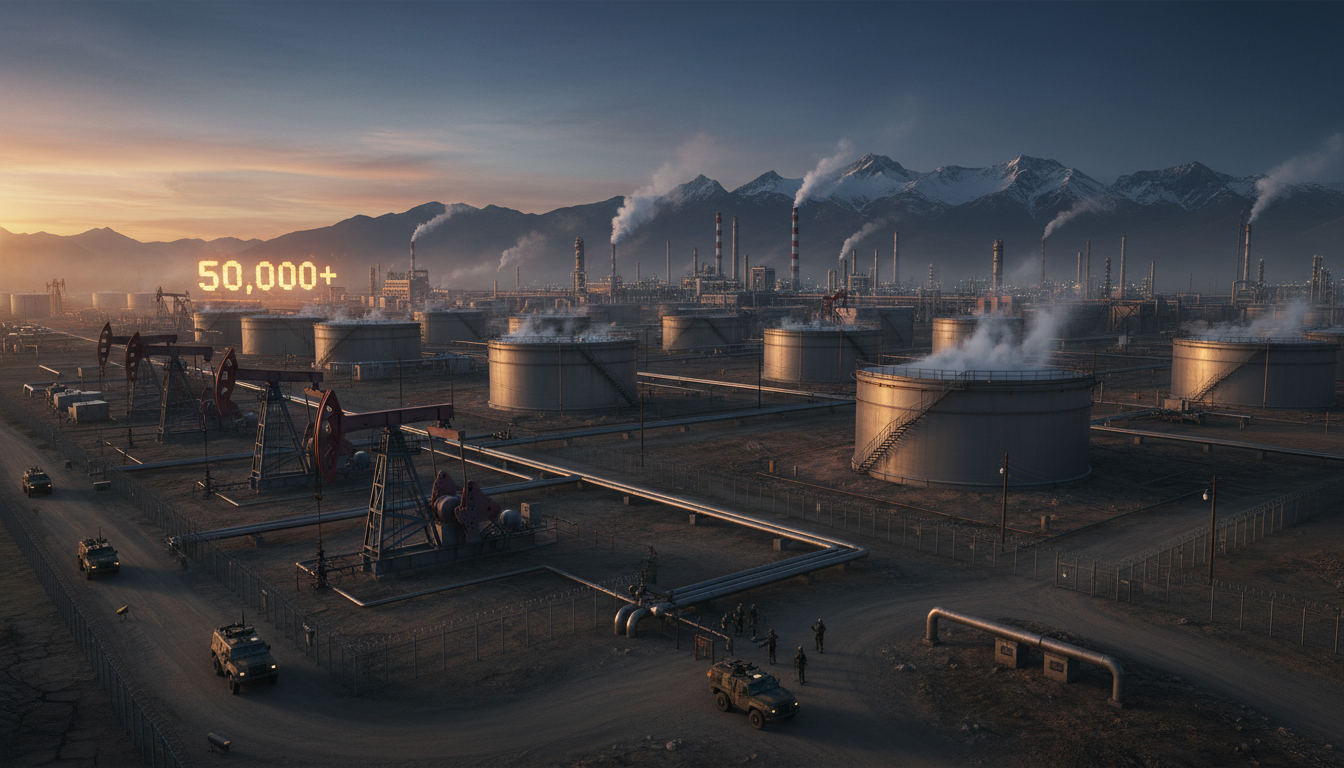
Amidst a persistently volatile global energy market and heightened geopolitical uncertainties, Oil India Ltd. (OIL) has delivered a significant boost to India’s domestic crude production capabilities. The state-run energy major recently announced a record daily output of 1,202 barrels from the challenging Jodhpur sandstone formation within Rajasthan’s Thar desert. This substantial achievement not only marks a new operational peak for the company but also underscores India’s strategic push towards greater energy independence, presenting a compelling narrative for investors keenly observing the nation’s upstream sector.
This latest production figure represents an impressive year-over-year growth of approximately 70% for the region, significantly climbing from the 705 barrels per day reported in the previous period. Such a dramatic increase is far more than just an operational success; it directly contributes to fortifying India’s energy security framework, thereby reducing susceptibility to the often-unpredictable fluctuations of global supply chains. For the fiscal year 2025-26, OIL’s operations in Rajasthan culminated in an annual crude oil production of 43,773 metric tonnes, showcasing robust growth from the 32,787 metric tonnes achieved in the prior fiscal year. This sustained upward trajectory clearly highlights the effectiveness of current operational strategies and the successful deployment of cutting-edge extraction technologies. The crude extracted from the Baghewala field in Jaisalmer is transported via tankers to Oil and Natural Gas Corporation (ONGC) facilities in Mehsana, Gujarat, before seamlessly entering a critical pipeline network destined for the Indian Oil Corporation Ltd (IOCL) refinery in Koyali, an integrated logistics chain ensuring efficient national distribution.
Technological Innovation Drives Heavy Oil Recovery
The remarkable success story at Baghewala stands largely as a testament to OIL’s strategic adoption of advanced recovery techniques, most notably Cyclic Steam Stimulation (CSS). This thermal enhanced oil recovery (EOR) method proves indispensable for extracting high-viscosity crude, a resource notoriously difficult to produce using conventional means. The unique and often challenging geological conditions of the Thar region further underscore the significance of effectively applying CSS, positioning it as a pivotal milestone in India’s broader EOR landscape. OIL has substantially scaled up its CSS operations, successfully completing these intricate procedures in 19 wells, marking an impressive 72% increase compared to the previous year. Furthermore, the company has aggressively expanded its drilling program, adding 13 new wells during the past year, an increase from nine previously, signaling a calculated and robust expansion strategy within its hydrocarbon assets.
Beyond the widespread implementation of CSS, Oil India is actively pioneering other state-of-the-art drilling and production technologies specifically tailored for India’s heavy oil reserves. Innovative methods such as fishbone drilling and barefoot completion techniques are being deployed for the first time within the country, showcasing the company’s commitment to technological leadership and pushing the boundaries of what’s possible in the upstream sector. These cutting-edge techniques, coupled with advanced equipment including electric downhole heaters, hydraulic sucker rod pumps, and high-temperature thermal wellheads, are meticulously engineered to overcome the inherent challenges posed by highly viscous crude. Such integrated solutions optimize flow rates, maximize resource recovery, and enhance overall operational efficiency. Given the unusually thick consistency of the crude in this region, conventional extraction methods proved unviable, necessitating the implementation of innovative solutions like diluent injection and advanced artificial lift systems, which collectively demonstrate OIL’s exceptional adaptive engineering capabilities.
The Strategic Value of the Baghewala Asset
The Baghewala oil field, strategically located within the Bikaner-Nagaur sub-basin of the expansive Rajasthan basin, stands as one of India’s few significant onshore heavy oil fields. Originally discovered in 1991, this vital asset spans an impressive area of 200.26 square kilometers. Oil India has maintained consistent production from the Baghewala field since 2017, with 33 of its 52 wells currently operational, contributing steadily to the nation’s energy supply. A pivotal moment for Baghewala’s productivity came with the successful implementation of CSS technology, which was first piloted in 2018. This technological breakthrough marked a paradigm shift in heavy oil extraction, enabling large-scale recovery from a previously challenging reservoir and establishing new benchmarks for thermal EOR within the Indian context.
Investment Outlook and Enhanced Energy Resilience
This impressive operational performance at Baghewala holds profound implications for investors and shapes the future trajectory of India’s energy landscape. The sustained increase in domestic crude oil production directly contributes to significantly reducing India’s substantial crude import bill, thereby bolstering the nation’s economic stability and strengthening foreign exchange reserves. For investors, this signifies robust performance within OIL’s upstream portfolio and clearly highlights the substantial potential for sustained growth from indigenous hydrocarbon assets. The company’s proactive deployment of advanced technologies in challenging environments signals strong technical acumen and a forward-looking strategy poised to unlock further resource potential. As global energy markets continue to be subject to geopolitical flux and price volatility, strategic domestic advancements like those demonstrated at Baghewala dramatically enhance India’s long-term energy resilience, offering a more stable and predictable supply foundation. OIL’s success in Rajasthan reaffirms the strategic value of heavy oil assets and firmly positions the company as a key player in India’s ongoing pursuit of energy independence, a compelling narrative that resonates strongly with long-term value investors in the dynamic oil and gas sector.


