

India’s Economic Tightrope: $100 Oil Prices Threaten Inflation and Monetary Stability
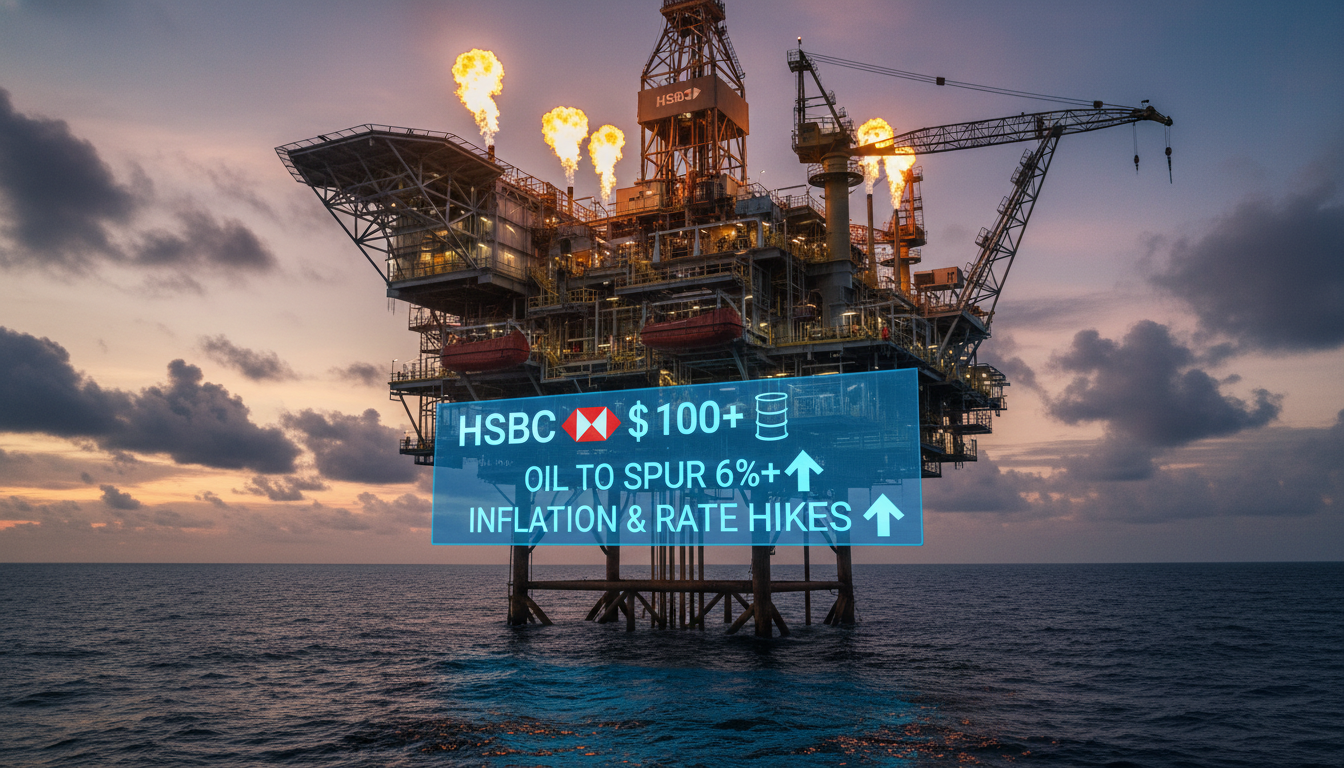
Investors are closely monitoring India’s economic trajectory as global crude oil benchmarks hover at critical levels. Sustained oil prices above the $100 per barrel mark are poised to push India’s headline inflation beyond the Reserve Bank of India’s (RBI) comfort zone, likely triggering a series of interest rate hikes. This scenario presents a significant challenge for policymakers aiming to balance economic growth with price stability in a volatile global energy landscape.
The $100 Threshold: A Catalyst for Inflationary Pressures
Recent analysis from leading economic strategists indicates that if crude oil prices consistently trade above $100 per barrel, India’s consumer price index (CPI) inflation will inevitably surpass the RBI’s upper tolerance band of 6 percent. Modelling suggests that inflation could remain subdued, below the 6 percent threshold, only if oil prices average under $100 per barrel. With Brent crude having already averaged $100 in March, the nation now stands at a crucial economic juncture, facing a potential shift in its monetary policy stance.
This surge in energy costs acts as a direct input cost for numerous sectors, from manufacturing to transportation, eventually filtering down to consumer prices. Higher fuel costs at the pump, coupled with increased freight charges, contribute significantly to overall inflationary pressures, making everyday goods and services more expensive for Indian consumers. For investors, this translates into potential erosion of purchasing power and a re-evaluation of sector-specific growth projections.
RBI’s Dilemma: Defending the Rupee Amidst Growth Concerns
As the date for the RBI’s next monetary policy announcement approaches, market speculation is rife regarding the central bank’s potential use of interest rates to defend the Indian Rupee (INR). However, economists warn that such a strategy could prove costly. An aggressive interest-rate defense for the INR risks impeding economic growth, particularly if the drag from elevated oil prices intensifies in a non-linear fashion. The dilemma for the RBI is profound: tighten monetary policy to curb inflation and support the currency, or maintain accommodative conditions to foster growth, potentially at the cost of higher inflation and a weaker rupee.
For capital markets, this balancing act introduces considerable uncertainty. Higher interest rates typically cool inflationary pressures but can also dampen investment and consumption, slowing down corporate earnings growth. A weakening rupee, while potentially boosting export competitiveness, increases the cost of imports, including vital crude oil, further fueling inflation and pressuring corporate margins, especially for companies reliant on imported raw materials.
A Call for Policy Neutrality: Learning from Past Lessons
In this complex environment, economic advisors are recommending a “neutral” stance on both monetary and fiscal fronts. The rationale behind this approach is clear: current inflationary pressures are largely supply-driven, stemming from global energy shocks. Stimulating domestic demand prematurely, before underlying supply chain issues are resolved, could exacerbate inflation, echoing the experience during the COVID-19 pandemic. At that time, a rush to boost demand before supply networks fully recovered led to persistently high inflation.
Policymakers now face a delicate balancing act. They must avoid overstimulating the economy, which could ignite further price increases, yet also refrain from excessive tightening that could deepen an already emerging growth slowdown. This nuanced approach is vital to navigate the current economic headwinds without triggering unintended consequences that could hinder long-term economic recovery and stability.
Fiscal Prudence and Energy Price Adjustments
On the fiscal side, the “neutral” prescription involves maintaining the government’s fiscal deficit close to the targets outlined for FY26. A crucial component of this strategy is the need to adjust domestic prices for petrol and diesel. By allowing these prices to reflect global crude costs more accurately, the government can help contain its fiscal deficit, which might otherwise balloon due to subsidized fuel prices. This move, while potentially unpopular with consumers, is deemed essential for fiscal health and to prevent a wider budget shortfall that could further destabilize the economy.
For investors, these fiscal adjustments are critical indicators of the government’s commitment to financial discipline. Rationalizing fuel prices, despite their political sensitivity, signals a willingness to undertake necessary reforms for macroeconomic stability, potentially attracting greater foreign investment and strengthening market confidence.
Monetary Strategy: Flexible Targeting Amidst Volatility
From a monetary policy perspective, India’s “flexible” inflation targeting framework provides the RBI with some room to maneuver. This framework allows inflation to fluctuate within a specified range of 2-6 percent, acknowledging that external shocks can lead to temporary deviations. This flexibility is particularly important during periods of high global commodity price volatility, enabling the central bank to avoid knee-jerk reactions that could harm growth without necessarily solving the root cause of inflation.
However, this flexibility is not limitless. Should the ongoing energy shock persist for an extended period – perhaps for several more weeks – the economic growth drag could begin to outweigh the immediate inflation shock. At that point, the RBI might need to recalibrate its focus, potentially prioritizing growth support over aggressive inflation containment, while still maintaining its long-term commitment to price stability. Investors should monitor the RBI’s rhetoric closely for any shifts in emphasis between managing inflation and supporting economic expansion.
In conclusion, India’s financial landscape is at a critical juncture, heavily influenced by global oil price dynamics. The interplay between inflation, interest rates, and the Rupee, guided by the RBI’s measured policy responses, will be key determinants of market performance and investor sentiment in the coming months. Staying informed on these macroeconomic indicators will be paramount for strategic investment decisions within the Indian market.
