

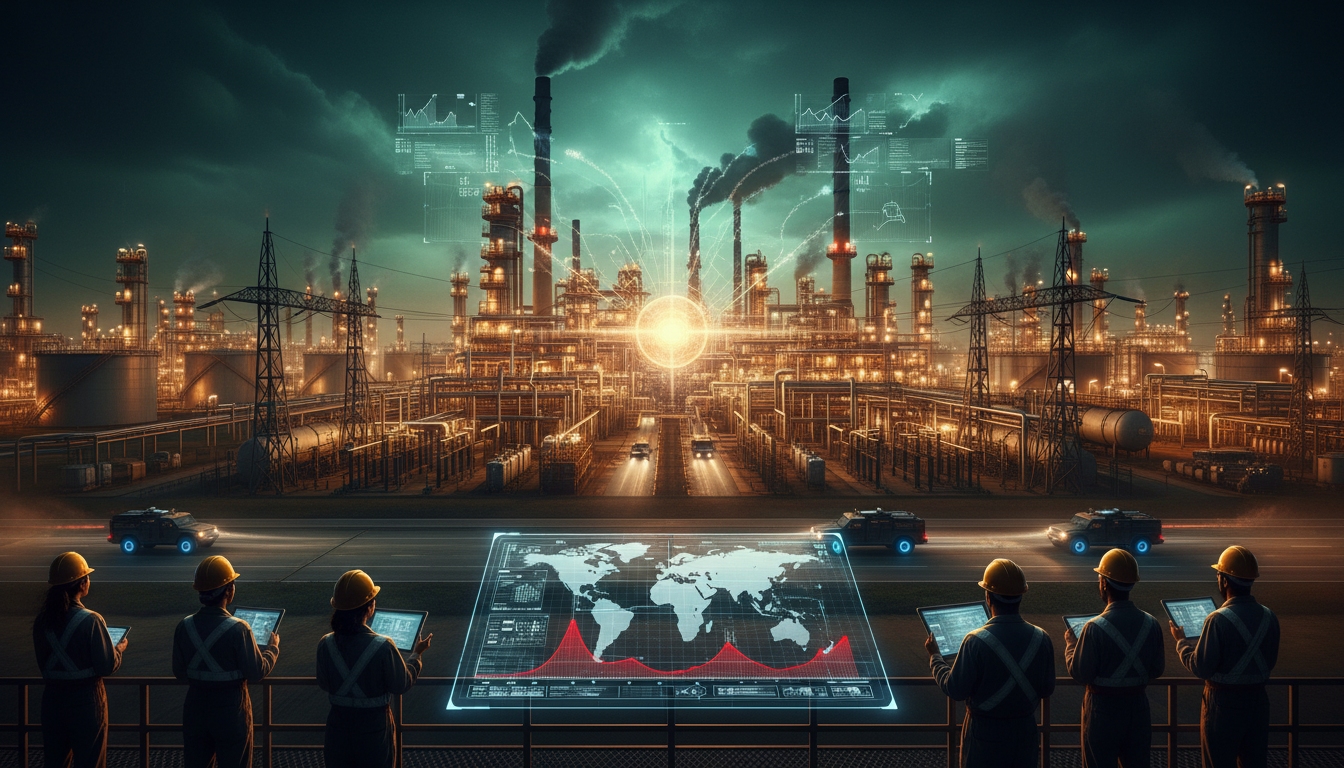
The global technology landscape is undergoing a profound transformation, with artificial intelligence at its core. This shift is not merely confined to Silicon Valley campuses; its implications reverberate across every major industry, including the energy sector. Microsoft, a titan in the tech world, has just made a pivotal move in the AI race, unveiling a trio of proprietary AI models designed to significantly enhance its independent capabilities. This development holds considerable weight for investors monitoring the oil and gas industry, as these advancements underscore the accelerating pace of digital transformation and operational efficiency that will define future market leaders.
Microsoft’s recent announcement introduces MAI-Transcribe-1, MAI-Voice-1, and MAI-Image-2. These sophisticated models, specializing in audio transcription, natural voice generation, and advanced image creation respectively, represent a strategic pivot for the Redmond-based giant. Critically, these tools are exclusively available through Microsoft’s Foundry platform, an integral part of its sprawling Azure cloud service ecosystem. This move signifies a clear intent to deepen its own AI competencies and reduce its dependency on external partners, even its closest ones.
Microsoft’s Strategic AI Autonomy and Its Enterprise Focus
The introduction of these in-house models puts Microsoft in direct competition with established offerings, including those from OpenAI, a company in which Microsoft is the single largest investor. OpenAI currently provides tools such as Whisper for transcription, a suite of text-to-speech models, and DALL·E for image generation, all of which are also accessible on the Azure Foundry platform. This dual availability highlights the evolving dynamics within the AI development arena, where collaboration often coexists with intense rivalry.
Mustafa Suleyman, CEO of Microsoft AI, lauded the new models, publicly declaring MAI-Transcribe-1 as “the most accurate transcription model in the world” and MAI-Voice-1 for setting “a new standard for natural speech.” Such bold claims, shared on platforms like X, underscore Microsoft’s confidence in its technological prowess and its commitment to delivering best-in-class AI solutions to its extensive enterprise client base.
This strategic push for AI independence is not a sudden shift. Microsoft and OpenAI have maintained a complex relationship, with OpenAI leveraging Microsoft’s Azure cloud for its demanding AI training and operational needs, while Microsoft integrates OpenAI’s groundbreaking ChatGPT into its own Copilot AI assistant. However, Microsoft has been systematically building its own advanced AI capabilities, aiming for greater self-sufficiency. In November, Suleyman established a dedicated superintelligence team at Microsoft, tasked with developing “frontier models of all scales with our own data and compute at the state-of-the-art level” to achieve comprehensive AI independence.
Previous agreements between the two tech giants often delineated the boundaries of their respective AI development efforts. A pivotal agreement in October redefined this relationship, explicitly allowing both companies to “independently pursue AGI (artificial general intelligence) alone or in partnership with third parties.” This revised understanding provides Microsoft with the necessary latitude to aggressively pursue its own advanced AI research and development agenda, culminating in releases like the MAI series.
Implications for Oil and Gas Investors: Beyond the Tech Headlines
For investors focused on the oil and gas sector, these advancements in AI are far from an abstract technological curiosity. They represent a fundamental shift in the operational paradigm that will increasingly define efficiency, safety, and profitability across the entire energy value chain. The enhanced capabilities of Microsoft’s new models offer tangible benefits and opportunities for energy companies looking to optimize operations, analyze vast datasets, and streamline complex processes.
Driving Efficiency Through Advanced Data Analysis
Consider the applications of MAI-Transcribe-1. In the oil and gas industry, vast amounts of critical information are stored in unstructured data formats, including field reports, geological surveys, safety briefings, and even audio recordings from control rooms or remote operations. An “unparalleled accurate transcription model” can rapidly convert these verbal or handwritten records into searchable, analyzable digital text. This capability significantly enhances data mining for trend analysis, regulatory compliance, and predictive maintenance. Imagine automatically transcribing years of legacy seismic interpretation notes or detailed well logs, unlocking insights that were previously too time-consuming or expensive to extract manually. For investors, this translates directly into potential cost savings and improved decision-making capabilities for portfolio companies.
Revolutionizing Communication and Remote Operations
MAI-Voice-1, with its ability to generate “natural speech,” has transformative potential for communication and automation in remote and hazardous environments. From improving the realism and efficacy of AI assistants in command centers to generating precise, real-time voice alerts for safety protocols, the applications are numerous. Furthermore, it could enhance human-machine interfaces for complex machinery, allowing for more intuitive control and faster response times. For oil and gas firms operating across vast geographies, leveraging such advanced voice technologies can optimize remote monitoring, incident response, and training simulations, ultimately contributing to safer operations and reduced downtime – critical metrics for investor confidence.
Enhancing Visual Intelligence for Asset Management
The introduction of MAI-Image-2 further bolsters visual intelligence capabilities. In the energy sector, image analysis is crucial for everything from drone inspections of pipelines and platforms to satellite monitoring of environmental compliance and geological feature mapping. A highly advanced image creation model, while initially seeming focused on generative AI for creative tasks, implies sophisticated underlying image understanding and processing capabilities. This could lead to more robust AI models for defect detection, anomaly identification in infrastructure, or even simulating complex geological formations for exploration planning. Accurate visual data analysis can prevent catastrophic failures, extend asset life, and optimize maintenance schedules, directly impacting the bottom line and reducing operational risk – key concerns for any energy investor.
The Future of Energy Investment is Digitally Intertwined
Microsoft’s deepening commitment to building its own cutting-edge AI models, fully integrated into its Azure cloud ecosystem, reinforces the undeniable trend: the future competitiveness of oil and gas companies will be heavily influenced by their ability to adopt and integrate advanced digital technologies. The move towards AI self-sufficiency by a tech giant like Microsoft mirrors the strategic imperative for energy companies to gain greater control over their data, their operational intelligence, and their technological stack.
Investors in the oil and gas space must recognize that the digital race is accelerating. Companies that proactively invest in AI infrastructure, embrace platforms like Azure Foundry for advanced model deployment, and integrate sophisticated tools for data processing, predictive analytics, and automation are positioning themselves for sustainable growth and improved resilience in a volatile market. Microsoft’s latest AI advancements are not just a tech story; they are a clear signal of the technological horsepower now available to industries worldwide, poised to redefine efficiency and profitability in the energy sector for years to come.
