

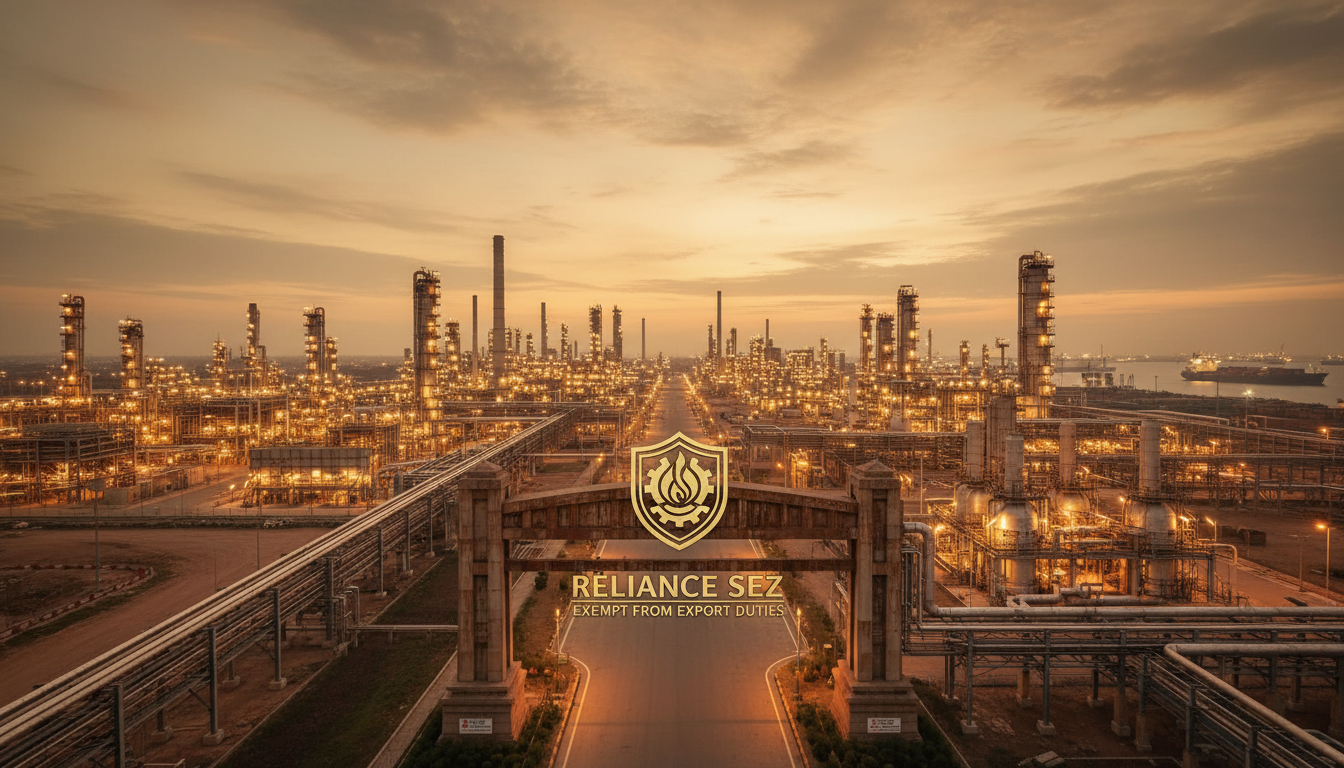
A pivotal regulatory clarification has delivered a significant boost to Reliance Industries, confirming that its massive special economic zone (SEZ) refinery will not be subject to the recently imposed export duties on critical refined products like diesel and jet fuel. This judicial pronouncement, publicly affirmed by a high-ranking government official, solidifies a key competitive advantage for India’s largest conglomerate in the volatile global energy markets, directly impacting investor sentiment and the company’s profitability outlook for its downstream operations.
The Ministry of Finance, through Joint Secretary Jainendra Singh Kandhari, unequivocally stated on Thursday that “as per judicial pronouncements on this issue, the special additional excise duty and additional excise duty are not applicable on SEZ refineries.” This official confirmation provides crucial clarity, insulating Reliance’s export-oriented refining capacity from a significant tax burden that will affect other domestic refiners engaging in overseas sales. For investors closely monitoring the refining sector, this exemption immediately translates into a healthier margin profile for a substantial portion of Reliance’s throughput.
Understanding the Export Duty Landscape
These export levies, amounting to a substantial ₹21.50 per litre on diesel and ₹29.50 per litre on jet fuel, were introduced by the government just last week. Their primary objective was to curtail overseas shipments, thereby ensuring adequate availability within the domestic market amidst escalating global supply chain disruptions exacerbated by the ongoing conflict involving Iran. This intervention marks a re-imposition of measures first seen in 2022, following the conflict in Ukraine, when refiners actively capitalized on higher international prices, leading to potential domestic shortages. While those initial taxes were eventually withdrawn, the current geopolitical landscape has necessitated their return, underscoring the government’s proactive stance on energy security. These duties are not static; the government has indicated they are subject to review every fortnight, introducing an element of policy uncertainty for affected refiners.
Reliance’s Strategic Advantage in Refining
Reliance Industries operates two distinct refining complexes in Gujarat, each serving different market segments. One unit is specifically dedicated to meeting domestic demand, while the other, strategically located within an SEZ, is exclusively geared towards exports. It is this SEZ unit, boasting an impressive annual refining capacity of 35 million tonnes, that stands to benefit immensely from the exemption. In contrast, the refinery focused on the domestic market has an annual capacity of 33 million tonnes. This structural distinction, validated by judicial precedent, means that Reliance can continue to maximize its profits from international sales without the impediment of these duties, a privilege not shared by competitors whose export volumes emanate from non-SEZ facilities.
For investors, this delineation is critical. The 35 million tonnes of annual capacity in the SEZ refinery represent a substantial earnings driver. By avoiding duties of ₹21.50 per litre on diesel and ₹29.50 per litre on jet fuel, Reliance maintains higher gross refining margins (GRMs) on its export volumes compared to its peers. This competitive edge is particularly valuable in a fluctuating commodity market where refining margins can be volatile. The ability to capture the full spread between crude oil and refined product prices on a significant portion of its output provides a more predictable and robust earnings stream for shareholders.
Implications for Investors and Market Dynamics
This ruling solidifies Reliance Industries’ position as a front-runner in the Indian oil and gas sector, particularly within the downstream segment. The exemption enhances the attractiveness of Reliance’s shares by de-risking a major part of its refining profitability from government interventions aimed at managing domestic supply. In an era where geopolitical tensions directly influence energy prices and government policies, the stability offered by an SEZ status proves to be an invaluable asset for long-term investors.
Moreover, this development could influence the broader refining landscape. While the government aims to curb exports to bolster domestic supplies, the SEZ exemption for large players like Reliance means that a significant volume of refined products will still find their way to international markets, where demand often commands premium pricing. This duality in policy—balancing domestic needs with enabling export-oriented units to thrive—highlights the complex regulatory environment faced by the oil and gas industry.
Shareholders and potential investors in Reliance Industries should view this as a strategic win that underscores the company’s foresight in establishing an SEZ refinery. It not only protects a substantial revenue stream but also positions Reliance favorably against global competitors and domestic players without similar structural advantages. As global energy markets continue to navigate the currents of supply-demand imbalances, geopolitical conflicts, and energy transition, such regulatory certainty and competitive leverage will be instrumental in driving shareholder value and maintaining robust profitability in the refining business. The market will undoubtedly factor this significant advantage into Reliance’s valuation, reinforcing confidence in its ability to navigate complex market conditions effectively.
