

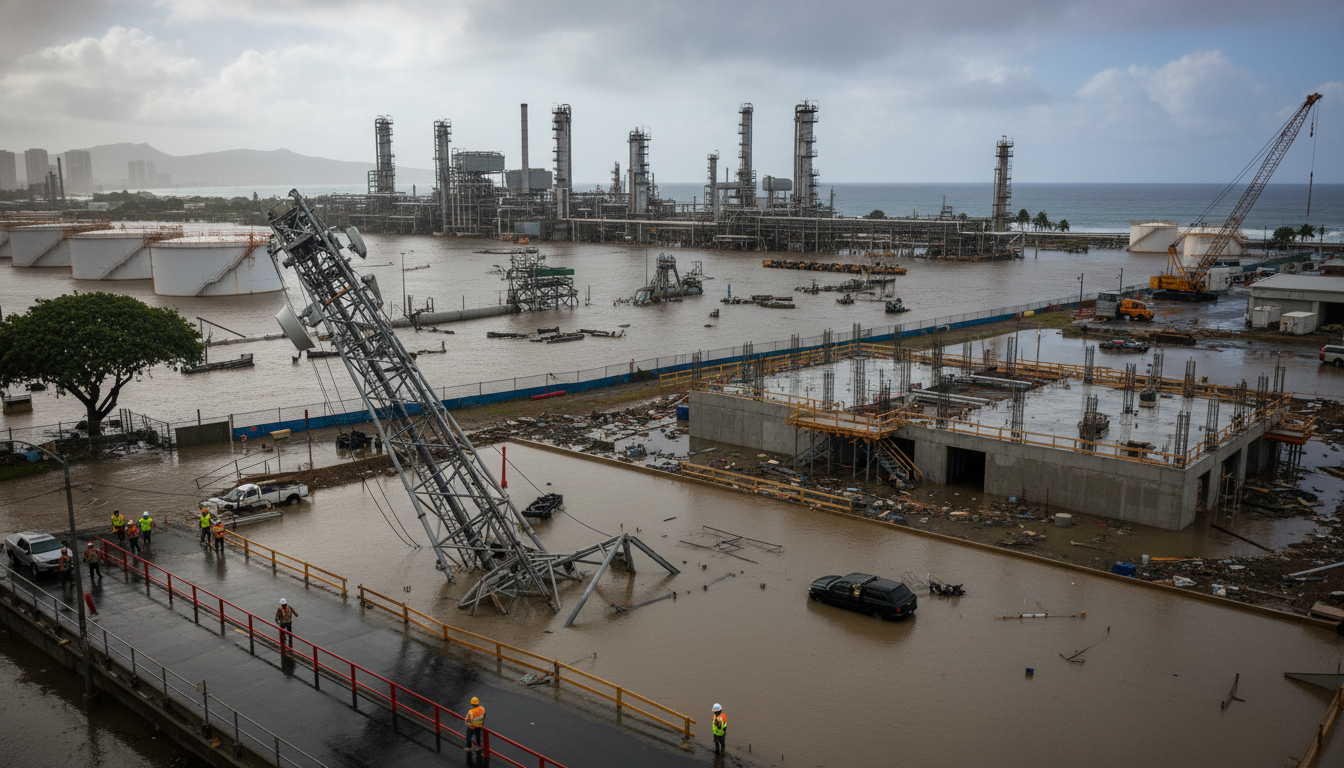
Oʻahu’s North Shore recently endured catastrophic floodwaters, sparking an intense review of Honolulu’s emergency response protocols and revealing significant infrastructure vulnerabilities. The financial repercussions are mounting, with preliminary damage estimates soaring into the billions, compelling investors to scrutinize the region’s resilience and the efficacy of its emergency management systems. This event underscores the critical need for robust infrastructure investment and transparent, timely crisis communication, key factors for maintaining economic stability and investor confidence in any region.
During a recent City Council session, Honolulu’s emergency management leadership faced pointed questions regarding the timing and clarity of public advisories. Residents in Waialua and Haleʻiwa reported wading through chest-deep water by approximately 5:30 a.m. on March 20, the time an evacuation directive was finally issued. Council members highlighted a stark contrast with prior, less severe flood events where warnings had been disseminated much earlier, questioning the delay in a situation of greater peril.
Randal Collins, Director of the Department of Emergency Management, defended the complex decision-making process for evacuation orders. He clarified that such mandates extend beyond simple stream gauge readings, noting that officials were intently monitoring the 120-year-old Wahiawā Reservoir, also known as Lake Wilson. This crucial dam, slated for transfer from Dole Food Co. to state ownership, was a primary concern, given the potential for overflow and catastrophic failure. Mayor Rick Blangiardi attributed the delays to the sheer unpredictability of the weather, which dumped an astonishing 2 trillion gallons of rain on the state over a single month, reaching a staggering 3,000% of historical average rainfall levels for the period. The National Weather Service had significantly underestimated the rainfall intensity for the night of March 19, leaving officials scrambling in an unprecedented meteorological event.
Honolulu Managing Director Mike Formby staunchly defended the city’s established metrics for initiating evacuations. He emphasized the intricate logistical planning required, including securing safe havens and ensuring adequate capacity for displaced residents. Formby also acknowledged the pressure to avoid premature evacuation orders, which could face criticism from stakeholders like Dole Food Co. for potentially causing undue disruption.
However, further questions arose concerning specific operational oversight. Council Chair Tommy Waters pressed officials on the lack of an evacuation order when Kaukonahua Stream, near Otake Camp, surged two feet at 8:25 p.m. on March 19. Director Collins explained that this critical event occurred before the city’s Emergency Operations Center became active, meaning his department lacked real-time awareness. He lamented the absence of an automated alert system for stream monitors, which currently do not automatically notify authorities when water levels become dangerous. Collins used this incident to advocate for increased departmental funding, seeking eight additional full-time positions to augment his current staff of 15, enabling continuous monitoring of all potential hazards.
The challenges extended to public communication. An advisory was finally dispatched just after 3:40 a.m. on March 20, urging residents to evacuate only if safe to do so. Collins explained that first responders were themselves struggling with ingress, making a mass evacuation under dark, rain-soaked conditions a perilous proposition for citizens. Council member Andria Tupola, representing the Waiʻanae Coast, praised the real-time updates from the Mayor’s Chief of Staff to council members but criticized the broader public communication via the HNL Alert system as confusing and lacking specific actionable guidance. This highlights a critical need for enhanced, actionable public information systems to protect both lives and property during crises.
State Seeks Federal Investment and Aid Amidst Political Crosscurrents
In a parallel briefing at the Hawaiʻi Capitol, agricultural sector representatives delivered an urgent plea for assistance, painting a stark picture of widespread devastation. Farmers, many of whom lack critical flood insurance coverage, reported catastrophic losses to crops and homes from the Kona low storm system. Brian Miyamoto, Executive Director of the Hawaiʻi Farm Bureau, emphasized that while farmers are resilient, resilience alone cannot replace tangible resources. He stressed the immediate need for financial aid, advocating for grants over loans, as many farmers are already burdened with significant debt.
Initial damage assessments reveal a grim financial reality for the agricultural community. Hunter Heavilin, Advocacy Director for the Hawaiʻi Farmers Union, reported at least $23 million in damage and the loss of 2,700 livestock, acknowledging that these figures are likely significantly underreported. Amanda Shaw, Director of Food Systems for the Oʻahu Resource Conservation and Development Council, placed the estimated true economic damage to farms between $46 million and $59 million. These figures represent a substantial blow to the state’s agricultural output and food security, requiring swift and comprehensive financial intervention.
The state’s recovery efforts are now largely contingent on federal support. Governor Josh Green formally requested a presidential disaster declaration last week, a designation critical for unlocking flexible federal emergency funding. However, as of a recent Wednesday afternoon, President Donald Trump had not granted this request. This delay is particularly concerning given a recent analysis indicating a significant disparity in federal disaster aid approvals during Trump’s second term: less than 25% for Democratic states compared to nearly 90% for Republican states. This unprecedented partisan dynamic adds a layer of political uncertainty to Hawaii’s recovery prospects.
Honolulu Managing Director Mike Formby, aware of this political landscape, acknowledged the uncertainty surrounding the federal declaration despite the state’s clear eligibility based on the scale of damage. Governor Green estimates the total damage at potentially $1 billion or more, a figure that unequivocally meets federal thresholds. The ongoing wait for this declaration leaves local communities and critical economic sectors in a precarious financial limbo, highlighting the broader market implications when federal aid becomes a political instrument rather than an impartial response mechanism. Investors monitoring regional stability and recovery efforts will be keenly watching how these funds materialize, as delays can significantly prolong economic revitalization and increase long-term costs.
