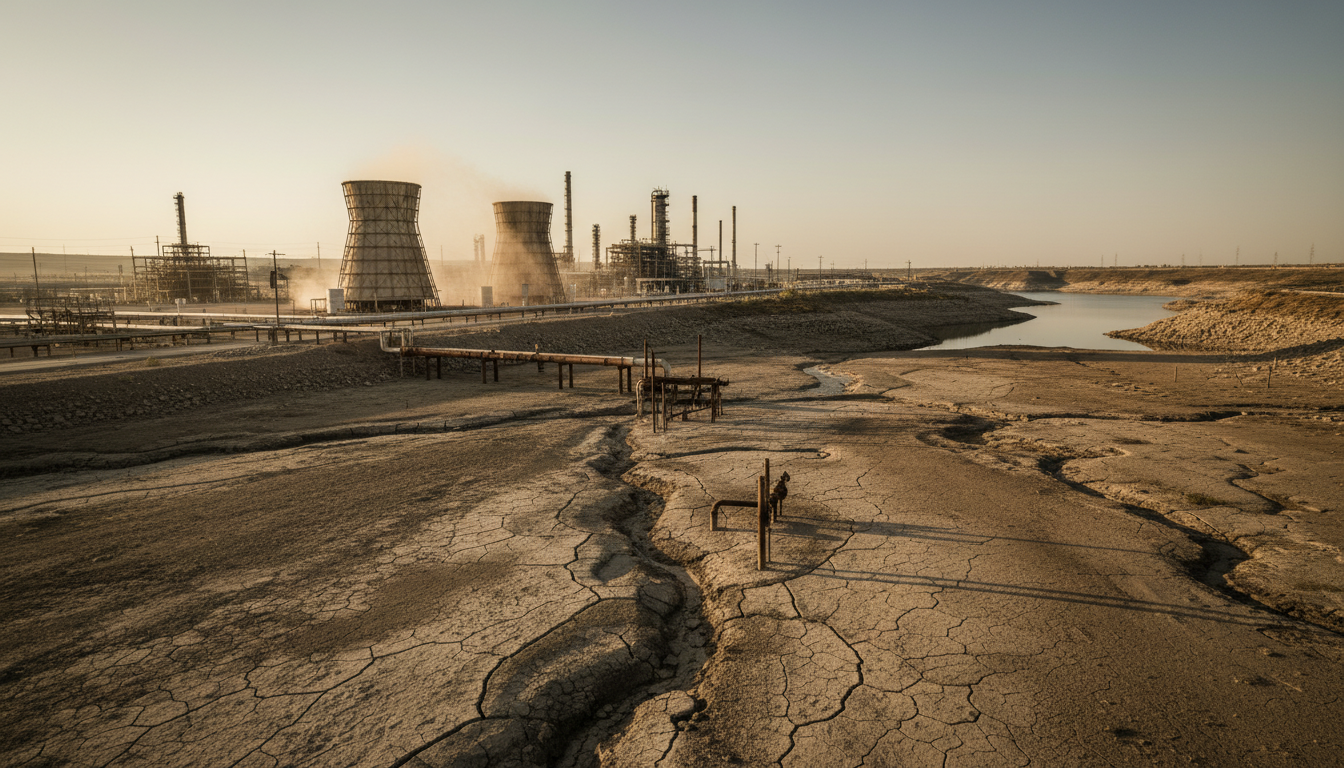
DENVER, CO – The lifeblood of the American West, its water supply, faces an unprecedented crisis, signaling significant ripple effects for energy markets, agricultural commodities, and regional economic stability. Recent data confirms Colorado is enduring its most severe snowpack conditions since statewide recordkeeping began in 1941, an alarming development that investors must closely monitor for its implications across various sectors.
A U.S. Department of Agriculture hydrologist, Maureen Gutsch, recently confirmed the grim reality from the Rocky Mountain headwaters of the Colorado River. Mountain snow accumulations peaked a full month earlier than usual and contained merely half of the average moisture. This dire scenario, exacerbated by a warm winter that saw record early springtime heat, means snow is rapidly disappearing from all but the highest elevations. With a significant drought already gripping the region, the prospect of worsening water shortages is now a near certainty, barring an extraordinary and unlikely deluge.
The immediate repercussions are already tangible. Urban centers across the West are initiating stringent water-use restrictions, while the agricultural sector faces an existential threat. Ranchers are grappling with how to sustain their herds, anticipating soaring costs for feed and water. Beyond agriculture, the specter of devastating wildfires looms large, representing not only ecological damage but also substantial economic losses and potential disruptions to energy infrastructure.
Arid Peaks: The Economic Fallout of a Parched West
For investors focused on long-term energy and commodity plays, the unfolding drought in Colorado’s high country serves as a critical indicator. Ranchers in vital areas like Colorado’s North Park valley, situated at approximately 8,100 feet (2,500 meters) and serving as headwaters for the Platte River system, are on the front lines. These agricultural operators, who recall severe droughts in 2002, 1981, and 1977, are witnessing conditions they describe as unprecedented.
Philip Anderson, a seasoned rancher in North Park, noted the historical absence of persistent winter snow on his pastures, which typically remains until spring, nurturing grass growth and replenishing stock ponds. Without this crucial moisture, his cattle are grazing nascent grass, and several ponds are already dry. The vital irrigation ditch from the nearby Illinois River, usually feeding his property, is also dry, its water diverted to neighbors holding more senior water rights – some dating back to the 1880s. Anderson vividly recalls hauling water in 2002 and being forced to sell off his herd, a scenario that now threatens to repeat.
Fifty-six kilometers west, across the Continental Divide on the Yampa River, Jo Stanko faces similar challenges. Low river flows, which allow cattle to wander across, necessitate extra labor for round-ups. This year, Stanko has been irrigating her meadows earlier than any time in her five decades of ranching, planning an early hay harvest before June and preparing to purchase supplemental hay for her 70-cow herd. The volatility in hay prices, a critical input for livestock operations, underscores the direct link between water scarcity and agricultural commodity markets.
Water Wars and Regulatory Risks for Investors
The adage “whiskey’s for drinking, water’s for fighting over” is never more apt than in the drought-stricken West. This long-standing conflict over scarce water resources, exacerbated by human-caused climate change, presents significant regulatory and policy risks for investors.
The Colorado River’s Upper Basin states (Colorado, New Mexico, Utah, and Wyoming) remain at an impasse with the Lower Basin states (Arizona, California, and Nevada) over new water management rules. The existing framework is set to expire in September, creating immense uncertainty. Arizona’s Democratic Governor, Katie Hobbs, expressed strong opposition to a recent federal proposal, arguing it would place the entire burden of conservation “completely on Arizona’s back.”
Colorado’s River negotiator, Becky Mitchell, highlighted the Upper Basin states’ position: they already utilize significantly less water than their historical entitlements, often deferring to older water rights during droughts without compensation. This fundamental disagreement has led both sides to engage legal counsel, signaling a potentially protracted and costly court battle. Such interstate disputes create an unpredictable operating environment for any industry reliant on stable water access, including energy production and heavy manufacturing.
Urban Restrictions and Industrial Impact
The drought’s impact extends far beyond agriculture, directly affecting large population centers and the industries they support. Following the driest and warmest winter on record, Salt Lake City has mandated a 10% reduction in daily water consumption, with major non-residential users limited to 200,000 gallons (2.6 million liters) per day. Denver Water, critical for a city whose supply relies partly on western precipitation piped through tunnels, is targeting a 20% savings through lawn-watering restrictions and other cuts. Nathan Elder, Denver Water’s supply manager, warned that with a deficit of “7 to 8 feet (2 to 2.4 meters) of snow,” significant recovery is unlikely, necessitating aggressive conservation.
These urban cutbacks signal a broader trend of escalating water costs and scarcity, posing a direct threat to industrial operations requiring substantial water for cooling, processing, or manufacturing. Investors in data centers, energy plants (especially thermal power generation), and even certain segments of oil and gas production (like hydraulic fracturing) must factor in the increasing risk of water restrictions and higher operational expenses in the American West.
Furthermore, critical regions in California, Oregon, and Nevada are also experiencing abnormally dry conditions. California’s Sierra Nevada snowpack, which provides one-third of the state’s water, registered a mere 18% of its average near Lake Tahoe, marking the second-lowest April 1 reading ever recorded. This underscores a systemic challenge across multiple Western states, necessitating diversified investment strategies and robust risk assessments for regional portfolios.
The Wildfire Threat: A Costly Consequence
The rapidly escalating temperatures compound the water crisis with a looming wildfire threat, a factor with significant economic and investment implications. Denver recently broke its March temperature record twice in one week, hitting 87 degrees (30 Celsius) after an 85-degree (29 Celsius) reading days earlier. These hot, dry conditions are a clear precursor to severe fire seasons.
While the South and Southwest currently face elevated fire risks, forecasters predict the Rockies will see a substantial increase in wildfire activity as above-average temperatures and below-normal precipitation persist through the summer. Wildfires incur immense costs: property destruction, infrastructure damage (including power lines and pipelines), business interruptions, and massive firefighting expenditures. For energy companies, this translates to potential asset damage, supply chain disruptions, and increased insurance premiums. Investors must integrate wildfire risk into their due diligence for assets located in vulnerable regions.
Although North Park anticipates a temporary reprieve with snow in the forecast, ranchers like Philip Anderson stress that sustained recovery requires far more – half an inch (1 centimeter) of rain every other day for an extended period. The call for cooperation among water users highlights the essential, yet often elusive, element of collaborative resource management. For the astute investor, the unfolding water crisis in the American West is not merely an environmental story; it is a profound economic signal demanding strategic foresight and adaptation across energy, agriculture, and infrastructure portfolios.