

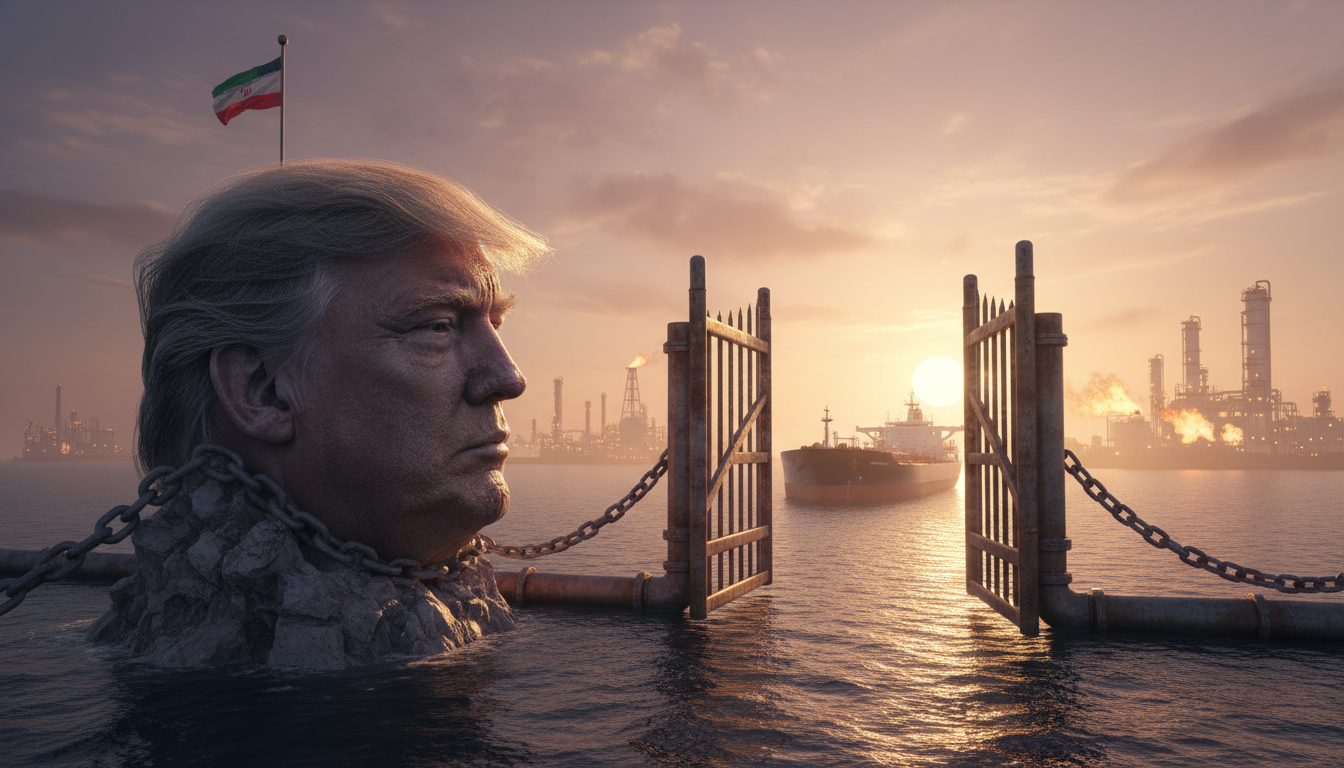
Oil Market on Edge: Trump Links Ceasefire to Open Hormuz Amid Iran Conflict
Global energy markets are bracing for heightened volatility following President Donald Trump’s latest pronouncement regarding the ongoing conflict with Iran. In a development sending ripples through commodity trading floors, President Trump confirmed that Iran’s leadership has put forth a request for a ceasefire. However, this overture for de-escalation has been met with a firm and uncompromising condition from Washington: the complete and unhindered freedom of navigation through the critical Strait of Hormuz.
This pivotal demand underscores the intense geopolitical risk premium currently embedded in crude oil prices, a direct consequence of hostilities that commenced on February 28 with concerted strikes by U.S. and Israeli forces against Iranian targets. The market reaction has been immediate, with investors and analysts scrutinizing every diplomatic exchange and military development for its potential impact on global oil supply and distribution.
The Ultimatum: Open Seas for Peace
Taking to Truth Social, President Trump articulated his administration’s position with stark clarity. He stated that the United States would only “consider” Iran’s ceasefire offer once the Strait of Hormuz is rendered “open, free, and clear.” The gravity of this stance was further amplified by a chilling threat directed at Tehran: “Until then, we are blasting Iran into oblivion or, as they say, back to the Stone Ages!!!” This aggressive rhetoric, disseminated just hours before a highly anticipated “important update on Iran” scheduled for 9 p.m. ET from the White House, immediately tightened the geopolitical risk premium in crude oil futures contracts.
For energy investors, such pronouncements are not merely political rhetoric; they are direct indicators of potential supply disruptions. Traders are actively recalibrating their risk assessments, factoring in an increased probability of further impediments to maritime shipping, a scenario that has historically triggered significant spikes in global benchmark crude prices like Brent and West Texas Intermediate (WTI).
Hormuz: The World’s Indispensable Oil Chokepoint
The persistent turbulence in global energy markets is inextricably linked to Iran’s continued capacity to disrupt transit through the Strait of Hormuz. This narrow, strategic waterway is an absolute linchpin of global energy security, serving as the compulsory passage for an immense volume of the world’s seaborne crude oil and liquefied natural gas (LNG) shipments. Any threat, perceived or actual, to the free flow of tankers through this chokepoint carries immediate and severe repercussions for global supply stability.
The conflict, ignited on February 28 by targeted U.S. and Israeli military operations against Iran, has already unleashed widespread economic turmoil across various sectors and spurred massive, often unpredictable, fluctuations in global energy commodity prices. The market’s deep-seated anxiety over the Strait’s accessibility remains the primary driver of this volatility, making it a focal point for all participants in the oil and gas sector.
Unpacking the Conflict’s Economic Ripple Effect
Since the initiation of hostilities in late February, the international financial landscape has been grappling with unprecedented levels of market uncertainty. Crude oil benchmarks, including both Brent and WTI, have exhibited wild, intraday swings, reflecting the market’s profound apprehension regarding the security of supply. Concurrently, shipping insurance premiums for vessels operating in the Persian Gulf have surged dramatically, adding significant costs to logistics chains and impacting the profitability of maritime transport. The looming specter of heightened inflationary pressures, directly attributable to potentially sustained higher energy costs, casts a long shadow over global economic forecasts.
This pervasive instability is undeniably a direct consequence of the strategic importance of the Strait of Hormuz. President Trump himself has frequently acknowledged the Strait’s pivotal role in the ongoing conflict. Even as other administration officials assert that Iran’s military capabilities have been “obliterated” and that U.S. objectives are rapidly being achieved, the President explicitly concedes that the status of the Strait remains a crucial point of contention and a key unresolved element in the war.
Navigating Geopolitical Risk for Energy Investors
For sophisticated investors with significant exposure to the oil and gas sector, the current geopolitical environment necessitates an elevated degree of vigilance and a highly agile approach to portfolio management. Direct pronouncements emanating from Washington and Tehran possess the power to instantly alter the perceived stability of Middle Eastern oil flows, which, in turn, translates into tangible shifts in crude oil prices and the valuations of exploration and production companies, midstream operators, refiners, and oil tanker shipping firms. The market is currently pricing in a substantial geopolitical risk premium, a reflection of the persistent uncertainty surrounding the Strait of Hormuz’s future.
Future crude price trajectories will be heavily influenced by whether President Trump’s upcoming 9 p.m. ET address outlines a clear pathway toward de-escalation, or conversely, signals a continuation, or even intensification, of the current assertive military and diplomatic posture. Energy investors are advised to meticulously monitor all developments that could either definitively secure the Strait’s free passage or, alarmingly, further exacerbate the existing supply anxieties. Robust risk management strategies, including judicious hedging, are paramount in this unpredictable landscape.
Strategic Imperatives for Global Oil Market Participants
The global economy’s fundamental reliance on consistent and stable energy supplies means that any enduring threat to the Strait of Hormuz translates directly into a broader threat to worldwide economic stability. Major integrated oil companies and independent producers alike are now compelled to contend with an environment of increased operational risks, potential disruptions to their supply chains, and elevated costs associated with securing their assets and transport routes. Futures markets will inevitably continue to serve as the most sensitive barometer of sentiment, with significant price swings highly probable upon any new information regarding diplomatic breakthroughs or further military engagements.
Long-term investment strategies must now intrinsically factor in a heightened baseline of geopolitical risk specifically concentrated in the Middle East. This imperative demands strategic diversification within energy portfolios and the implementation of robust hedging mechanisms designed to mitigate potential downside risks stemming from unexpected disruptions. The collective stakes for global oil supply stability, and consequently, for international economic health, have arguably rarely been more profound.
