

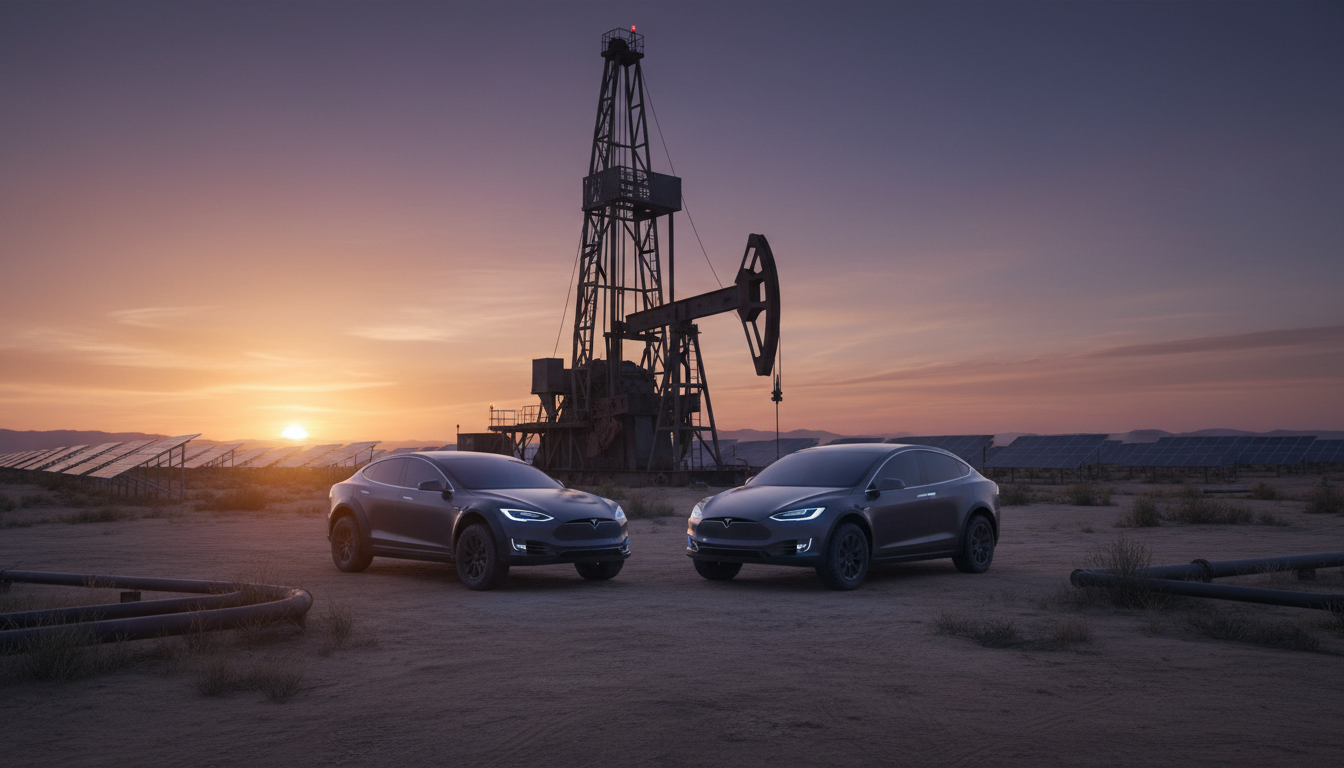
In a significant strategic recalibration, electric vehicle titan Tesla has officially ceased new production of its foundational Model S sedan and Model X SUV. This move marks the end of an era for the vehicles that largely defined the company’s ascent and pioneered mainstream electric mobility, with CEO Elon Musk confirming that only existing inventory units remain available for purchase. For investors tracking the intricate dance between electrification trends and traditional energy markets, this development offers a potent signal regarding the evolving landscape of automotive demand and its profound implications for global petroleum consumption.
Musk, reflecting on the profound impact of these long-serving models, noted a sentimental “ending of an era” in an online post, referencing the Model S production launch in 2012. As of Wednesday, prospective buyers visiting Tesla’s website are no longer presented with the option to custom-configure a new Model S or X. Instead, the company now directs them towards a finite selection of pre-configured vehicles from its remaining stock. This abrupt shift underscores a deeper strategic pivot within Tesla, one that carries significant weight for the broader energy transition narrative.
Tesla’s Strategic Reorientation: Beyond Traditional EVs
The Model S, introduced in 2012, and the Model X, which followed in 2015, were instrumental in elevating Tesla from a niche manufacturer to a dominant force in the automotive world, challenging incumbents and accelerating the adoption of electric vehicles globally. These luxury offerings became synonymous with cutting-edge technology and sustainable transport. However, their contribution to Tesla’s overall sales volume has dwindled considerably in recent years, overshadowed by the mass-market success of the Model 3 and Model Y.
Musk’s rationale for discontinuing the Model S and X centers on freeing up valuable factory capacity. This space, he revealed in January, is earmarked for the production of the company’s Optimus humanoid robot. This declaration highlights Tesla’s accelerating transition from purely an electric car manufacturer to a diversified technology and artificial intelligence powerhouse. The CEO characterized the cessation of Model S and X production as a “slightly sad” but necessary step in the automaker’s journey towards an “autonomous future,” signaling a profound departure from its roots.
Further emphasizing this strategic reorientation, Tesla is reportedly set to commence production of its two-seater Cybercab robotaxi as early as this month. Notably, this futuristic vehicle is designed entirely without a steering wheel or pedals, embodying Musk’s vision of a fully autonomous transportation ecosystem. While the next-generation Roadster is anticipated to be unveiled in April, Musk has indicated that the company is unlikely to produce any more conventional, non-autonomous vehicles in the future. This bold stance from a market leader suggests a potential plateau in the widespread appeal of personal, driver-operated electric vehicles, a trend that energy investors must closely monitor.
Cooling EV Demand and Its Ripple Effect on Petroleum Markets
Tesla’s decision, while specific to its internal strategy, arrives amidst a broader slowdown in electric vehicle demand across the United States. This deceleration has prompted several major automakers to reassess or even scrap their existing and planned electric models. Giants such as Ford, Hyundai, and Honda have, in recent months, either scaled back or entirely abandoned specific EV initiatives. A primary catalyst for this cooling enthusiasm appears to be the expiration of the federal $7,500 tax credit for many EV purchases last September.
The withdrawal of these critical consumer incentives has exposed a more tempered underlying demand for electric vehicles, particularly at higher price points. For oil and gas investors, this trend carries significant implications. Projections for peak oil demand and the pace of the global energy transition have often heavily factored in aggressive EV adoption curves. A slowdown in this trajectory suggests that the displacement of gasoline and diesel consumption may not occur as rapidly as previously anticipated, potentially extending the demand horizon for refined petroleum products.
A sustained plateau or even a slight rebound in traditional internal combustion engine (ICE) vehicle sales, fueled by softened EV interest, could underpin stronger, more stable demand for crude oil. Refining margins, particularly for gasoline, might also find renewed support in a scenario where EV market penetration advances more cautiously. This evolving dynamic warrants a re-evaluation of long-term investment strategies within the upstream, midstream, and downstream sectors of the oil and gas industry, as the timeline for a significant demand reduction from ground transportation shifts.
Investment Implications for Oil & Gas Stakeholders
For shareholders in energy companies, these developments reinforce the resilience of hydrocarbon demand, at least in the medium term. While the long-term imperative for energy diversification and decarbonization remains, the immediate market signals suggest a more protracted transition period. This allows for continued strategic capital allocation within the oil and gas sector, particularly for projects focused on efficiency, lower-emission production, and stable supply to meet ongoing global energy needs.
The cooling of consumer EV appetite, evidenced by major automakers’ retrenchment and Tesla’s own strategic pivot away from maximizing traditional EV sales, provides a crucial counter-narrative to the prevailing “peak oil is imminent” sentiment. It underscores the profound influence of economic incentives and consumer preferences on technological adoption, serving as a powerful reminder that energy transitions are complex, non-linear processes.
Investors should closely monitor not only vehicle sales data but also government policy shifts regarding EV subsidies and infrastructure development. The sustained demand for petroleum, alongside robust performance from energy equities, continues to offer compelling value propositions. Tesla’s decision to sunset its flagship Models S and X, viewed through the lens of an oil and gas financial journalist, is less about the end of a specific car line and more about a recalibration of expectations for the speed and nature of the broader energy transition, ultimately signaling a more prolonged role for conventional fuels in the global energy mix.
