

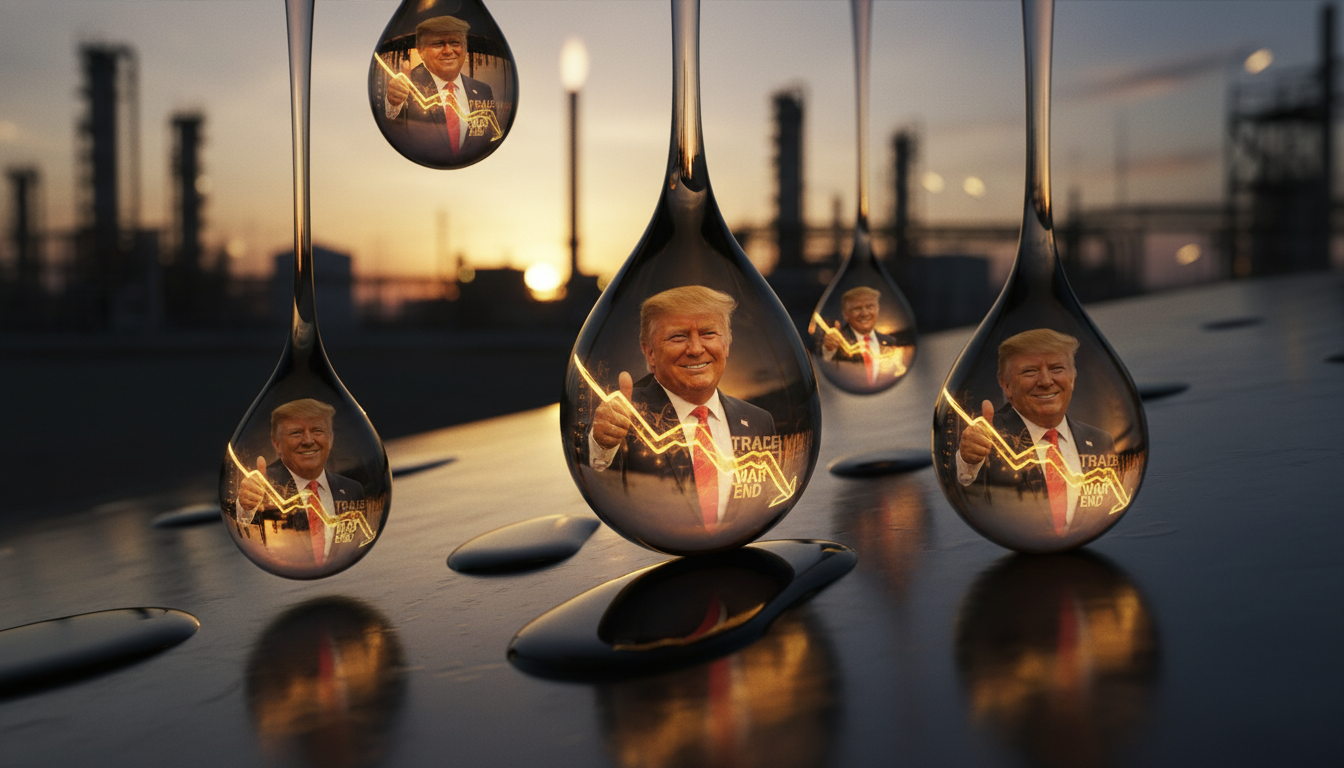
Oil Market Roils as Geopolitical Tensions Ease, Equities Surge
Global energy markets experienced a dramatic shift yesterday, with crude oil prices tumbling significantly as hopes of an imminent resolution to the Middle East conflict gained traction. This optimism fueled a widespread rally across international equity markets, reflecting investor relief over potential de-escalation in a region critical to global energy supply.
Brent crude, the international benchmark, at one point shed more than 5%, dropping below the psychological $100 per barrel threshold for the first time since last week. West Texas Intermediate (WTI), the US benchmark, also saw a substantial decline of over 4%. This sharp reversal from recent highs suggests that traders are actively re-evaluating risk premiums previously built into oil prices amidst escalating tensions.
Presidential Remarks Drive Market Optimism
The catalyst for this market reset appears to be a series of declarations from key political figures. US President Donald Trump stated emphatically that the Middle East conflict could conclude within “two weeks, maybe three,” emphasizing that the United States was “finishing the job” and intended to “knock out every single thing they have.” Intriguingly, Trump also left room for a diplomatic breakthrough, mentioning that “it’s possible that we’ll make a deal before that.” The White House later confirmed that President Trump would address the nation at 0100 GMT on Thursday to provide an important update on the situation, a development closely watched by energy investors.
Echoing a sentiment of de-escalation, Iranian President Masoud Pezeshkian communicated to the head of the European Council that Tehran possessed “the necessary will to end this conflict.” However, Pezeshkian qualified this willingness with specific conditions, particularly emphasizing “the guarantees required to prevent repetition of the aggression,” indicating that a lasting peace would hinge on robust security assurances.
Global Equities Reflect Investor Relief
The prospect of reduced geopolitical risk ignited a broad-based surge in global stock markets. Wall Street led the charge, with the tech-heavy Nasdaq Composite climbing an impressive 3.8%, while the S&P 500 added nearly 3%. The momentum carried into Asian trading sessions, where markets that had been particularly vulnerable to the energy crisis showed remarkable recovery.
Seoul, which previously bore the brunt of the conflict’s economic fallout, soared over 8%. Tokyo’s Nikkei 225 piled on more than 5%, closing at 53,739.68, and Taipei saw an increase of over 4%. Other major Asian exchanges also registered healthy gains: Hong Kong’s Hang Seng Index rose 2.0% to 25,294.03, Shanghai Composite gained 1.5% to 3,948.55, Sydney added 2.3%, Singapore was up 1.85%, Mumbai climbed 1.7%, Bangkok saw a 1.6% rise, Manila increased by 0.84%, and Jakarta closed 1.93% higher. European markets, including London’s FTSE 100 which rose 1.8% to 10,359.34, Paris, and Frankfurt, also ended the day higher.
Strait of Hormuz and Shifting Alliances in Focus
Despite the prevailing optimism, certain statements introduced new complexities and potential flashpoints. President Trump made it clear that the United States would not undertake efforts to unblock the Strait of Hormuz, a crucial choke point through which approximately one-fifth of global oil and gas supplies transit. He explicitly stated, “What happens with the strait we’re not going to have anything to do with,” asserting that this responsibility fell to other nations. This position was further emphasized in a social media post where he criticized NATO allies and other countries for their perceived lack of support in securing the waterway. “The USA won’t be there to help you anymore, just like you weren’t there for us,” he wrote, adding, “Iran has been, essentially, decimated. The hard part is done. Go get your own oil!” This stance follows his earlier declaration that he was willing to conclude the war even if the strait remained closed.
These remarks inject a degree of uncertainty regarding international cooperation on maritime security and energy transit, potentially creating new risks for global oil and gas supply chains. The President’s oscillating rhetoric, moving between advocating for military action and pursuing diplomatic solutions, continues to keep investors on edge.
Economic Headwinds Persist Amidst Diplomatic Signals
While the immediate market reaction was positive, analysts cautioned against premature celebrations regarding the broader economic implications. Fiona Cincotta, a market strategist at City Index, highlighted that “even if outright military tensions ease, the economic damage from elevated oil prices may already be feeding through.” She elaborated that “higher energy costs are likely to tighten financial conditions, raise inflation pressures, and weigh on growth.” Cincotta further noted that “diplomatic signals remain mixed, and as long as uncertainty persists and shipping disruptions remain in place, oil prices are likely to stay elevated,” underscoring the delicate balance between political rhetoric and tangible economic impacts.
The potential for a protracted energy crisis continues to weigh heavily on regions heavily reliant on imported energy. Jean Maynier, president of maritime analyst group Kpler, specifically pointed to Asia as facing “the gravest fallout from the war,” asserting, “We think Asia will, for now, be the ones suffering the most.” This assessment underscores the ongoing vulnerability of key economic powerhouses in the region to sustained energy market volatility.
Lingering geopolitical risks also include reports of continued US troop deployments in the region. Furthermore, the Wall Street Journal cited Arab officials indicating that the United Arab Emirates was preparing to assist Washington in opening the Strait of Hormuz by force, potentially making it the first Gulf nation to directly engage in the conflict. Such developments suggest that despite conciliatory statements, the operational landscape remains fraught with the potential for escalation.
Broader Market Movements
Beyond energy and equities, other markets also reacted to the shifting geopolitical sands. Gold, often seen as a safe-haven asset, rallied. This move reflected renewed hopes that easing oil prices could mitigate the feared spike in inflation, thereby reducing the pressure on central banks to aggressively hike interest rates. In corporate news, Chinese artificial intelligence startup Zhipu saw its shares skyrocket over 32% following an announcement that revenue from its cloud business had nearly tripled last year, highlighting strong growth in the technology sector.
Market Snapshot at 0810 GMT:
West Texas Intermediate (WTI): DOWN 4.7% at $96.63 a barrel
Brent North Sea Crude: DOWN 4.2% at $99.56 a barrel
Tokyo – Nikkei 225: UP 5.2% at 53,739.68 (close)
Hong Kong – Hang Seng Index: UP 2.0% at 25,294.03 (close)
Shanghai – Composite: UP 1.5% at 3,948.55 (close)
London – FTSE 100: UP 1.8% at 10,359.34
Dollar/yen: DOWN at 158.59 from 158.77 yen
New York – Dow: UP 2.5% at 46,341.51 (close)
