

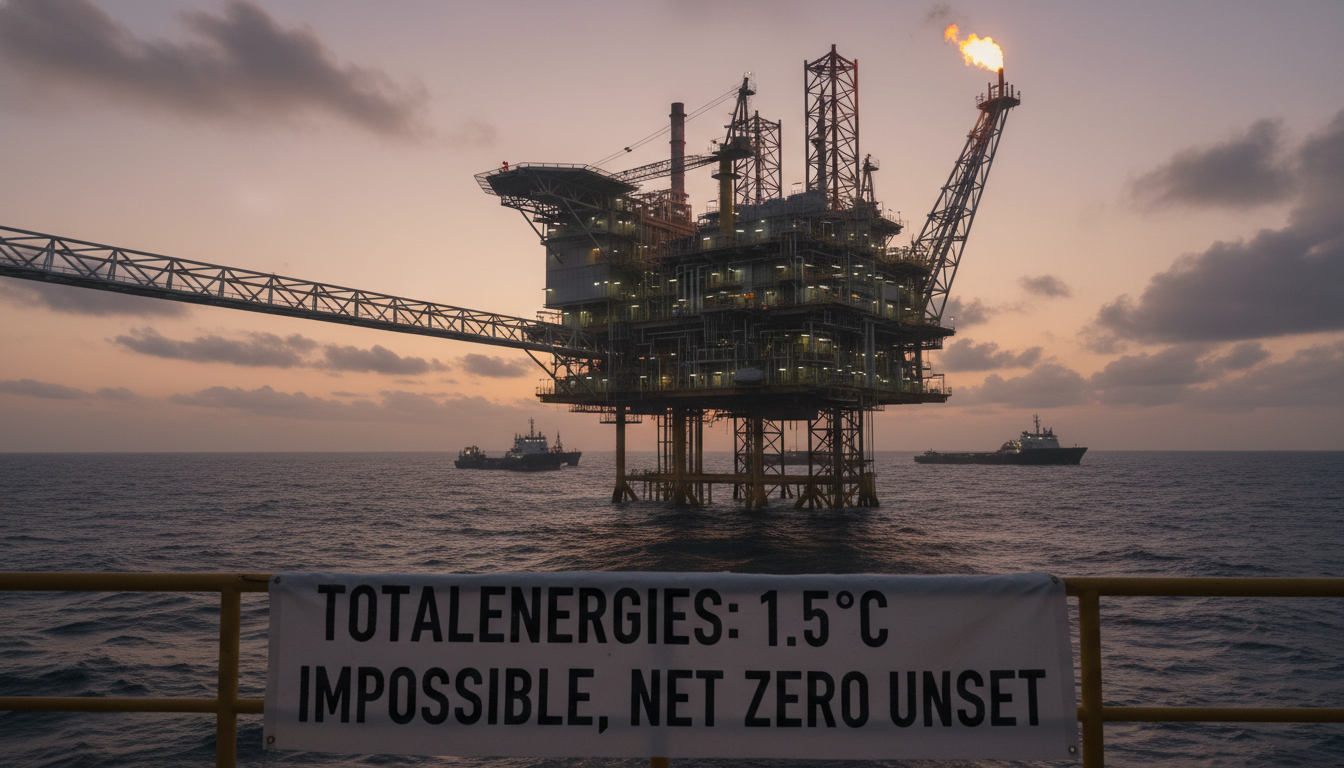
TotalEnergies, a prominent global energy company, has signaled a significant recalibration in its climate change commitments, indicating a pragmatic adjustment to its Net Zero targets. The firm recently disclosed its inability to formulate Net Zero goals that align with current European reporting standards. This challenge stems from the company’s assessment that it cannot adopt a transition plan compatible with a 1.5°C global warming trajectory by 2050, a target it now deems unfeasible based on the prevailing scientific consensus.
This critical update, found within TotalEnergies’ 2026 Sustainability & Climate Report, offers essential insights for investors navigating the complex landscape of energy sector decarbonization. Patrick Pouyanné, TotalEnergies’ Chairman and CEO, affirmed the company’s continued commitment to its 2050 operational carbon neutrality and its 2030 objective to diminish the carbon intensity of energy products sold. However, Pouyanné underscored the necessity of confronting ambition with current realities, recognizing that the collective pace of societal transition does not yet support the rapid achievement of carbon neutrality as outlined by the Paris Agreement.
“Our capability to achieve carbon neutrality, alongside society, inherently depends on advancements in technical innovation, the implementation of supportive public policies, and the evolving choices of consumers,” Pouyanné stated. “Consequently, the pathways guiding our carbon neutrality ambition must undergo continuous reassessment and adaptation, reflecting the dynamic shifts within the global energy system.” This nuanced perspective highlights the multifaceted factors influencing large-scale energy transition, a key consideration for long-term strategic investors.
TotalEnergies Reevaluates 1.5°C Alignment and Regulatory Frameworks
TotalEnergies originally set its 2050 climate goals in 2020, articulating an aim for net-zero emissions by 2050 across its global operations and for the energy products used by its customers, termed “together with society.” However, the latest sustainability report introduces a crucial distinction: while the energy transition has commenced, the global economy is not accelerating at the rate required to meet the Paris Agreement’s more ambitious benchmarks. The company explicitly references current scientific consensus, citing leading climatologists and the International Energy Agency (IEA), which now suggests that the aspirational target of limiting global warming to 1.5°C above pre-industrial levels is increasingly beyond reach.
During a presentation on the new report and the company’s progress, Aurelien Hamelle, TotalEnergies’ President of Strategy and Sustainability, further clarified the regulatory implications. He explained that the company cannot adopt a Net Zero transition plan under current European regulations, primarily because such a plan must rigorously align with the 1.5°C target. Given the scientific assessment that this target is now considered unattainable, TotalEnergies faces a regulatory conundrum. For astute investors, this transparency regarding the company’s strategic response to evolving climate science and regulatory mandates is paramount, potentially influencing capital allocation decisions in a sector under intense scrutiny.
In light of its inability to adopt an EU-aligned transition plan, TotalEnergies confirms it must evolve its wording to precisely articulate the dependencies of its carbon neutrality ambition, particularly the critical “together with society” component. This refinement in communication underscores a broader industry challenge as major energy players endeavor to reconcile aspirational climate pledges with operational realities and a rapidly evolving scientific understanding of climate change.
TotalEnergies’ Operational Goals and Demonstrated Progress
TotalEnergies has clearly articulated its current core objectives for investors. The company aims for carbon neutrality across its global operated emissions (Scope 1 and 2) by 2050. Furthermore, it actively engages with its customers to support their own energy transition strategies, consistently offering an energy mix with progressively lower carbon intensity year after year. The company reiterates that its capacity to achieve these goals remains critically contingent on the pace and affordability of technological innovation, the efficacy of public policies, and the evolution of consumer behavior—factors collectively embodied by the phrase “together with society.”
Significantly, TotalEnergies has reaffirmed its specific and measurable 2030 targets. These include a robust commitment to reduce Scope 1 and 2 emissions by 40% from a 2015 baseline. Additionally, the company is focused on an 80% reduction in operated methane emissions based on 2020 levels. A further key objective for 2030 is achieving a 25% reduction in the life cycle carbon intensity of the energy products sold to its customers, compared to 2015 levels. These concrete targets provide investors with clear benchmarks for assessing the company’s environmental performance and strategic direction.
The company also provided an update on its substantial progress toward these ambitious objectives. As of the end of 2025, TotalEnergies reported a commendable 28% reduction in its Scope 1 and 2 emissions when measured against its 2015 baseline. Concurrently, it has achieved an 18.6% reduction in the lifecycle intensity of energy products sold, also compared to 2015. Notably, the company has made significant strides in methane abatement, reporting an impressive 65% reduction in operated methane emissions on a 2020 basis. These figures underscore tangible operational improvements and a steadfast commitment to decarbonization within its direct operational control.
Navigating the Global Energy Trilemma: A Strategic Imperative
Beyond its internal commitments, TotalEnergies highlighted a fundamental global challenge impacting the overall acceleration of the energy transition: the “trilemma.” This refers to the inherent difficulty states face in simultaneously balancing energy reliability, affordability, and sustainability. For an investment community focused on energy market dynamics, understanding this trilemma is crucial for evaluating long-term risks, opportunities, and the viability of various energy strategies.
Pouyanné underscored the significant humanitarian and economic dimensions of this challenge, pointing out that 4.6 billion people worldwide still lack access to the basic level of energy required for satisfactory human development. He asserted that governments, businesses, and citizens are increasingly confronted with this complex trade-off in their energy supply decisions. To truly accelerate the transition, Pouyanné argues, public policies must embrace a “new realism.” This realism necessitates prioritizing solutions that offer the lowest carbon abatement costs, fostering stronger international cooperation, and actively contributing to the decarbonization efforts of emerging economies. This strategic perspective suggests TotalEnergies is positioning itself as a pragmatic and responsible player in the global energy transition, focusing on solutions that address immediate global energy needs while working towards long-term sustainability. Investors should consider how this balanced approach differentiates TotalEnergies from its peers and influences its future growth trajectory and risk profile in a dynamic energy market.
