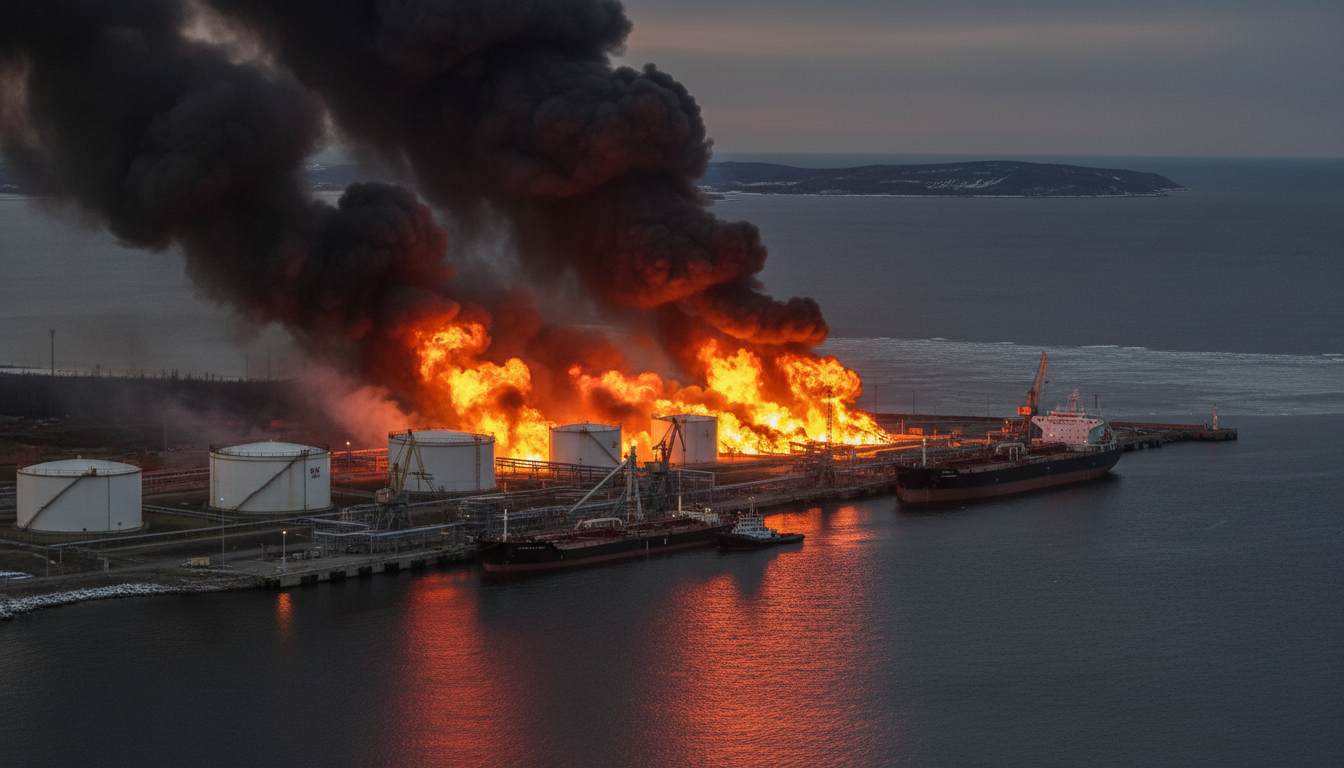
The global energy landscape is once again gripped by heightened geopolitical tensions, with Russia’s critical Baltic Sea oil export infrastructure facing repeated and escalating assaults. Early Friday, reports confirmed renewed fires at the crucial loading ports of Primorsk and Ust-Luga, signaling a persistent campaign aimed at crippling Moscow’s crude export capabilities and diminishing the financial benefits derived from its energy sales. This intensification of conflict, directly impacting a primary artery for Russian crude, has sent immediate ripples through the market. As of today, Brent Crude is trading at $94.81 per barrel, marking a significant 4.9% increase, while WTI Crude stands at $87.15, up 5.52%. These sharp daily gains underscore the market’s swift reaction to potential supply disruptions, reversing a recent trend where Brent had softened from $112.78 on March 30th to $90.38 by April 17th. Investors are now keenly watching how this escalating risk premium will reshape the short-term and long-term outlook for global oil supplies.
Escalating Disruptions at Russia’s Key Export Hubs
The recent attacks on Primorsk and Ust-Luga represent a notable escalation in the strategic targeting of Russia’s energy infrastructure. This week alone has seen multiple incidents, starting with drone strikes on Monday that ignited fires at fuel storage tanks in Primorsk and halted operations at Ust-Luga. The aggression intensified further on Wednesday, with a major conflagration at Ust-Luga forcing a complete cessation of all activities. The latest reports of fires early Friday, corroborated by NASA satellite images indicating blazes several hours prior to detection, confirm the persistent nature of these efforts. Located in Russia’s Leningrad region, these ports are indispensable. Primorsk, in particular, boasts a capacity of approximately 1 million barrels per day (bpd), instrumental in shipping flagship Urals crude and low-sulfur diesel to international buyers. It also serves as a critical node for Russia’s “shadow fleet,” facilitating exports outside conventional Western insurance and oversight. The repeated targeting of such high-volume infrastructure directly impacts Russia’s ability to monetize its crude, injecting a substantial geopolitical risk premium into global oil prices.
The Supply-Side Shock and Its Market Implications
The cumulative effect of these sustained drone attacks is a tangible threat to Russia’s oil export capacity, impacting a northern lifeline that is vital for global supply. While Russian defenses reportedly intercepted 36 drones overnight during the latest incidents, the sheer persistence and effectiveness of these strikes in causing operational disruptions are undeniable. Temporary suspensions and complete halts at facilities like Ust-Luga mean that barrels designated for export may be delayed or even deferred, tightening an already sensitive global market. This disruption to Urals crude flows, a key global grade, forces buyers to seek alternative sources, potentially driving up prices for competing benchmarks. For investors, this translates into increased volatility and a need to re-evaluate supply assumptions. The immediate market response, with Brent and WTI showing significant daily increases, reflects this concern, especially as gasoline prices also climbed to $3.01 today, up 2.73%.
Addressing Investor Concerns and Navigating Upcoming Events
Our proprietary reader intent data reveals a consistent theme among investors this week: a burning desire for clarity on price direction. Questions like “Is WTI going up or down?” and “What do you predict the price of oil per barrel will be by end of 2026?” highlight the profound uncertainty in the market. The escalating risk to Russian exports directly feeds into these concerns, making short-term price movements more volatile and long-term forecasts harder to pin down. Investors are right to be asking these questions, and the answers will heavily depend on how geopolitical events unfold alongside key industry announcements. Looking ahead, the next two weeks are packed with critical events that will provide further data points. The OPEC+ Joint Ministerial Monitoring Committee (JMMC) meeting on Monday, April 20th, followed by the full OPEC+ Ministerial Meeting on Saturday, April 25th, will be paramount. Any decisions regarding production levels from this alliance will be heavily influenced by the perception of Russian supply stability. Additionally, weekly data from the API and EIA on crude inventories (April 21st, 22nd, 28th, 29th) and the Baker Hughes Rig Count (April 24th, May 1st) will offer crucial insights into the underlying supply-demand balance and the health of North American production. Investors should closely monitor these dates for signals that could either exacerbate or alleviate the current supply anxieties.
Investment Outlook Amidst Persistent Risk Premium
The sustained targeting of Russia’s Baltic ports firmly embeds a geopolitical risk premium into oil prices. This is not merely a transient spike; it reflects a structural vulnerability that could persist as long as the conflict continues. For energy investors, this environment demands a re-evaluation of portfolios. Companies with strong balance sheets and diversified production assets, particularly those less exposed to geopolitical hot zones, may offer greater resilience. Integrated majors with downstream capabilities could benefit from higher refined product margins, though rising crude input costs remain a factor. Conversely, companies heavily reliant on global shipping routes or with direct exposure to Russian crude trading might face increased operational costs or logistical hurdles. The consistent disruption to a 1 million bpd export hub like Primorsk suggests that the market will continue to price in a higher floor for crude, at least until clear signs of de-escalation or robust alternative supply emerge. We anticipate continued volatility, with each new development in the conflict having the potential to trigger significant price swings. Investors should prepare for a market where supply security remains a primary concern, driving strategic decisions and investment flows throughout the remainder of 2026.


