Geopolitical Tensions Reshape Oil Flows: A 40% Capacity Hit Challenges Global Supply
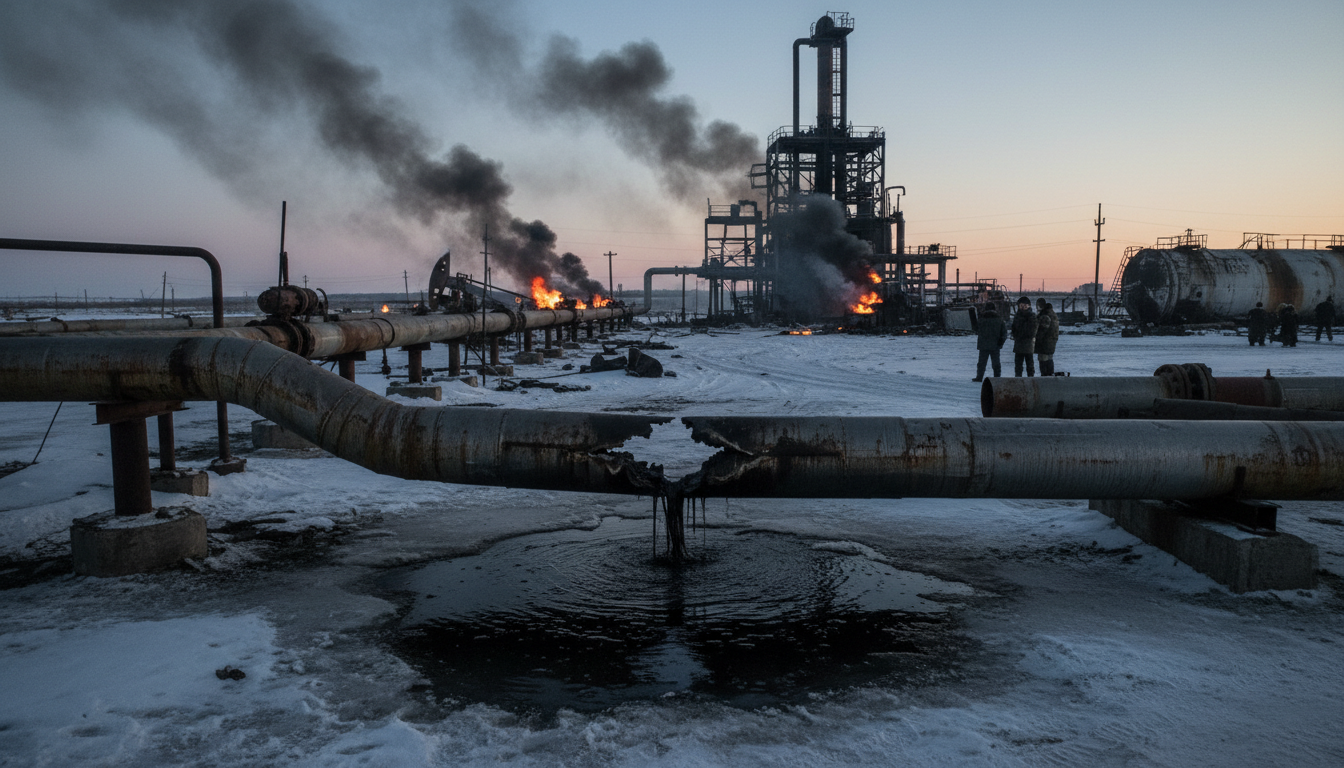
The global energy landscape is once again recalibrating, this time under the shadow of a significant escalation in geopolitical tensions directly impacting Russia’s vital oil export infrastructure. Recent strikes against key Baltic Sea ports, specifically Primorsk and Ust-Luga, have dealt a substantial blow to Russia’s capacity to move crude and refined products to market. Our analysis indicates that nearly 40% of Russia’s total oil export capacity could be compromised, a figure that accounts for port outages, pipeline disruptions, and broader tanker-related challenges. This immediate logistical crisis for Russia’s energy sector reverberates across global oil markets, adding a fresh layer of complexity and risk premium to an already volatile commodity environment. Investors are now forced to re-evaluate supply stability and pricing forecasts, with the long-term implications for energy security becoming increasingly pronounced.
The Baltic Bottleneck: A Crippling Blow to Russia’s Export Machine
The disruption to Russia’s export capacity is profound, with the 40% figure representing a critical metric for investors tracking global supply. Primorsk, a colossal gateway, routinely handles over 1 million barrels per day (bpd) of Urals crude. Its incapacitation creates an immediate and severe bottleneck for this key benchmark crude, directly impacting the volumes available to global buyers. Similarly, Ust-Luga, a crucial hub for refined products, processed nearly 33 million tons of oil products last year. The temporary cessation of operations at both these facilities presents a formidable challenge that cannot be swiftly overcome, demanding complex logistical maneuvers under extreme pressure. Transneft, the state pipeline operator, has openly acknowledged the profound difficulty in rerouting such massive volumes on short notice, confirming that quick, seamless adjustments are simply not feasible. This points to a prolonged period of potential disruption for Russian energy exports, underpinning a bullish sentiment for crude prices despite some recent daily fluctuations.
Market Reaction and Forward-Looking Indicators
As of today, Brent crude trades at $92.86 per barrel, reflecting a 0.41% dip from its opening, with an intraday range of $91.39 to $94.21. WTI crude follows a similar pattern, sitting at $89.13, down 0.6%, within a day range of $87.64 to $90.71. These immediate intraday movements, while slightly negative, belie a more significant trend over the past two weeks, where Brent has shed $7.07, or 7%, from its $101.16 peak on April 1st. This recent volatility suggests a complex interplay between geopolitical risk premiums and broader macroeconomic concerns. However, the fundamental supply shock from Russia’s compromised export capacity introduces a strong underlying support for prices. Gasoline prices, currently at $3.11, down 0.64% today, could see upward pressure as disruptions to refined product exports from Ust-Luga filter through the market, impacting regional balances and potentially offsetting any broader demand-side weakness.
Addressing Investor Concerns and Upcoming Catalysts
Our first-party intent data reveals that investors are actively grappling with the directional uncertainty of crude prices, with questions like “is WTI going up or down?” dominating search queries. This reflects a market searching for clarity amid conflicting signals. Understanding this volatility requires a close watch on key data points. The upcoming EIA Weekly Petroleum Status Reports on April 22nd and April 29th, alongside the API Weekly Crude Inventory releases on April 28th and May 5th, will offer crucial insights into U.S. inventory levels. These reports will provide a clearer picture of demand signals and potential offsetting supply from the world’s largest consumer, helping investors gauge the net impact of the Russian supply shock. Furthermore, the EIA Short-Term Energy Outlook on May 2nd will be pivotal, offering updated projections that will likely factor in the latest geopolitical developments and their implications for global balances through 2026. The Baker Hughes Rig Count on April 24th and May 1st will also be scrutinized for signs of U.S. production response, which could either mitigate or exacerbate the current supply concerns, directly influencing the forward price curve investors are attempting to predict.
Navigating Limited Alternatives and Investment Implications
Russia faces a dire situation with limited viable alternatives for rerouting the massive displaced volumes. While Black Sea ports and inland pipelines offer some capacity, they are far from ideal. Existing infrastructure on these routes is finite, meaning it cannot fully absorb the volumes from the Baltic without creating new chokepoints and significant operational inefficiencies. Moreover, the Black Sea itself has become an increasingly perilous transit zone, with tanker attacks escalating notably in recent weeks. This adds another layer of risk and cost to shipping operations, translating into higher insurance premiums and longer transit times, further straining global supply chains. For investors, this implies a sustained geopolitical risk premium in oil prices. Companies involved in alternative shipping routes or those with diversified energy portfolios may present opportunities. Furthermore, the impact on refined product markets, particularly in Europe, warrants close attention, as the disruption to Ust-Luga could lead to regional product shortages and price spikes. The inability to quickly and seamlessly adjust to these disruptions underscores the fragility of global energy flows and the critical need for vigilance in investment strategies.


