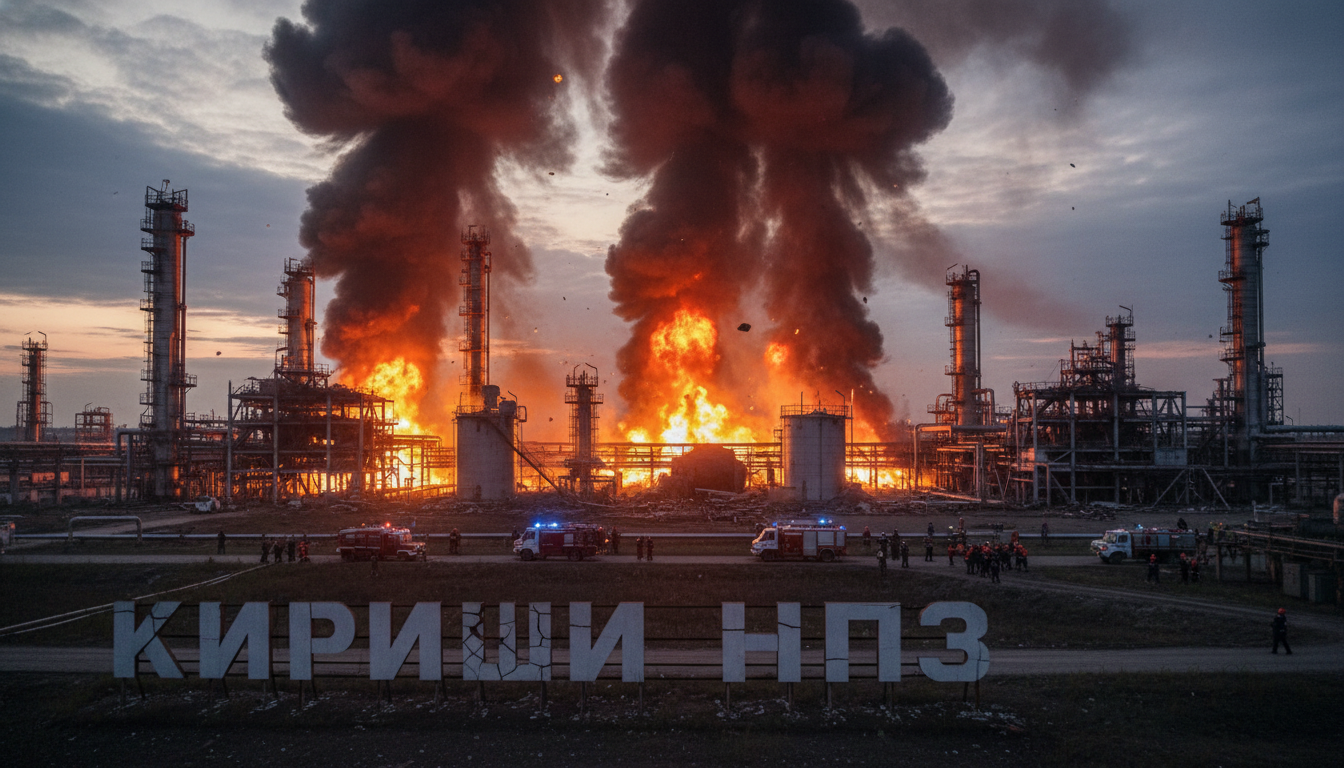
Kirishi Attack: A Direct Hit on Russia’s Export Nerve Center
The global oil market is once again grappling with heightened geopolitical risk following a confirmed drone strike on the Kirishi oil refinery in Russia’s Leningrad region. This is not merely an isolated incident but a significant escalation in a targeted campaign against Russia’s critical energy infrastructure, directly threatening global refined product supply stability. For investors, the implications are profound, demanding a re-evaluation of supply risk premiums and potential price trajectories in an already sensitive market. This facility, with an impressive design capacity exceeding 400,000 barrels per day (b/d), is a cornerstone of Russia’s refined product export capabilities, focusing on high-value light products like diesel, gasoline, and fuel oil destined for international markets. Any prolonged disruption here translates directly into global supply shocks, particularly for Europe and other key importers.
Reports indicate that primary crude processing units and vital storage tanks were successfully ignited, with local authorities confirming a fire in Kirishi’s industrial zone. While the full extent of the damage and the duration of operational curtailment remain subject to independent verification, the mere threat to such a high-capacity, export-focused asset immediately injects uncertainty into the market. As of today, Brent crude trades at $92.95, reflecting a slight dip of 0.31% within a day range of $91.39 to $94.21. WTI crude similarly saw a marginal decrease, currently at $89.14, down 0.59% for the day. Gasoline prices also mirrored this slight downturn, trading at $3.11, down 0.32%. This immediate price reaction, while seemingly muted or even slightly negative, belies the underlying tension and the tightening supply outlook. The market often processes such events over time, and the strategic nature of this attack, coupled with its potential for extended impact, suggests that the current daily dip might not reflect the full picture of investor concern.
Strategic Escalation: Baltic Infrastructure Under Siege
The Kirishi incident is far from an anomaly; it represents the latest chapter in a strategic and intensifying campaign against Russia’s Baltic energy infrastructure. Just days prior, other pivotal Russian oil ports on the Baltic Sea, Primorsk and Ust-Luga, were reportedly struck by drones, leading to fires and, crucially, a halt in oil loadings at these major export terminals. This coordinated series of attacks underscores a deliberate strategy to impede Russia’s ability to export both crude oil and refined products, directly targeting the arteries of its energy complex. The cumulative effect is a significant increase in the geopolitical risk premium associated with Russian supply, compelling investors to factor in potential long-term disruptions.
Despite these escalating supply-side risks, our proprietary data indicates a broader market balancing act. The 14-day Brent trend shows a notable decline from $101.16 on April 1st to $94.09 on April 21st, representing a $7.07 or 7% drop over that period. This downward movement, even in the face of direct infrastructure attacks, suggests that while the market acknowledges the supply threat, other factors—such as global demand outlooks, inventory levels, or broader macroeconomic concerns—are exerting significant counter-pressure. However, this dynamic creates a precarious situation: any further, more impactful disruption, or a shift in the demand narrative, could quickly reverse this trend, sending prices sharply higher as the inherent supply vulnerability becomes undeniable. Investors should not mistake recent price softening for a reduction in underlying risk.
Addressing Investor Concerns: Navigating Price Volatility Ahead
Our first-party intent data reveals that a top concern for investors this week revolves squarely around price direction. Questions like “is WTI going up or down” and “what do you predict the price of oil per barrel will be by end of 2026?” highlight the prevailing uncertainty and the urgent need for clarity on market trajectory. The Kirishi attack, while currently showing a modest daily price dip, fundamentally strengthens the bullish case for oil in the medium term by tightening the supply outlook. The market is currently weighing the immediate impact against broader macroeconomic signals, but the structural erosion of Russian export capacity introduces a critical floor to potential price declines and a catalyst for future rallies.
Looking ahead, several key events on the energy calendar will provide crucial data points for investors assessing these dynamics. The upcoming EIA Weekly Petroleum Status Reports on April 24th and May 1st, alongside the API Weekly Crude Inventory reports on April 28th and May 5th, will offer essential insights into U.S. inventory levels and demand. Any unexpected draws in crude or refined product inventories, particularly gasoline and diesel, could amplify the impact of the Kirishi disruption, signaling a tighter global market than currently priced in. Furthermore, the Baker Hughes Rig Count on April 24th and May 1st will indicate North American supply response. Most critically, the EIA Short-Term Energy Outlook on May 2nd will provide a comprehensive forward-looking assessment, which, when juxtaposed with the ongoing geopolitical disruptions, will be instrumental in shaping end-of-year price expectations and addressing long-term investor questions.
Investment Strategy in a High-Risk Environment
For discerning investors, the Kirishi attack and the broader pattern of strikes against Russian energy infrastructure necessitate a proactive adjustment to investment strategies. The direct targeting of an export-oriented refinery like Kirishi points to a sustained effort to impact Russia’s revenue streams and its ability to supply refined products to global markets. This translates into increased volatility and potential upside for crude and refined product prices, particularly diesel and gasoline, which are directly produced at such facilities. Companies with diversified supply chains, strong hedging strategies, or those benefiting from higher refined product margins may prove more resilient or even capitalize on this elevated risk environment.
Moreover, the heightened geopolitical risk premium should prompt a re-evaluation of exposure to regions directly impacted by or indirectly reliant on Russian energy flows. While the immediate market reaction has been nuanced, the long-term implications of sustained supply disruptions from one of the world’s largest energy producers are undeniable. Investors should focus on companies with strong balance sheets, operational resilience, and strategic positioning to navigate these turbulent waters. The ongoing evolution of the conflict, coupled with the critical data releases in the coming weeks, will shape the immediate future of crude and refined product markets, making vigilant monitoring and agile portfolio adjustments paramount for success in this evolving energy landscape.


