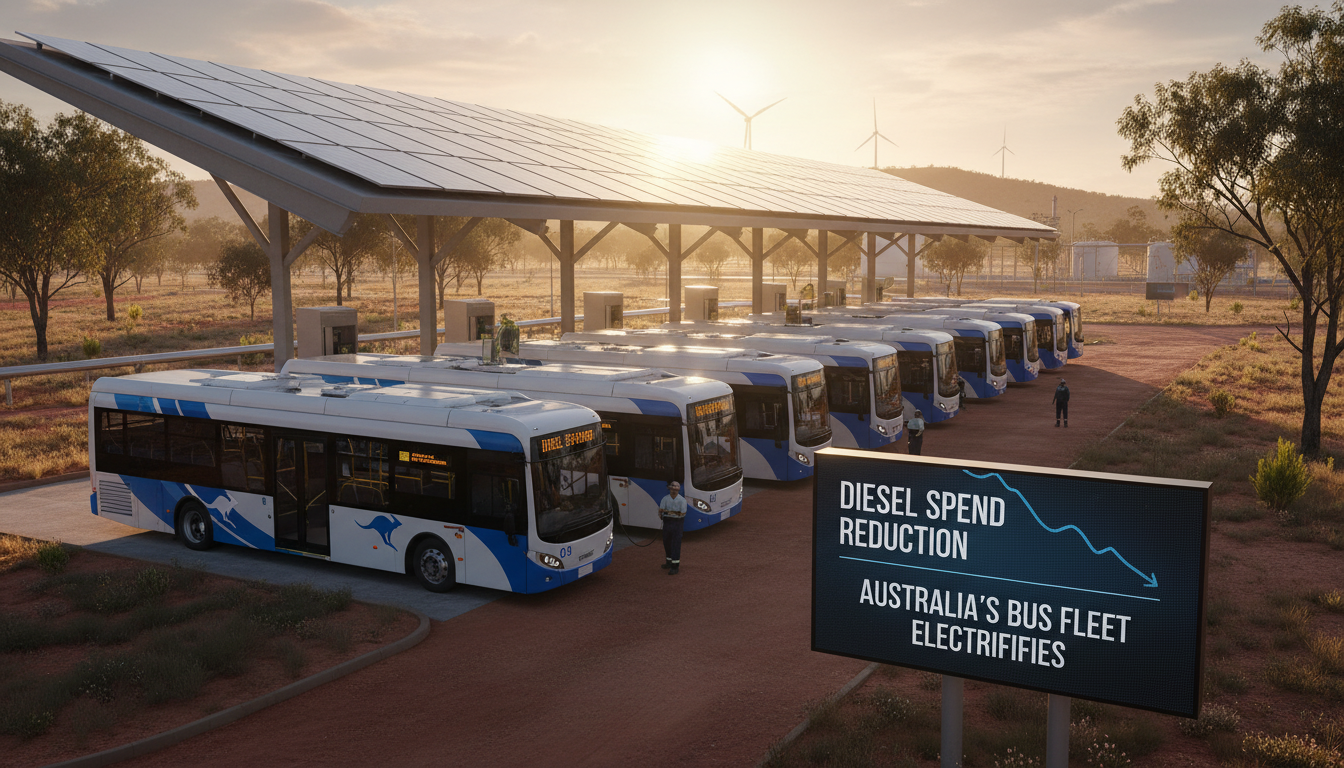
Australia’s transportation sector is at a pivotal juncture, signaling a significant structural shift for investors tracking energy market dynamics. While global oil prices remain a dominant focus, a localized yet impactful transition is underway Down Under: the rapid, albeit nascent, adoption of electric buses. This electrification initiative, driven by fuel security concerns and escalating operational costs, is set to progressively erode diesel demand within a critical public service sector, creating both headwinds for traditional oil investments and compelling opportunities in the burgeoning clean energy infrastructure space. For savvy investors, understanding this evolving landscape is crucial for positioning portfolios for future energy market realities.
The Diesel Demand Disconnect Amidst Market Volatility
Australia’s extensive bus network, the backbone of its public transport, currently consumes an astounding 530 million litres of diesel annually. This massive consumption exposes the nation’s economy to the inherent volatility of global oil markets and geopolitical risks. As of today, Brent Crude trades at $92.95 per barrel, reflecting a -0.31% dip within a day range of $91.39 to $94.21. Similarly, WTI Crude stands at $89.14 per barrel, down -0.59% with a daily range of $87.64 to $90.71. This ongoing price fluctuation, underscored by Brent’s recent 14-day trend showing a decline from $101.16 on April 1st to $94.09 on April 21st, highlights the financial vulnerability associated with heavy diesel reliance. While the current 1% electric bus penetration in Australia pales in comparison to leaders like China (80%), the Netherlands (25%), or the United Kingdom (12%), this significant gap represents not just a sustainability lag but a massive future investment corridor where demand for traditional fuels will inevitably diminish. Investors must recognize that even localized demand destruction contributes to the broader narrative of peak oil demand in certain sectors.
Strategic Electrification: Government Momentum and Investment Hotspots
The imperative for fuel security and operational resilience is driving Australian state and territory governments to prioritize bus fleet electrification. This strategic shift is not merely an environmental endeavor; it’s a fundamental economic and social equity play, ensuring vital public services remain resilient against external energy shocks. Government data for 2025 indicates approximately 42,800 registered diesel buses versus a mere 629 battery-electric models, a profound infrastructural deficit that is now being aggressively addressed. Momentum is palpable across the country. Canberra and Greater Sydney have set ambitious targets for fully electric bus operations by 2040. The Australian Capital Territory (ACT) is already showcasing leadership, with electric buses comprising about 24% of its fleet, operating on 100% Australian-produced renewable electricity and boasting lower running costs. Other states are demonstrating tangible progress: South Australia expects its electric bus count to reach 81 this year (approximately 8% of its fleet), while Western Australia recently deployed its 100th electric bus. These commitments underscore a clear government-backed transition that will necessitate significant investment in charging infrastructure, grid upgrades, and manufacturing capabilities for electric vehicles, opening new avenues for investors beyond traditional oil and gas.
Navigating Uncertainty: Investor Inquiries and Upcoming Market Catalysts
Investors are keenly observing the interplay between long-term energy transitions and short-term market dynamics, frequently asking about the direction of oil prices and the outlook for the year. This sentiment reflects a critical need to understand how demand shifts, like Australia’s EV bus adoption, factor into broader crude forecasts. While the Australian market shift is a localized demand erosion for diesel, it is symptomatic of global trends challenging the supremacy of fossil fuels. Looking ahead, the next few weeks present several key data releases that will shape near-term oil price sentiment and, by extension, the perceived urgency of such electrification projects. The EIA Weekly Petroleum Status Reports on Wednesday, April 22nd, and Wednesday, April 29th, alongside the API Weekly Crude Inventory updates on Tuesday, April 28th, and Tuesday, May 5th, will provide crucial insights into US supply and demand fundamentals. Furthermore, the Baker Hughes Rig Count on Friday, April 24th, and Friday, May 1st, will indicate production trends, while the EIA Short-Term Energy Outlook on Saturday, May 2nd, will offer a macro view of expected market balances. These events will directly influence the cost of diesel and the economic attractiveness of electric alternatives, providing vital context for investors assessing opportunities in both traditional energy and the accelerating transition to electrified transport. Understanding these upcoming catalysts is essential for investors looking to anticipate market movements and position their portfolios effectively within a rapidly evolving energy landscape.
Beyond Buses: Broader Implications for Oil & Gas Investments
While the focus here is on Australia’s bus fleet, the underlying drivers and implications extend far beyond this specific segment. The commitment to electrifying public transport signals a broader governmental inclination towards reducing fossil fuel dependency across various sectors. For oil and gas investors, this trend translates into long-term considerations for refining capacity, particularly for diesel, and the overall demand trajectory for crude oil. Integrated oil companies with significant downstream assets may face pressures to adapt their portfolios, potentially shifting investments towards biofuels, hydrogen, or renewable energy infrastructure to maintain relevance. Conversely, companies specializing in battery technology, charging networks, smart grid solutions, and renewable energy generation stand to benefit immensely from this accelerating transition. The Australian example serves as a microcosm of a global phenomenon where environmental mandates, fuel security, and cost efficiencies are converging to reshape energy consumption patterns. Investors should critically assess their exposure to traditional fossil fuel assets and actively seek diversification into sectors that are poised to capitalize on these inevitable, government-backed shifts in energy demand, ensuring their portfolios are resilient in a decarbonizing world.


