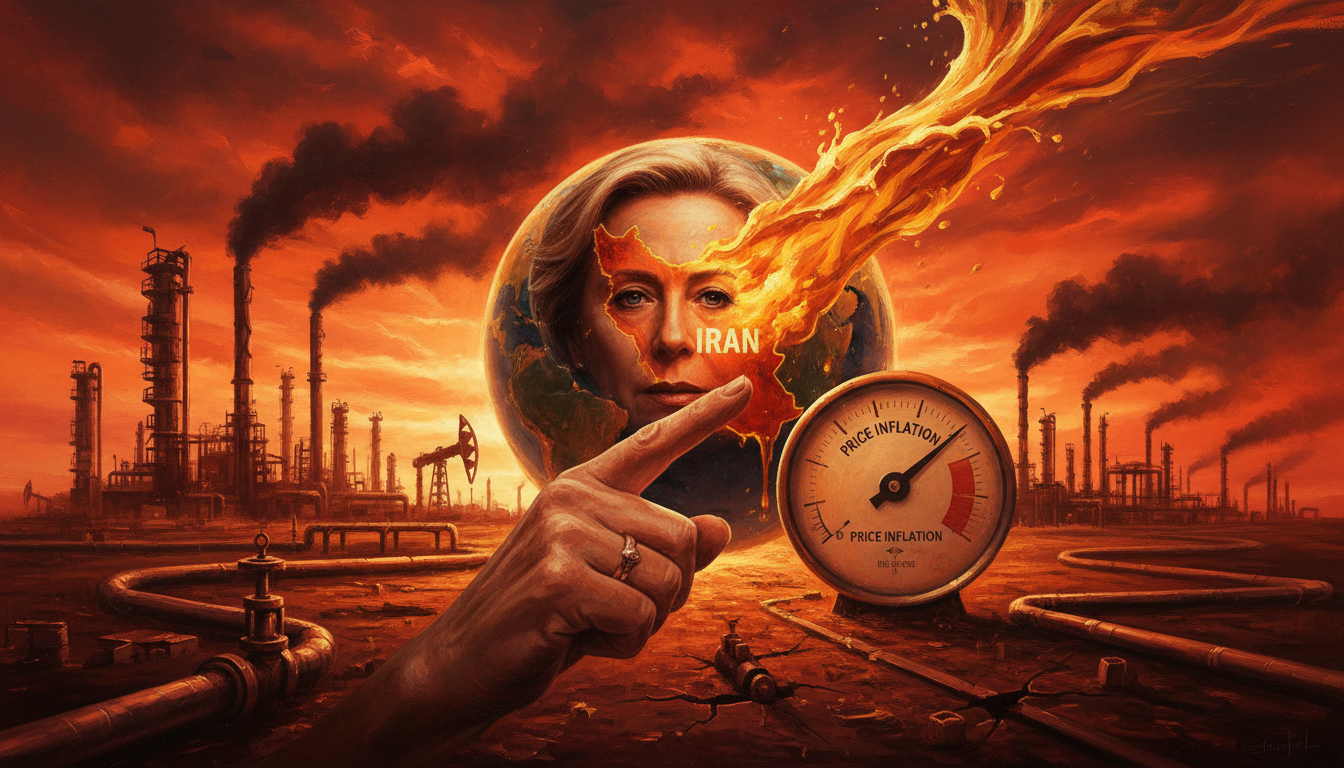
The global energy market is once again at a critical juncture, with geopolitical tensions in the Middle East threatening to inject fresh volatility into crude prices and, consequently, global inflation. Christine Lagarde, President of the European Central Bank, recently underscored a significant concern: the lingering memory of the 2022 energy crisis means businesses and workers are likely to react with unprecedented speed to any new oil shock. This accelerated response mechanism could swiftly translate higher input costs into consumer prices and wage demands, creating a potent inflationary feedback loop. For energy investors, understanding this altered economic psychology and its interplay with market fundamentals is paramount.
The New Inflationary Psychology: A Faster Fuel-Price Feedback Loop
Lagarde’s recent remarks highlight a fundamental shift in economic behavior, directly linked to the traumatic experience of 2022. Following the full-scale conflict in Ukraine, Europe faced severe energy supply disruptions, driving euro-bloc inflation to an alarming peak of 10.6% by October 2022. That period marked the first significant inflationary scare for an entire generation, leaving an indelible mark on collective consciousness. Now, should geopolitical instability, particularly from potential escalations involving Iran, trigger another oil price surge, the market expects a much swifter pass-through of costs. This means businesses are primed to increase consumer prices more quickly, and workers are poised to demand higher wages to compensate for diminishing purchasing power. For investors, this psychological predisposition adds a layer of complexity, as even a temporary price spike could rapidly evolve into a more entrenched inflationary trend, forcing central banks to consider a hawkish stance even if the initial shock is external and short-lived. This sensitivity is particularly relevant given that while concerns are high, Brent crude has actually seen a recent cooling, trading at $92.46 today. This represents a decline of approximately 7% from its $101.16 level just two weeks ago on April 1st, suggesting the market has not yet fully priced in the worst-case geopolitical scenarios, maintaining a fragile balance.
Current Market Dynamics Amid Heightened Geopolitical Jitters
Despite the palpable geopolitical anxieties, current market data reveals a nuanced picture. As of today, Brent crude trades at $92.46 per barrel, down 0.84% on the day, with WTI crude following a similar trajectory at $88.72, down 1.06%. Gasoline prices also reflect this slight downward pressure, currently at $3.1 per gallon. This recent softening, exemplified by Brent’s $7.07 decline from its April 1st peak, indicates that while the risk premium remains elevated, a full-blown supply disruption event is not yet fully baked into prices. Investors are keenly watching this divergence, with many asking, “is WTI going up or down?” The answer, currently, points to slight downside pressure in the very near term, but with significant underlying upside potential should the geopolitical landscape deteriorate. The market is effectively in a holding pattern, balancing current supply/demand fundamentals against the looming threat of conflict. This delicate equilibrium means that any concrete development, positive or negative, could trigger a rapid re-pricing. Our proprietary data shows that while the fears are real, the market has pulled back slightly from its recent highs, presenting both risk and opportunity for those closely monitoring developments.
Forward Outlook: Key Data Points and Investor Questions
The coming weeks will be crucial for discerning the true direction of oil prices amidst the geopolitical noise. Investors are actively seeking clarity, with questions like “what do you predict the price of oil per barrel will be by end of 2026?” dominating sentiment. To answer this, we must look beyond the immediate headlines to the fundamental data releases on our calendar. The EIA Weekly Petroleum Status Reports, scheduled for April 22nd, April 29th, and May 6th, will provide vital insights into crude oil inventories, refinery utilization, and product supplied, offering a real-time pulse on U.S. supply and demand. Similarly, the API Weekly Crude Inventory reports on April 28th and May 5th will offer an early indication of these trends. Further insights into future production capacity will come from the Baker Hughes Rig Count on April 24th and May 1st. Perhaps most pivotal for the mid-term outlook will be the EIA Short-Term Energy Outlook, due on May 2nd, which will offer a comprehensive forecast on global and domestic energy markets. These events, particularly when viewed through the lens of Lagarde’s warning about accelerated price transmission, mean that even minor shifts in inventory or production data could have an outsized impact on market sentiment and price action. Investors should brace for heightened sensitivity to these reports, as they will be key inputs into projecting oil’s trajectory not just for the next quarter, but potentially through the end of 2026.
Investment Implications in an Accelerated Market Environment
The confluence of elevated geopolitical risk and an accelerated inflationary response mechanism presents a complex landscape for oil and gas investors. The traditional playbook for managing supply shocks has been altered by the “recent memory” of 2022, implying that markets will react faster and more intensely to any perceived threat. This means the window for proactive positioning could be narrower than in previous cycles. Investors must weigh the current market’s slight downward correction against the significant upside risk posed by a potential Middle East escalation. Companies with robust balance sheets, diversified asset portfolios, and strong hedging strategies may be better positioned to navigate this volatility. Conversely, energy-intensive sectors and consumer discretionary companies could face renewed margin pressures if an oil shock materializes and rapidly feeds into broader inflation. The dilemma for central banks, caught between fighting external supply shocks and managing demand-side inflation, adds another layer of uncertainty, particularly regarding interest rate trajectories. Staying agile, monitoring both the daily geopolitical headlines and the upcoming fundamental data releases, and considering the potential for swift market reactions will be critical for protecting capital and seizing opportunities in this uniquely sensitive energy market.