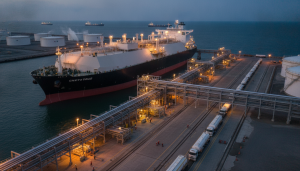
The specter of a Strait of Hormuz closure, first dramatically highlighted by Kuwait Petroleum Corporation (KPC) CEO Sheikh Nawaf Al-Sabah at CERAWeek in March 2025, continues to cast a long shadow over the global energy markets. His stark warning of a “global economic cataclysm” and KPC’s subsequent declaration of force majeure on its oil exports, effectively halting Kuwait’s substantial 2.6 million barrels per day (bpd) of crude from reaching international markets, marked a watershed moment. More than a year later, as investors grapple with persistent geopolitical tensions and complex market dynamics, understanding the ongoing implications of this critical chokepoint’s disruption is paramount for navigating energy investments. Our analysis delves into the market’s current posture, the broader supply chain ramifications, and the critical data points that will shape the path forward for oil and gas portfolios.
Hormuz’s Lingering Shadow: Market Realities vs. Dire Warnings
While Sheikh Al-Sabah’s initial warnings painted a grim picture of immediate and severe price spikes, the market’s reaction, while significant, has evolved into a more complex equilibrium. As of today, April 22, 2026, Brent Crude trades at $92.37 per barrel, down 0.93% for the day within a range of $91.39-$94.21. WTI Crude mirrors this sentiment, sitting at $88.75, a 1.03% dip, trading between $87.64 and $90.71. Gasoline prices have also seen a slight decline, currently at $3.1 per gallon. These figures, while elevated compared to historical averages, are not indicative of the hyper-inflationary “cataclysm” initially feared, suggesting a degree of market adaptation or perhaps a tempering of the most extreme initial projections.
Indeed, our proprietary data reveals that Brent has actually experienced a recent decline, dropping from $101.16 on April 1st to $94.09 by April 21st, a 7% reduction over two weeks. This recent downtrend, despite the ongoing Hormuz constraint, prompts critical questions for investors: Has global demand softened sufficiently to offset a significant portion of the supply loss from Kuwait? Have other producers, notably non-OPEC+ members, managed to ramp up output more effectively than anticipated? Or is the market simply pricing in a prolonged, but not necessarily escalating, state of disruption? The initial shock of Kuwait’s 2.6 million bpd offline undoubtedly tightened the market, but the current price action suggests a battle between persistent supply concerns and other countervailing forces like demand elasticity or strategic reserve releases. This dynamic highlights the need for a nuanced view beyond simplistic supply-shock models.
Beyond Crude: The Broader Supply Chain Vulnerability
The impact of the Strait of Hormuz closure extends far beyond the immediate crude oil barrels, creating a cascade of challenges across global supply chains. As KPC’s CEO rightly emphasized, the disruption to vital petrochemical feedstocks originating from the Gulf region poses a severe threat to industries reliant on plastics, particularly in food packaging and preservation. This impending scarcity translates directly into higher costs and logistical nightmares for global food transportation, ultimately impacting consumer prices and potentially exacerbating food security concerns worldwide. The ramifications for integrated energy companies, especially those with significant downstream chemical operations, are substantial, as feedstock availability and pricing become highly volatile.
Furthermore, the timely delivery of agricultural fertilizers from the Gulf is now critically jeopardized. With planting seasons imminent in numerous parts of the world, delays or shortfalls in fertilizer supply could lead to reduced crop yields, higher food prices, and widespread inflationary pressure. This intricate web of interdependencies means that the Hormuz situation isn’t merely an energy crisis but a profound economic one, touching every sector from manufacturing to agriculture. Investors must therefore look beyond direct crude exposure and consider the knock-on effects on chemical producers, agricultural companies, and even logistics and shipping firms, where increased costs and operational risks are becoming the new norm.
Navigating Uncertainty: Key Data Points for Investors
Given the persistent uncertainty surrounding global oil supply in the wake of the Hormuz disruption, investors must closely monitor upcoming market indicators for actionable intelligence. Our proprietary event calendar highlights several critical releases in the coming weeks that will offer clarity. This very day, April 22nd, the EIA Weekly Petroleum Status Report will provide fresh data on U.S. crude oil and product inventories, refinery utilization, and demand. This will be followed by another EIA report on April 29th and API Weekly Crude Inventory data on April 28th and May 5th. These inventory figures are paramount, as sustained draws could signal deeper global supply deficits that the current market price might not fully reflect, potentially pushing Brent and WTI higher.
Furthermore, the Baker Hughes Rig Count, due on April 24th and May 1st, will offer insights into North American production activity. A significant increase in active rigs could signal a robust supply response from shale producers attempting to fill the void left by Gulf exports, tempering upward price pressure. Perhaps the most comprehensive forward-looking assessment will come with the EIA Short-Term Energy Outlook on May 2nd. This report will provide updated supply, demand, and price forecasts for the coming months, factoring in the latest geopolitical developments and market adjustments. Discrepancies between these official projections and market expectations could trigger significant trading opportunities or risks, making these dates crucial for any energy portfolio manager.
Investor Outlook: Addressing Core Concerns Amidst Geopolitical Risk
In this turbulent environment, we note that many of our readers are asking fundamental questions, such as “is WTI going up or down?” and “what do you predict the price of oil per barrel will be by end of 2026?” These direct questions underscore the pervasive uncertainty and the need for clear, actionable insights. While the immediate outlook for WTI and Brent remains volatile, the sustained closure of the Strait of Hormuz from March 2025 onwards creates an underlying bullish bias on the supply side. The market’s recent dip, as seen in Brent’s 7% decline over the last two weeks, could be attributed to temporary demand concerns, profit-taking, or perhaps a perceived de-escalation of *other* geopolitical risks, rather than a full resolution of the Hormuz issue.
For the remainder of 2026, the trajectory of oil prices will heavily depend on two key factors: the duration and intensity of the Hormuz disruption, and the global economic response. Should the Strait remain effectively closed, sustained supply deficits will likely push prices higher, potentially retesting the $100+ range. However, significant global economic slowdowns or a robust, sustained increase in non-OPEC+ supply could cap these gains. Investors should brace for continued volatility and consider strategies that account for both upward price potential due to supply constraints and downward risks from demand destruction. Diversification across energy equities, including those with resilient refining margins or strong upstream asset bases outside the immediate conflict zone, alongside strategic hedging, will be critical for navigating the remainder of 2026.