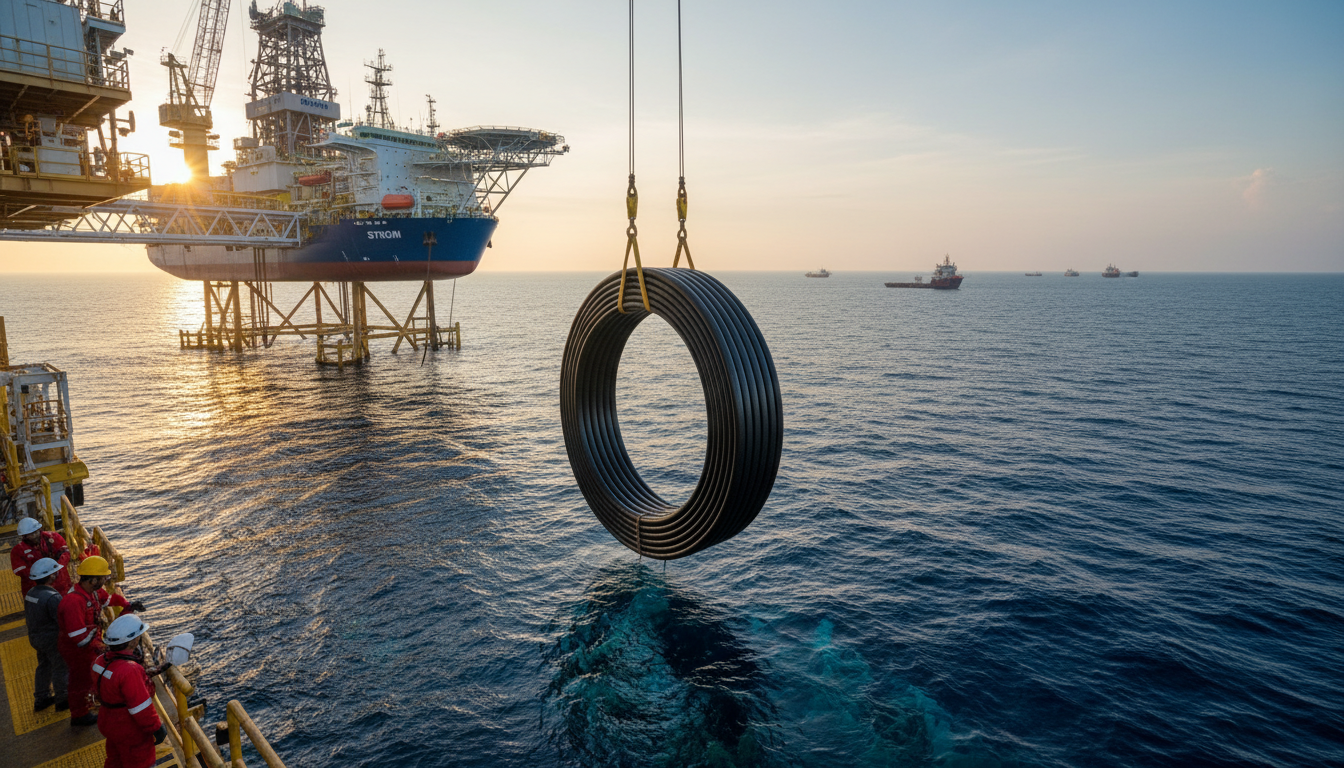
The recent contract win by a leading advanced subsea technology provider, securing a significant order for insulated thermoplastic composite pipe (TCP) production jumpers for a crucial deepwater field extension project offshore Sabah, Malaysia, signals more than just a new entry in an order book. This agreement underscores a pivotal moment for the energy sector, highlighting the increasing dominance of non-metallic solutions in the demanding deepwater environment and pointing towards a strategic industry shift. For investors, this move represents a compelling case for the long-term value proposition of innovative, resilient, and ultimately more cost-effective subsea infrastructure, particularly in high-CAPEX deepwater plays.
Advanced Composites Drive Deepwater Efficiency and Reliability
The Malaysia deepwater project, managed by Dynamic Ocean Sdn Bhd, will integrate two 7-inch internal diameter (ID) production jumpers, meticulously manufactured from carbon fiber-reinforced PA12 (CF/PA12). This high-performance composite material is specifically engineered for extreme conditions, crucial for deployment at an impressive water depth of approximately 1,350 meters. The delivery of this specialized equipment is strategically planned to precede the anticipated installation phase in 2027, highlighting the extensive lead times and precise coordination characteristic of complex deepwater endeavors. The accelerating adoption of Thermoplastic Composite Pipe (TCP) technology, as evidenced by this project, is a key market trend for investors to monitor. TCP distinguishes itself in the subsea domain through superior properties compared to traditional metallic piping. Its exceptional resistance to corrosion, a persistent challenge in marine environments, dramatically extends asset lifespan and significantly reduces integrity management costs. Coupled with outstanding fatigue performance, TCP offers enhanced reliability under the constant dynamic stresses encountered in deepwater operations, ensuring sustained performance in the most challenging conditions.
Navigating Market Volatility with Strategic Investments
The current market backdrop for oil and gas continues to present a complex picture for investors, even as technological advancements like TCP gain traction. As of today, Brent Crude trades at $92.37, reflecting a modest daily dip of 0.93% within a range of $91.39-$94.21. Similarly, WTI Crude stands at $88.75, down 1.03% with a daily range of $87.64-$90.71. While these figures represent a softening from early April highs, where Brent traded at $101.16 just three weeks ago, the sustained price levels above $90 for Brent continue to incentivize capital allocation towards strategic, long-term deepwater projects. The 14-day trend saw Brent decline by approximately 7%, illustrating the short-term volatility that defines global energy markets. However, the decision by operators to invest in advanced, durable solutions like composite pipes for projects extending into 2027 and beyond signals a long-term confidence in hydrocarbon demand and the economic viability of deepwater production, provided the underlying infrastructure offers superior life-cycle value and operational resilience.
Investor Focus on Long-Term Price & Supply Dynamics
Investors are keenly observing the market for signals on future oil price trajectories. Our proprietary intent data indicates a strong focus on price predictions, with common inquiries ranging from short-term movements in WTI to end-of-year forecasts for oil per barrel in 2026. While daily price fluctuations are a constant, the investment in advanced subsea technology for deepwater projects reflects a strategic outlook that prioritizes long-term operational efficiency over immediate market noise. The upcoming energy calendar offers several critical data points that will further shape these investor sentiments. The EIA Weekly Petroleum Status Reports on April 22nd, April 29th, and May 6th will provide crucial insights into crude inventories and demand patterns, directly impacting short-term price sentiment. The Baker Hughes Rig Count on April 24th and May 1st will offer an indicator of drilling activity and future supply. Most notably for long-term outlooks, the EIA Short-Term Energy Outlook on May 2nd will deliver a comprehensive forecast that can significantly influence investor predictions for crude prices through the end of 2026. These macroeconomic indicators, alongside micro-level advancements like composite pipe adoption, collectively inform the investment thesis for the broader oil and gas sector.
Unlocking Economic and Operational Efficiencies with TCP
The underlying economic and operational benefits of non-metallic composite pipe deployment are substantial, presenting attractive value propositions for both operators and investors. TCP systems are engineered for delivery in long, continuous, and spoolable lengths, a capability that dramatically streamlines the installation process. This continuity allows for deployment using smaller, more versatile installation vessels, significantly reducing both installation time and overall cost compared to traditional metallic pipe sections that require extensive welding and heavier equipment. The reduced weight of composite pipes further translates into logistical advantages, simplifying handling and deployment across various subsea applications, including jumpers, flowlines, and risers. Beyond installation, the long-term advantages are equally compelling: extended asset lifespan due to corrosion resistance, reduced integrity management costs over the operational life, and superior fatigue performance. These factors contribute to a significantly lower total cost of ownership (TCO) for deepwater projects. TCP’s robust construction ensures reliable performance not only in standard oil and gas service but also in highly aggressive and sour environments, broadening its applicability and reinforcing its value proposition as a future-proof solution for the industry’s most challenging deepwater developments.


