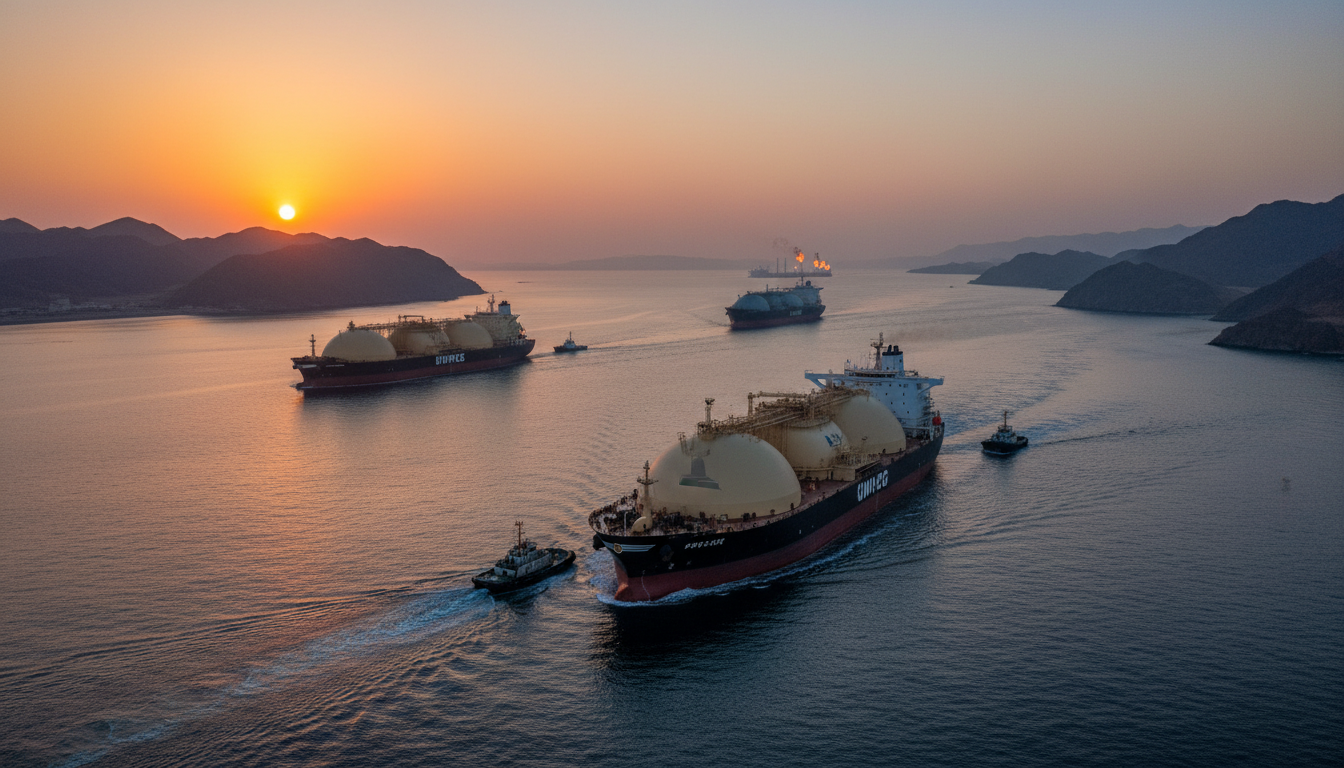
The successful navigation of the Strait of Hormuz by two Indian-flagged liquefied petroleum gas (LPG) carriers, Jag Vasant and Pine Gas, marks a significant moment for global energy security and, more specifically, for India’s burgeoning energy demand. This event, far from being a mere logistical update, serves as a crucial signal to investors assessing supply chain resilience and the broader implications of geopolitical tensions in the West Asia region. For those monitoring the intricate balance of energy markets, the safe passage and imminent arrival of these tankers at Indian ports this week underscore a proactive approach to risk management, offering a measure of reassurance amidst persistent uncertainties that continue to shape commodity price trajectories.
Navigating Critical Chokepoints and Bolstering Energy Security
The Strait of Hormuz stands as an indispensable artery for international energy trade, facilitating the transit of a substantial portion of the world’s crude oil, natural gas, and fertilizer shipments. Geopolitical volatility in the West Asia region inevitably amplifies risks for maritime operations through this passage, leading to ongoing concerns about supply disruptions and potential spikes in commodity prices. India, as one of the world’s largest energy importers, has a profound vested interest in the stability and unimpeded flow of traffic through this vital waterway, making each successful transit a testament to the nation’s proactive risk management strategies.
The Jag Vasant, carrying a substantial 47,600 metric tonnes of LPG, is anticipated to berth at Kandla Port on March 26. Following closely, the Pine Gas, laden with an equally vital 45,000 metric tonnes of LPG, is scheduled to reach New Mangalore Port on March 27. These successful transits represent the culmination of intricate planning and coordination, ensuring the continuous flow of essential energy resources into India’s rapidly expanding economy. This isn’t an isolated incident; earlier, the MT Shivalik and MT Nanda Devi successfully delivered approximately 92,712 tonnes of LPG to Indian shores without incident, establishing a precedent of robust logistical management. While these successes offer a positive signal, investors must remain cognizant that 20 other Indian vessels, carrying approximately 540 Indian seafarers, remain in the Persian Gulf, awaiting similar windows for safe passage. This ongoing situation highlights the dynamic nature of regional risks and the necessity for continued vigilance.
Market Response and Investor Sentiment in a Volatile Landscape
In a market acutely sensitive to supply chain stability, successful transits through a chokepoint like Hormuz can help temper the geopolitical risk premium often priced into crude oil. As of today, Brent Crude trades at $92.54, down 0.75% within a day range of $91.39 to $94.21. Similarly, WTI Crude stands at $88.78, reflecting a 0.99% decrease within its daily range of $87.64 to $90.71. This modest daily decline comes after a more significant downward trend over the past two weeks, where Brent fell from $101.16 on April 1st to $94.09 on April 21st, a notable $7.07 or 7% drop. While multiple factors influence this broader trend, the continued, albeit challenging, flow of critical energy resources like LPG through Hormuz likely contributes to preventing more significant upward price spikes driven by supply fears.
Our proprietary reader intent data reveals that investors are frequently asking questions such as “is WTI going up or down” and “what do you predict the price of oil per barrel will be by end of 2026?” This underscores a prevailing uncertainty regarding market direction. While the safe passage of these LPG carriers offers a tangible demonstration of supply chain resilience, it’s crucial to understand that such events address only one facet of a complex equation. Broader macroeconomic indicators, global demand outlooks, and the sustained threat of geopolitical escalations continue to exert significant influence on crude prices. The consistent delivery of energy, even in challenging environments, provides a baseline stability that helps prevent runaway price inflation, but does not eliminate the underlying volatility that investors are keenly monitoring.
Forward Outlook: Monitoring Supply, Demand, and Geopolitical Undercurrents
Looking ahead, investors must maintain a keen eye on key market data releases and upcoming events to gauge the continued balance of supply and demand, and how these might interact with persistent geopolitical risks. The successful Hormuz transits demonstrate a capacity for managing immediate supply challenges, but the broader picture demands constant evaluation. Critical upcoming events include the EIA Weekly Petroleum Status Reports on April 22nd, April 29th, and May 6th, which will provide vital insights into crude oil and product inventories, offering a snapshot of current market tightness or looseness.
Further informing supply-side dynamics will be the Baker Hughes Rig Counts scheduled for April 24th and May 1st, providing an indicator of future production trends. For early signals, the API Weekly Crude Inventory reports on April 28th and May 5th will offer preliminary data ahead of the official EIA releases. Perhaps most critical for longer-term price predictions, especially for those asking about the “price of oil per barrel by end of 2026,” will be the EIA Short-Term Energy Outlook on May 2nd. This report offers a comprehensive forecast on supply, demand, and prices, incorporating global economic factors and geopolitical assessments. While India’s recent successes in the Strait of Hormuz are positive, they do not negate the need for continuous, data-driven analysis of these broader market forces, especially given the ongoing situation with other vessels still awaiting passage through this critical chokepoint.


