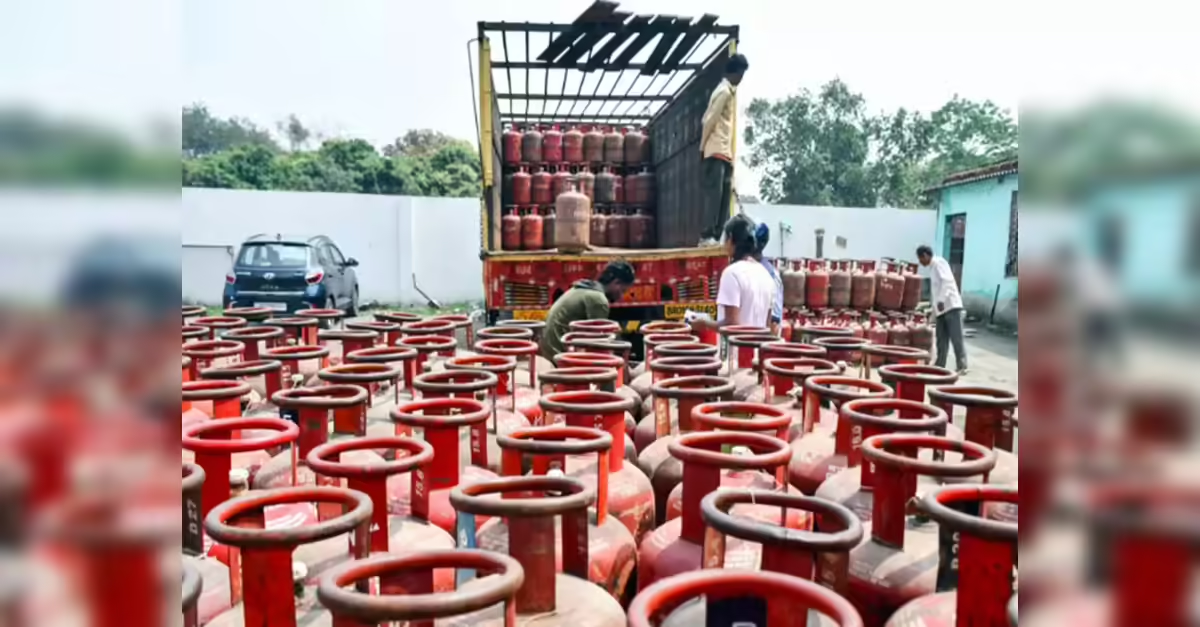
India’s energy landscape is undergoing a significant transformation, driven by a concerted governmental push to transition from Liquified Petroleum Gas (LPG) to Piped Natural Gas (PNG). This strategic pivot, aimed at addressing persistent supply concerns and environmental goals, presents a compelling long-term investment thesis for the natural gas sector, particularly within City Gas Distribution (CGD) networks. As a major global energy consumer, India’s policy shifts resonate across international markets, signaling robust demand growth for natural gas and creating distinct opportunities for investors attuned to infrastructure plays and evolving energy consumption patterns.
India’s Strategic Pivot: De-risking Energy Supply with PNG
The Indian government has openly acknowledged a “worrisome” situation regarding LPG availability and distribution, prompting a proactive strategy to incentivize a widespread shift to PNG. This isn’t merely a suggestion; it’s backed by a significant offering to states and union territories: an additional 10% commercial LPG allocation, contingent upon their commitment to facilitating a long-term transition towards PNG. This allocation is tiered, designed to encourage specific reforms that streamline CGD expansion. For instance, a 1% boost is granted for establishing state and district-level committees to approve CGD applications and resolve grievances, while a further 2% is tied to issuing orders that grant deemed CGD permissions. Critically, 3% additional allocation is offered for implementing “Dig and Restore” schemes, vital for CGD entities to expand infrastructure, and another 4% for reducing annual rental or lease charges, directly impacting operational costs. This comprehensive framework places the onus squarely on state and local governments to expedite approvals and ensure seamless connections for both domestic and commercial PNG consumers, setting the stage for accelerated network growth and stable natural gas demand.
Global Market Backdrop and India’s Insulative Strategy
Against a backdrop of fluctuating global energy prices, India’s strategic pivot towards PNG offers a degree of insulation from international volatility. As of today, Brent Crude trades at $92.92, reflecting a slight dip of 0.34%, with WTI Crude at $89.33, down 0.38%. This recent market behavior follows a broader trend; Brent has seen a notable decline from $101.16 on April 1st to $94.09 by April 21st, representing a 7% reduction over the past three weeks. While this offers some relief on crude and by extension, LPG import costs, the inherent volatility underscores India’s need for a more stable domestic energy source. The government’s push for PNG is a fundamental move to reduce reliance on imported LPG, despite a reported 40% increase in domestic LPG production. This policy ensures that essential energy supplies, particularly PNG and CNG for transport, are delivered to consumers without cuts, even amidst broader gas shortage reports. For investors, this highlights India’s commitment to energy security and the potential for a premium on reliable, domestically sourced or long-term contracted natural gas supplies.
Investor Focus: Navigating Uncertainty with Growth Opportunities
The current investment climate is rife with questions about market direction, reflecting broader uncertainty. Our proprietary intent data shows investors are keenly asking, “is WTI going up or down?” and seeking predictions for “the price of oil per barrel by end of 2026.” While global crude trends remain a key concern, India’s robust domestic energy policy provides a clear, actionable growth narrative that stands apart from short-term commodity swings. This focus on internal energy transition offers a compelling alternative for capital allocation. Looking ahead, key market events like the EIA Weekly Petroleum Status Report (due April 22nd and 29th) and the Baker Hughes Rig Count (April 24th, May 1st) will provide granular data on Western supply-demand dynamics. However, the EIA Short-Term Energy Outlook on May 2nd will be crucial for a macro perspective, providing context for how India’s evolving energy mix integrates into the global energy demand picture. Investors should consider how India’s long-term gas demand growth, underpinned by government incentives, can provide a more predictable return profile compared to purely speculative plays on crude price movements.
Unlocking Value in India’s City Gas Distribution Sector
The incentivized shift to PNG directly translates into accelerated growth and enhanced profitability for City Gas Distribution (CGD) companies. The government’s proactive measures to streamline the regulatory environment – from forming dedicated approval committees to granting ‘deemed CGD permissions’ – significantly de-risk expansion projects. The introduction of “Dig and Restore” schemes, coupled with reductions in annual rental/lease charges, directly improves the economics of laying down and expanding gas pipeline networks. This creates a fertile ground for capital expenditure, attracting both domestic and international investors looking for infrastructure-led growth. Commercial LPG consumers, who are specifically being requested to switch to PNG, represent a significant, high-volume segment that CGD companies can now target more aggressively, often with their own incentives for connection. The long-term implications are clear: a rapidly expanding customer base, stable demand from a growing economy, and a supportive regulatory framework that makes investments in India’s natural gas distribution sector increasingly attractive and predictable. This structural shift underscores a sustained period of growth for companies operating in this vital energy infrastructure space.


