The specter of $200 per barrel oil has once again captured the attention of global energy markets, fueled by escalating tensions in the Middle East and explicit warnings from Iranian military command. Recent pronouncements from Ebrahim Zolfaqari on March 11, cautioning the world to “get ready for oil to be $200 a barrel” due to regional destabilization, underscore the profound geopolitical risks currently priced into — or perhaps discounted by — crude futures. While some market commentators and analysts, such as Greg Newman of Onyx Capital Group, have suggested that Middle Eastern benchmarks are already nearing $150 and that Brent could follow, the complex interplay of geopolitical risk, fundamental supply-demand dynamics, and broader macroeconomic factors paints a nuanced picture for energy investors. Understanding this intricate balance is paramount for navigating the volatility ahead.
The Hormuz Chokepoint: A Geopolitical Sword of Damocles
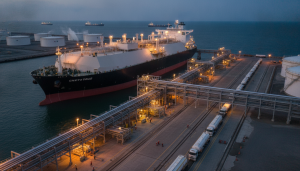
At the heart of the current market anxiety lies the strategically vital Strait of Hormuz. This narrow maritime corridor, linking the Persian Gulf with the Gulf of Oman, serves as a critical artery for global energy flows, with approximately 20% of the world’s oil and gas typically transiting its waters. Iran’s pledge to use the waterway’s disruption as a “tool to pressure the enemy” is not merely rhetoric; recent weeks have seen significant disruptions to shipping traffic, directly impacting supply lines. The U.S. and Israeli-led efforts in the region are perceived by some as contributing to this instability, creating an environment ripe for supply shocks. Historically, any credible threat to the Strait of Hormuz has sent ripples through oil markets, highlighting its irreplaceable role in ensuring global energy security. For investors, the potential for prolonged or intensified blockades represents an existential threat to supply, justifying the extreme price forecasts by some analysts who see parallels to past crisis-driven surges.
Market Realities vs. High-End Projections: A Disconnect?
Despite the dire warnings and the evident geopolitical premium, the current market snapshot reveals a more tempered immediate reaction compared to the most aggressive $200 projections. As of today, Brent Crude trades at $92.90 per barrel, reflecting a slight daily decline of 0.36%, with its intraday range spanning $92.57 to $94.21. Similarly, U.S. West Texas Intermediate (WTI) Crude futures are at $89.25, down 0.47% for the day, having traded between $88.76 and $90.71. While these levels represent a significant surge of over 50% in both contracts over the past month, reaching their highest points since 2022, they remain considerably below the $150 benchmark mentioned by some experts for regional crude or the $200-$250 scenarios. In fact, our proprietary 14-day Brent trend data indicates a recent pullback, moving from $101.16 on April 1st to $94.09 on April 21st, a decline of $7.07 or 7%. This suggests that while markets acknowledge the risk, they are not yet fully pricing in a complete and sustained shutdown of the Strait, or perhaps they anticipate mitigating factors. Investors are clearly weighing the immediate supply disruption risks against broader demand concerns and the potential for diplomatic de-escalation, preventing a full-blown parabolic move.
Investor Sentiment and Forward-Looking Catalysts
Our first-party reader intent data reveals a keen focus from investors on the future trajectory of oil prices, with common queries such as “is WTI going up or down?” and “what do you predict the price of oil per barrel will be by end of 2026?” This highlights the deep uncertainty and the critical need for forward-looking analysis. While geopolitical events are inherently unpredictable, a series of upcoming energy events will provide crucial data points for investors to refine their outlook. The EIA Weekly Petroleum Status Reports on April 22nd, April 29th, and May 6th will offer fresh insights into U.S. crude inventories, refinery utilization, and product demand, which can significantly influence near-term sentiment. Similarly, the Baker Hughes Rig Count on April 24th and May 1st will shed light on North American production trends, a key factor in global supply. Perhaps most critically, the EIA Short-Term Energy Outlook on May 2nd will present updated government forecasts on supply, demand, and prices, serving as a benchmark for many market participants. These scheduled releases, combined with ongoing geopolitical developments, will act as powerful catalysts, either reinforcing current price levels or pushing the market towards the higher-end predictions should supply concerns intensify.
Beyond the Headlines: The Broader Supply-Demand Picture
While the focus remains heavily on the Middle East, investors must also consider the broader fundamental landscape. Global oil demand has shown resilience, particularly from developing economies, though macroeconomic headwinds in some major consuming nations could temper growth. On the supply side, non-OPEC+ production, particularly from the U.S. shale patch, continues to provide a crucial balancing force. However, the pace of this growth, coupled with OPEC+’s ongoing production policies, will play a significant role in determining the market’s ability to absorb potential geopolitical shocks. The current gasoline price of $3.10 per gallon, down 0.64% today, suggests some cooling in refined product markets, which can indirectly influence crude demand. Ultimately, while the $200 oil scenario represents a tail risk driven by geopolitical escalation, the market’s current positioning suggests a more cautious approach, waiting for tangible shifts in supply-demand fundamentals or a definitive turn in regional stability before fully committing to such extreme price targets. Vigilance on both geopolitical developments and upcoming data releases will be key for investors in the coming weeks and months.