Escalating Tensions and Supply Vulnerabilities
The Middle East remains a critical flashpoint for global oil markets, with recent events signaling a dangerous widening of the conflict between Iran and Israel, directly impacting investor sentiment regarding crude supply. The Islamic Revolutionary Guard Corps (IRGC) has publicly vowed to target Israeli Prime Minister Benjamin Netanyahu, an escalation that follows Israel’s targeted elimination of senior Iranian intelligence officials and strikes on Iran’s Space Agency research center and an aerial defense system factory. In retaliation, Iran unleashed a missile barrage on central Israel, underscoring the immediate and volatile nature of the confrontations.
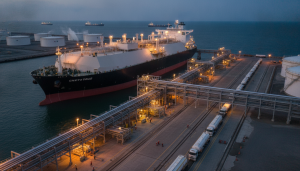
Of paramount concern to energy investors are the direct threats to vital oil infrastructure and shipping lanes. The U.S. Central Command, under President Trump’s directive, recently conducted bombing raids on Iran’s Kharg Island, a highly sensitive economic target. This island is critical, handling approximately 90% of Iran’s crude exports with a formidable loading capacity of roughly 7 million barrels per day. Any sustained disruption here would have profound implications for global supply. Furthermore, the Strait of Hormuz, the narrow waterway separating Iran and the UAE, continues to be a choke point for energy flows, with the U.S. urging allies to deploy warships to help secure its passage. While oil-loading operations at the UAE’s Fujairah port resumed after a drone-related fire, the incident serves as a stark reminder of the region’s vulnerability to disruption. The initial stages of this conflict saw Brent crude futures surge over 40%, highlighting the market’s sensitivity to geopolitical risk.
The Market’s Measured Response: A Closer Look at Crude Prices
Despite the intensifying rhetoric and direct attacks on energy infrastructure, the immediate market reaction to these widening threats has been surprisingly nuanced. As of today, Brent Crude trades at $92.9 per barrel, reflecting a marginal decline of 0.36% within a day range of $92.57 to $94.21. Similarly, WTI Crude stands at $89.24, down 0.48%, fluctuating between $88.76 and $90.71. Gasoline prices also saw a slight dip to $3.11, down 0.64%.
This current price action, while still elevated due to an inherent geopolitical risk premium, stands in contrast to the initial sharp rally. Our proprietary data reveals that Brent crude has actually trended downwards over the past two weeks, falling from $101.16 on April 1st to $94.09 on April 21st, representing a decline of 7%. This suggests that while the threat of disruption is real, the market might be factoring in several mitigating elements. These could include existing global crude inventories, the potential for strategic petroleum reserve releases, or perhaps a belief that major, sustained supply disruptions through key chokepoints like the Strait of Hormuz or Kharg Island will ultimately be averted through diplomatic efforts or a contained conflict. Investors are clearly weighing the immediate headlines against underlying supply-demand fundamentals and broader macroeconomic concerns, such as the potential impact of higher interest rates on global oil demand.
Addressing Investor Uncertainty: What’s Driving Oil’s Direction?
Our internal reader intent data shows a clear demand for clarity on oil’s future trajectory, with questions like “Is WTI poised for an ascent or decline?” and “What do you predict the price of oil per barrel will be by the end of 2026?” dominating investor queries. This reflects the significant uncertainty currently clouding the energy market. The direction of WTI, and crude prices more broadly, will be a complex interplay of geopolitical risk, global demand dynamics, and supply responses.
On one hand, any further direct attacks on critical infrastructure, such as Kharg Island, or a full closure of the Strait of Hormuz, would undoubtedly trigger a substantial supply shock, pushing prices significantly higher. The threat of a wider regional conflict also carries an inherent risk premium. On the other hand, persistent concerns about global economic growth, particularly from major consuming nations, could temper demand and cap price rallies. The market is also closely watching the pace of U.S. shale production and OPEC+’s output decisions, both of which can add supply or maintain discipline to balance the market. Predicting an exact year-end price for 2026 is challenging given the fluidity of these factors, but investors should prepare for continued volatility, with significant swings possible based on geopolitical developments and economic indicators.
Forward Visibility: Key Data Points and Upcoming Catalysts
For investors navigating this complex landscape, monitoring key data releases and upcoming events is paramount. The fundamental supply and demand picture, which ultimately underpins price movements, will be illuminated by several reports over the next two weeks. We anticipate the release of the EIA Weekly Petroleum Status Report on April 22nd, April 29th, and May 6th. These reports provide crucial insights into U.S. crude oil and product inventories, refining activity, and demand, offering a vital snapshot of the largest consumer market. Any significant drawdowns or builds will directly influence market sentiment, particularly in the context of ongoing geopolitical tensions.
Furthermore, the Baker Hughes Rig Count, scheduled for April 24th and May 1st, will offer an indication of future U.S. oil and gas production trends. A rising rig count could signal an increase in future supply, potentially counteracting some of the geopolitical risk premium. Conversely, a stagnant or declining count might exacerbate supply concerns. Investors should also pay close attention to the API Weekly Crude Inventory reports on April 28th and May 5th, which often precede the official EIA data and can provide early indications of inventory changes. Finally, the EIA Short-Term Energy Outlook on May 2nd will offer updated projections for global supply, demand, and prices, providing a crucial forward-looking perspective against which to assess the current volatile environment.