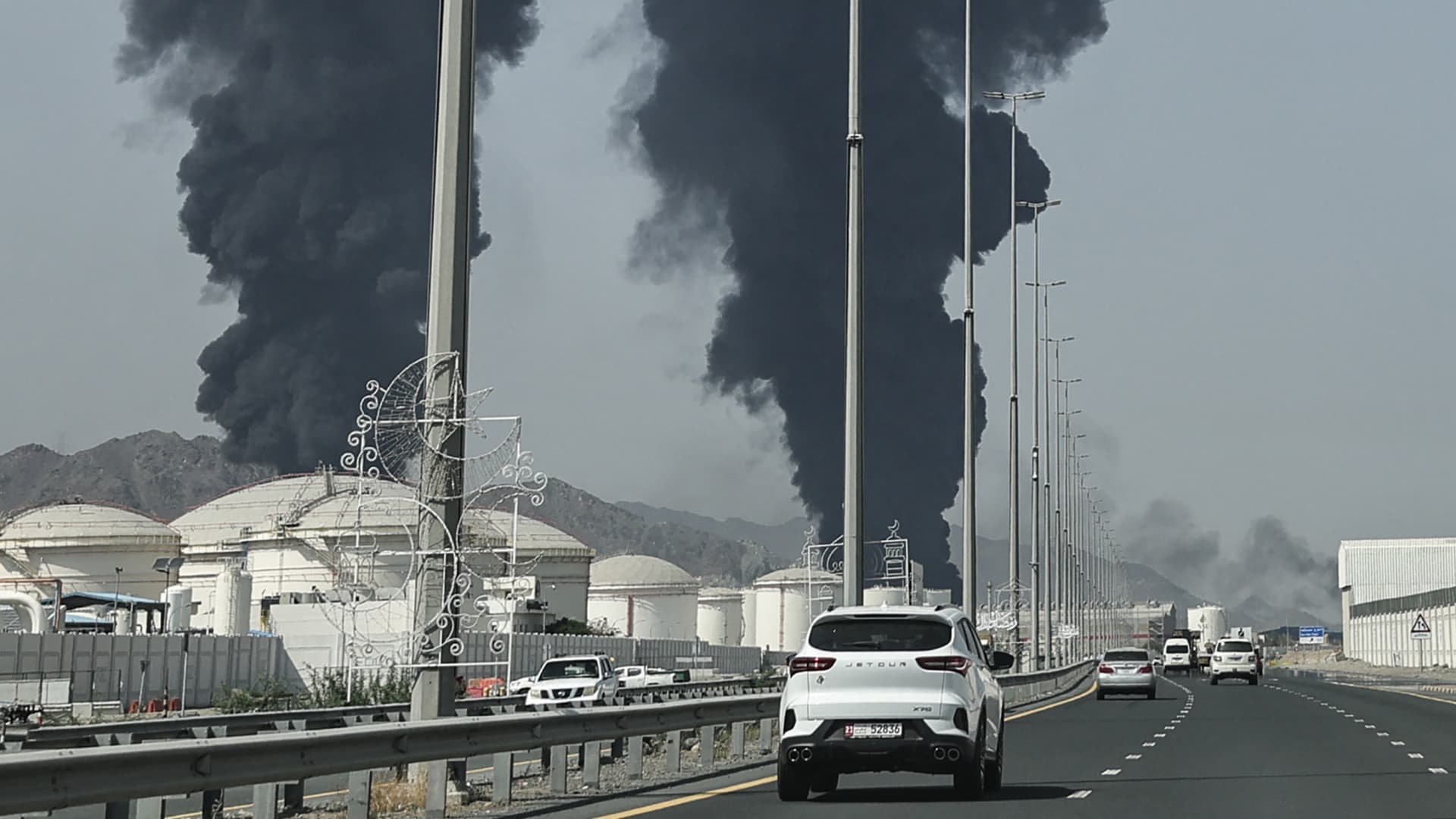
The global oil market is once again navigating a treacherous geopolitical landscape, with an incident in Fujairah, a critical maritime hub in the United Arab Emirates, sending fresh ripples of supply uncertainty across the investment community. Reports of a fire and subsequent suspension of some oil-loading operations, following a drone interception, underscore the fragility of supply chains in the Persian Gulf. This event, occurring closely after U.S. military actions against Iranian targets, including the vital Kharg Island, highlights the escalating risks for energy investors as regional tensions intensify, demanding a sharp focus on both immediate price reactions and forward-looking indicators.
Fujairah Incident: Immediate Supply Implications and Market Reaction
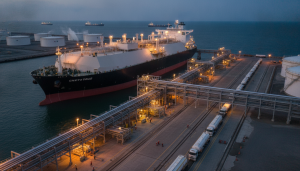
The reported fire in Fujairah, attributed to falling debris from a drone interception, has cast an immediate spotlight on the UAE’s role in global oil logistics. Fujairah is not merely a regional port; it stands as a cornerstone bunkering hub and a key point for crude and refined product loading, bypassing the Strait of Hormuz. While official confirmation from ADNOC has been pending, industry and trade sources have indicated a halt to some loading activities, signaling a tangible, albeit potentially short-lived, disruption. The timing is particularly sensitive, given the preceding U.S. military strikes on Iran’s Kharg Island, amplifying market anxiety about regional stability. As of today, Brent Crude trades at $92.96 per barrel, reflecting a slight dip of 0.3% within a day range of $92.57-$94.21, while WTI Crude stands at $89.36, also down 0.35% for the day. This current market snapshot shows a modest retreat, yet it’s crucial to note Brent’s broader trajectory; the global benchmark has seen a decline from $101.16 on April 1st to $94.09 on April 21st, a 7% drop. This recent price softening suggests that the market, while sensitive to geopolitical shocks, is also factoring in other supply/demand dynamics, but the Fujairah incident injects a fresh geopolitical premium into an already volatile equation, potentially limiting further downside.
Escalating Regional Tensions and the “Oil Lifeline” Threat
The Fujairah incident cannot be viewed in isolation; it is intricately linked to a broader pattern of escalating U.S.-Iran confrontation. U.S. President Donald Trump confirmed directing strikes against military targets on Iran’s Kharg Island, a site he explicitly stated was not “wiped out” in terms of its oil infrastructure. However, the very act of targeting this island, often dubbed Iran’s “oil lifeline” due to its strategic importance in crude exports, sends a potent message. Iran’s Islamic Revolutionary Guard Corps quickly responded, declaring U.S. interests in the UAE, including ports and military locations, as legitimate targets. This tit-for-tat escalation significantly elevates the risk profile for oil transit and production in the entire Gulf region. The prospect of any direct move against Kharg Island has long been considered an extremely high-risk scenario, both geopolitically and economically, given its critical function for Iranian oil exports. For investors, this creates a challenging environment where the probability of further supply disruptions, whether accidental or intentional, remains elevated, keeping a floor under prices despite any short-term market corrections.
Navigating Uncertainty: Investor Focus and Upcoming Market Signals
In this climate of heightened geopolitical risk, our readers are actively seeking clarity on market direction. Questions like “Is WTI going up or down?” or “What do you predict the price of oil per barrel will be by the end of 2026?” underscore the pressing need for forward-looking analysis. While immediate geopolitical events drive short-term volatility, smart investors recognize the importance of fundamental data to inform their long-term strategies. The coming weeks will bring a series of crucial data releases that will interact with and potentially temper or amplify the geopolitical premium. This Wednesday, April 22nd, the EIA Weekly Petroleum Status Report will offer insights into U.S. crude inventories, refinery activity, and demand, providing a snapshot of domestic supply-demand balances. Following that, the Baker Hughes Rig Count on Friday, April 24th, will give an indication of future U.S. production trends. As we move into the end of April and early May, further API and EIA inventory reports will continue to paint a detailed picture, culminating in the EIA Short-Term Energy Outlook on May 2nd. These scheduled events will be critical for investors to gauge underlying market health and assess whether fundamental supply-demand dynamics can absorb or mitigate the impact of ongoing geopolitical tensions.
For investors attempting to predict oil prices for the remainder of 2026, the interplay between these fundamental data points and the unpredictable geopolitical landscape will be paramount. While the Fujairah incident and the Kharg Island strikes inject significant uncertainty, the market’s ability to process and price in these risks will be heavily influenced by inventory builds or draws, and the pace of global demand recovery. A diversified approach, attentive to both immediate news flows and the consistent rhythm of market data releases, remains the most prudent strategy.