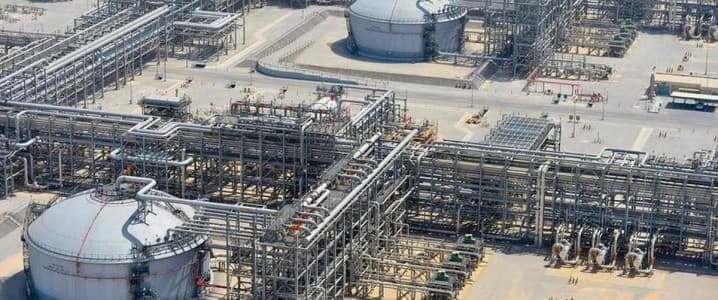
Saudi Arabia was regarded for decades as the ‘global swing oil producer’, able to quickly decrease or increase its oil flows to respectively raise or lower world oil prices. Riyadh has long perpetuated this idea, with grandiose claims about the Kingdom’s crude oil reserves and resultant spare capacity. After two of its key oil installations were hit by rockets from the Iran-backed Houthis back in 2019, it also highlighted that its capacity to recover from such shocks was also extremely quick. So, with the world facing continued spikes in oil prices the longer the current U.S./Israel-Iran conflict persists, what can this global oil powerhouse really do to help keep them subdued?
Given Iran’s targeting last week of Saudi Arabia’s Ras Tanura refinery — the Kingdom’s largest, with crude refining capacity of around 550,000 barrels per day (bpd) — the immediate question is how quickly the country could respond to a successful attack on its key oil infrastructure, as it saw back in 2019? In the recent strikes on Ras Tanura, most of the drones were intercepted, although the refinery was shut temporarily as a precaution, but this and other refineries will almost certainly be in Iran’s sights for further attacks. At the time of the Houthi attacks in 2019 on Saudi Arabia’s Abqaiq and Khurais oil processing units, as analysed in full in my latest book on the new global oil market order, the two facilities together represented around 50% of Saudi Arabia’s oil production, or about 5% of global oil supply. Following the rocket strikes on them, global oil prices spiked by up to 20%.
Related: Little-Known US Company Lands Important Pentagon Contract in Rare Earth Race

The lessons of the immediate aftermath of those 2019 attacks were startling, in several respects for oil traders and analysts alike. Firstly, Saudi Arabia’s new oil minister at that time (and currently still in position), Prince Abdulaziz bin Salman stated that the Kingdom planned to restore its “production capacity” to 11 million bpd by the end of September and recover its “full capacity” of 12 million bpd two months later. As one senior London-based oil industry analyst exclusively told OilPrice.com at the time: “The Saudi statements may not contain any direct falsehoods as such but nor are they being entirely fulsome with the truth.” He added: “It is extremely telling that he speaks of ‘capacity’ and later of ‘supply to the market’, as these are terms that Saudi tends to use in order to avoid talking about actual production, as capacity and supply are not the same thing at all as actual production at the wellheads.” He concluded: “What Saudi Arabia is trying to do by not revealing the true picture is to protect its reputation as a reliable oil supplier, especially to its target clientele in Asia, so we have to take all of these comments with a hefty pinch of salt.”
The truth, as exclusively revealed by OilPrice.com at the time, and fully detailed in my book on the new global oil market order, is that these comments sought to obfuscate the far from world-leading oil figures that Saudi Arabia has always sought to project, for the simple reason that its sole lever of power in the world derives for its oil sector, so the bigger this is seen to be, the better for Riyadh. So, on the first claim that Saudi Arabia has production capacity of 11 million bpd: it averaged crude oil production of just 8.151 million bpd from 1973 to 14 September 2019. It had never produced anywhere near 12 million bpd at that point and had only briefly averaged 11 million bpd once — in November 2018, at 11.093 million bpd. Little has changed since then, with average Saudi Arabian crude oil production from 1973 to the close of business yesterday being 8,303,070 bpd.
Related: No Missiles, No Drones: What Happens When Rare Earths Stop Flowing?
These figures also highlight that the spare capacity stated by the Saudis up to that point, and beyond, of 12-13 million bpd is also wishful thinking. Anecdotally, as one senior Geneva-based oil trader exclusively told OilPrice.com at the time: “If the Saudis really had those barrels spare, they’d have used them when they were in a battle for survival in the 2014-2016 price war with the U.S. to force prices even lower, but they didn’t because they couldn’t.” More technically, the Energy Information Agency defines ‘spare capacity’ specifically as production that can be brought online within 30 days and sustained for at least 90 days. Even Saudi Arabia has since admitted that it would need at least 90 days to move rigs to drill new wells and raise production in any meaningful way. In the aftermath of the 2019 attacks, according to the London source, Riyadh obfuscated this problem by employing a variety of tactics. “The Saudis drew down supplies to its domestic industry and reduced the amounts it sent to domestic refineries – with one big refinery, SASREF, conveniently bringing forward its planned maintenance a year early.” He added: “Saudi also aggressively bought Iraqi oil through brokers, which is close to Saudi’s export grades, which is somewhat ironic as a lot of this Iraqi oil is actually Iranian oil, which was the organiser of the attacks against it in the first place.”
None of this would be surprising if the fantastical claims of Saudi Arabia’s crude oil reserves were widely appreciated, as also analysed in full in my latest book on the new global oil market order. Specifically, at the beginning of 1989, Saudi Arabia’s claimed proven oil reserves were 170 billion barrels, but only a year later — without the discovery of any major new oil fields or major verified reappraisals of reserves at existing fields — the official estimate somehow grew by 51.2%, to 257 billion barrels. Shortly after that, and again without any major discoveries, Saudi Arabia’s proven reserves increased to just over 266 billion barrels, and they rose once more in 2017 to 268.5 billion barrels. Over the period in which these increases were announced, the country was extracting an average of 8.162 million bpd. Therefore, from 1990 (the year in which Saudi Arabia’s claimed proven oil reserves jumped from 170 billion barrels to 257 billion barrels), to 2017 (the year when Saudi Arabia was claiming proven oil reserves of 268.5 billion barrels), the Kingdom had physically removed from the ground forever an average of just over 2.979 billion barrels of crude oil every year. The total amount of crude oil permanently removed from the beginning of 1990 to the beginning of 2017 was, therefore, 80.43 billion barrels. In short, from 1990 to 2017, Saudi Arabia’s official crude oil reserves number had gone up 98.5 billion barrels, despite there being no new oil finds and it physically removing 80.43 billion barrels forever.
Washington, of course, knows all of this, and understands that Riyadh’s ability to help keep oil prices down through meaningfully increasing its own production is absolutely zero. That said, Saudi Arabia has been earmarked for some time to play a crucial role in Trump’s vision of the Middle East, in a post-militant-Islamic-Iran world. The broad strategic foundation for this world is the resuscitation of U.S.-brokered ‘relationship normalisation’ deals between key Arab states and Israel. These ‘Abraham Accords’ had started being rolled out in Trump’s first term as president, with the UAE being the first major Middle Eastern Arab state to sign in August 2020. These, in turn, had been promulgated by Trump’s administration as a means of beginning to reverse the expanding influence of China and Russia across the region following the U.S.’s unilateral withdrawal from the Joint Comprehensive Plan of Action (JCPOA, colloquially ‘the nuclear deal’) with Iran in May 2018, as also fully detailed in my latest book. The ouster from office of Trump in 2021 derailed this Abraham Accords-led plan and eventually resulted in the extraordinary relationship resumption deal between key Shia power Iran and key Sunni power Saudi Arabia being signed on 10 March 2023 – brokered by China.
However, Trump made it clear during his campaigning for his second term that he favoured a resumption of the Abraham Accords, including one between Israel and Saudi Arabia. The US hope had been that Saudi Arabia – Iran’s longstanding rival in the region – might publicly signal its support for the relationship normalisation deals initiative and eventually make such a deal itself after current Crown Prince Mohammed bin Salman succeeded to the throne. This fitted in with the widely held view that he was far more sympathetic to the agreement than his father, King Salman. An indication that such a deal with Saudi Arabia might take place came when Saudi Foreign Minister, Prince Faisal bin Farhan, cautiously welcomed the Israel-UAE agreement, saying: “It could be viewed as positive.” It is also apposite to note that back in 2002, it had been the Saudis who had launched the ‘Crown Prince Abdullah Peace Plan’ at the Beirut Arab summit, offering Israel full recognition in exchange for a return to its pre-1967 borders.
By Simon Watkins for Oilprice.com
More Top Reads From Oilprice.com