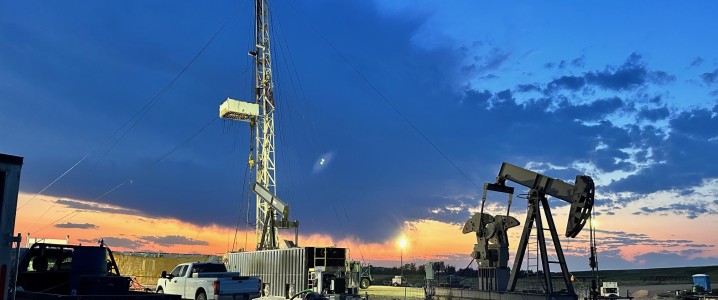
The US oil and gas landscape is sending mixed signals to investors, as a modest uptick in drilling activity emerges against a backdrop of fluctuating crude prices and a slight dip in overall domestic production. While WTI crude has seen significant volatility recently, prompting some cautious re-engagement from producers, the market remains characterized by a delicate balance of supply response, geopolitical tension, and demand uncertainties. For investors navigating this complex environment, understanding the nuances of drilling trends and upcoming data points is crucial for informed decision-making.
US Rig Count Sees Modest Growth Amidst Broader Downtrend
Fresh industry data indicates a slight increase in active drilling rigs across the United States. The total number of active oil and gas rigs rose to 551 this week. Delving deeper into the numbers, active oil rigs climbed by 4, reaching a total of 411, while gas rigs saw a decrease of 2, settling at 132. The miscellaneous rig count held steady at 8. While any increase might seem positive, it’s vital for investors to consider the broader context: the current total rig count remains 41 rigs below levels observed this time last year, and oil-specific rigs are down by 75 year-over-year. This suggests that while producers are beginning to react to price signals, the recovery in drilling activity is far from robust or pre-pandemic levels.
Regionally, the Permian Basin, a bellwether for US shale activity, added 1 rig, bringing its total to 241, though this is still 63 rigs fewer than a year ago. The Eagle Ford shale also showed some life, increasing its count by 3 to 43 active rigs, a modest gain that still leaves it 6 rigs shy of its year-ago figure. Complementing the drilling data, our proprietary insights reveal a continued push in well completion efforts. The Frac Spread Count, an essential indicator of wells being brought online, rose by 7 crews for the week ending February 27th, following an identical gain the week prior. This sustained increase in completion activity suggests that while new drilling is cautious, producers are actively working through their drilled but uncompleted (DUC) well inventory, aiming to capitalize on improved pricing.
Crude Price Volatility Dictates Cautious Investment
The recent swings in crude oil prices are undoubtedly influencing producer sentiment and capital allocation. As of today, Brent Crude trades at $92.77 per barrel, reflecting a -0.5% decrease on the day, with its range fluctuating between $92.57 and $94.21. Similarly, WTI Crude stands at $89.24 per barrel, down 0.48% for the day, having traded between $88.76 and $90.71. This current dip follows a period of significant volatility. Our 14-day Brent trend data indicates a notable correction, with prices falling by $7.07, or 7%, from $101.16 on April 1st to $94.09 on April 21st. This downward momentum, despite earlier surges, underscores the market’s sensitivity to geopolitical developments and supply-demand perceptions.
Historically, US drilling activity exhibits a lag in response to oil price spikes. Producers typically wait several months to ascertain the sustainability of higher prices before committing substantial new capital to drilling programs. This cautious approach is prudent, given the substantial upfront investment required for new wells and the inherent uncertainty in long-term price forecasts. The recent modest increase in rig counts, even after significant price movements, aligns with this historical pattern. It suggests that while current prices are attractive enough to encourage some activity, the broader industry remains hesitant to unleash a torrent of new supply without clearer signals of sustained market strength.
Navigating Future Supply-Demand Dynamics: What Investors Are Asking
Our proprietary reader intent data highlights key questions on the minds of investors this week, reflecting a deep concern about market direction. Many are asking, “is WTI going up or down?” and “what do you predict the price of oil per barrel will be by end of 2026?” These questions underscore the prevailing uncertainty and the critical need for forward-looking analysis. While the modest increase in US rig counts signals a potential supply response, the latest EIA data shows a slight counter-trend: weekly U.S. crude oil production actually fell by 6,000 bpd in the week ending February 27th, averaging 13.696 million bpd. This figure places production 166,000 bpd below the all-time high, suggesting that despite increased drilling and completion activity, overall production is not yet showing a consistent upward trajectory.
This paradox – rising rig counts and frac spreads alongside a dip in weekly production – indicates that either new wells are taking time to come online, or decline rates from existing wells are significant, requiring continuous drilling simply to maintain output. The market’s supply-demand balance is further complicated by recent production curtailments from Iraq and Kuwait, driven by storage constraints. For investors seeking clarity, the interplay of these factors will dictate future price movements. The cautious ramp-up in US drilling activity is a critical component of the global supply picture, but its impact must be weighed against ongoing geopolitical factors and the inherent operational lag in bringing new production to market.
Key Upcoming Events to Shape the Investment Outlook
For investors seeking to position themselves strategically, the coming weeks are packed with crucial data releases that will provide further clarity on market fundamentals and potential price trajectories. We encourage close monitoring of the EIA Weekly Petroleum Status Reports, scheduled for April 22nd, April 29th, and May 6th. These reports offer granular detail on U.S. crude oil inventories, refinery inputs, and product supplied, providing an up-to-the-minute snapshot of domestic supply and demand dynamics. Any significant deviation from expectations in these reports could trigger immediate market reactions.
Equally important for gauging the pace of US production growth are the upcoming Baker Hughes Rig Count reports on April 24th and May 1st. These will confirm whether the recent modest increase in active rigs is a nascent trend or merely a temporary blip. A sustained increase would signal growing confidence among producers, while a reversal could indicate renewed caution. Furthermore, the EIA’s Short-Term Energy Outlook, due on May 2nd, will offer a comprehensive forecast for crude oil, natural gas, and refined products through 2027, providing essential long-term guidance for investment strategies. By meticulously tracking these events and integrating them with our proprietary data, investors can gain a crucial edge in anticipating market shifts and optimizing their portfolios in the dynamic oil and gas sector.