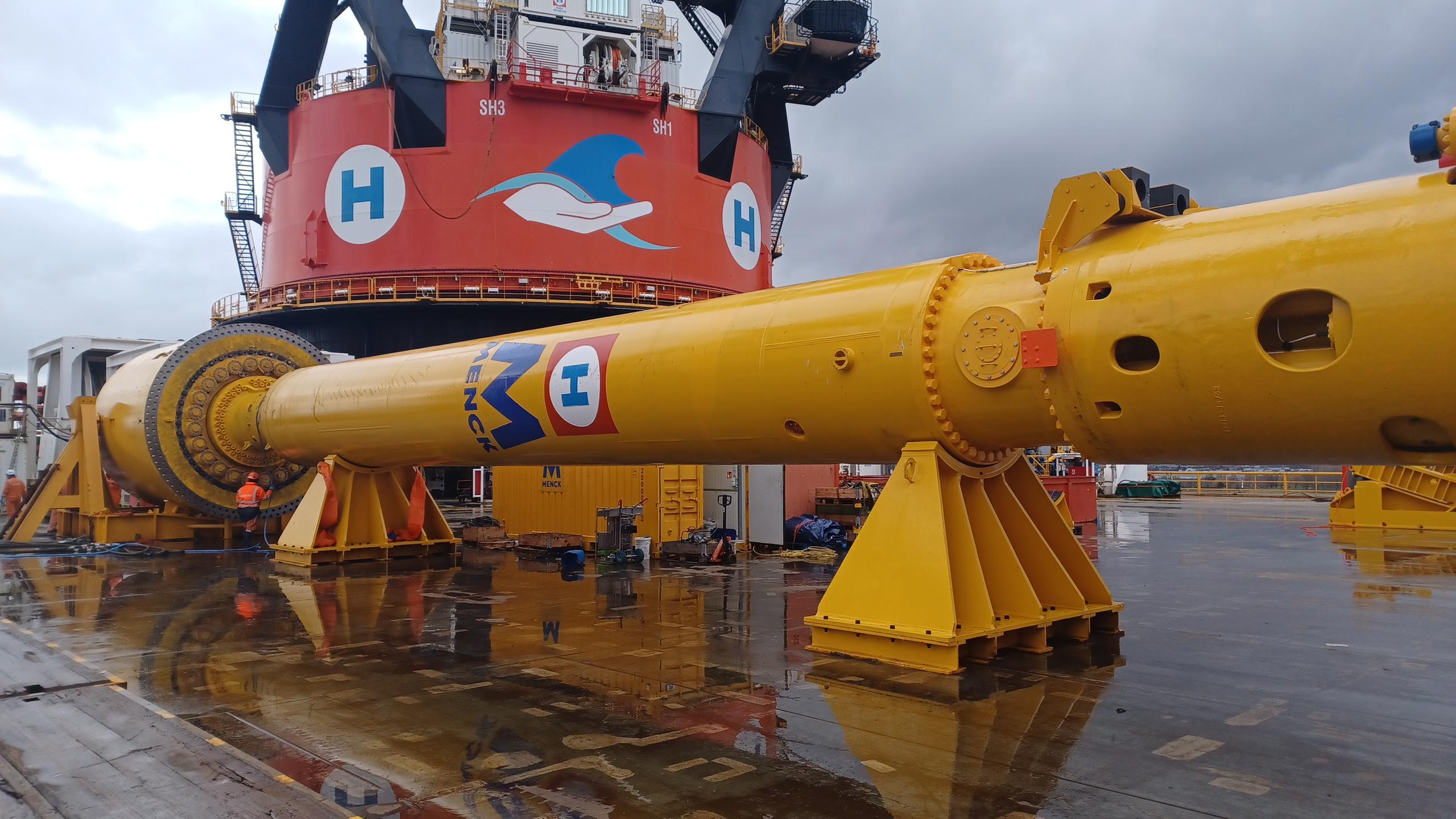
Strategic Investment Amplifies Heerema’s Offshore Capabilities
In a significant move for the offshore energy sector, Heerema Marine Contractors has taken delivery of the first MHU4400S hydraulic hammer system from Acteon’s Marine Foundations business line, Menck. This delivery, part of a multi-million-pound, two-hammer contract, represents a strategic enhancement of Heerema’s capabilities in offshore foundation installation and pile-driving operations. For investors tracking the intricate dynamics of energy infrastructure, this development signals a commitment to efficiency, environmental stewardship, and long-term project viability within a perpetually evolving market landscape. As global energy demand continues to pressure existing infrastructure and spur new developments, the quality and technological edge of service providers like Heerema become critical differentiators, influencing project timelines, costs, and ultimately, returns.
Advanced Technology Driving Operational Excellence and Environmental Compliance
The newly delivered MHU4400S hammer system is not merely an addition to Heerema’s fleet; it’s an upgrade designed to set new standards in offshore construction. Equipped with global navigation satellite system (GNSS) capability, the system offers unparalleled precision in placement, a vital factor in complex offshore environments. Furthermore, the integration of Menck Noise Reduction Units (MNRU) directly addresses the increasing scrutiny on environmental impact during offshore piling campaigns. This noise-mitigation technology is crucial for meeting stringent environmental compliance requirements, which are becoming non-negotiable for securing project approvals and maintaining social license to operate. The focus on reducing environmental footprint, alongside enhancing operational performance, reflects a broader industry trend where sustainability is no longer a luxury but a core component of competitive advantage. The fact that these systems are designed to seamlessly integrate with Heerema’s existing power, control, and lifting infrastructure underscores a thoughtful, long-term capital expenditure strategy, minimizing disruption while maximizing the benefits of technological advancement. The second MHU4400S hammer, slated for delivery in October 2027, further reinforces Heerema’s phased expansion plan to support an anticipated pipeline of future offshore installation projects.
Navigating Market Volatility with Strategic Capital Allocation
Heerema’s substantial investment comes at a fascinating juncture for the broader energy markets. As of today, Brent Crude trades at $90.38, a figure that reflects a considerable degree of recent market volatility. Over the past fourteen days alone, Brent has seen a significant downward correction, dropping from $112.78 on March 30th to its current level, representing a nearly 20% decline. This kind of price movement naturally prompts questions from investors, with many asking whether WTI, currently at $82.59, is poised for further upward or downward movement. Despite this short-term uncertainty and the daily price swings, strategic investments like Heerema’s underscore a foundational belief in the long-term demand for offshore energy infrastructure and services. While daily trading signals may fluctuate, the multi-year lifecycle of offshore projects necessitates a stable, high-performance equipment base. This capital allocation in advanced systems during periods of market flux signals confidence in sustained project sanctioning and execution, demonstrating that even as gasoline prices hover around $2.93, the underlying need for robust offshore capabilities remains undiminished. Such investments are insulated, to a degree, from immediate commodity price fluctuations, reflecting a focus on operational efficiency and competitive positioning that transcends short-term market noise.
Upcoming Energy Catalysts and the Offshore Outlook
Looking ahead, the next few weeks are packed with events that could shape the near-term energy market, indirectly influencing the pace and type of projects that will eventually require Heerema’s advanced services. On April 20th, the OPEC+ JMMC Meeting will set the tone for production policies, followed by the main OPEC+ Ministerial Meeting on April 25th. Any decisions around supply management will impact global crude balances and, consequently, the economics of offshore exploration and production projects. Furthermore, the regular API Weekly Crude Inventory reports (April 21st, April 28th) and EIA Weekly Petroleum Status Reports (April 22nd, April 29th) will provide crucial insights into demand trends and inventory levels in key markets. The Baker Hughes Rig Count updates (April 24th, May 1st) will offer a snapshot of drilling activity, which, while more focused on onshore operations, can be a bellwether for broader industry sentiment and capital expenditure trends that eventually ripple into the offshore sector. Heerema’s investment, with the second hammer arriving in October 2027, aligns with a long-term view that future offshore projects, whether traditional oil and gas or the rapidly expanding offshore wind sector, will require superior installation capabilities. These macroeconomic and industry-specific events, though seemingly removed from the physical delivery of equipment, collectively form the backdrop against which future offshore project decisions are made, validating the foresight behind Heerema’s strategic expansion.
Investor Focus: Long-Term Value in Specialized Services
The persistent investor question, “what do you predict the price of oil per barrel will be by end of 2026?”, highlights the deep uncertainty many feel regarding future commodity prices. However, for astute investors, the focus should extend beyond mere price predictions to the underlying strength and strategic positioning of key service providers. Heerema’s investment in state-of-the-art hydraulic hammer systems speaks directly to this. Companies that proactively invest in advanced, more efficient, and environmentally compliant technology are better positioned to secure lucrative contracts, maintain higher utilization rates, and command premium pricing for their specialized services, regardless of the precise trajectory of Brent or WTI. These capabilities de-risk projects for energy developers, offering faster completion times and reduced environmental liabilities, making them preferred partners. In a capital-intensive industry, the ability to deliver projects more efficiently and sustainably translates directly into improved margins and a stronger competitive moat. Therefore, while commodity prices will always be a factor, the long-term value creation in the offshore services segment often stems from operational excellence and technological leadership, qualities that Heerema’s latest acquisition clearly exemplifies.