The Dollar’s Enduring Appeal Amidst Geopolitical Turbulence
The escalating conflict involving Iran has once again cast a long shadow over global markets, reigniting discussions around energy security, inflation, and the enduring role of the US dollar as a safe-haven asset. As geopolitical tensions simmer, the immediate response from investors often involves a flight to perceived safety, and historically, the dollar has been a primary beneficiary. This analysis delves into the intricate interplay of energy prices, monetary policy, and capital flows, examining why the greenback is experiencing a resurgence and what factors will dictate the sustainability of this rally in the face of ongoing Middle East instability. Crucially, the United States’ unique position of energy independence offers a significant buffer, contrasting sharply with the energy vulnerabilities of Europe and Asia, thereby strengthening its economic resilience and the dollar’s appeal.
Crude Volatility and the Dollar’s Ascent: A Current Market Snapshot
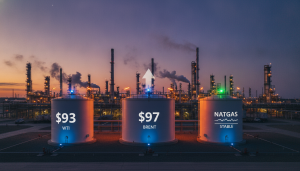
Geopolitical shocks invariably send ripples through the energy complex, and the current situation is no exception. As of today, Brent Crude trades at $93.57, reflecting a modest daily gain of 0.35% within a day range of $93.49 to $94.21. Similarly, WTI Crude stands at $90.12, up 0.5% with its daily range between $89.71 and $90.71. While these daily movements appear contained, it’s vital to place them in context: our proprietary data reveals Brent Crude has experienced a notable decline over the past two weeks, falling over 7% from $101.16 on April 1st to $94.09 on April 21st. This recent dip, however, should not obscure the underlying sensitivity to supply risks. A historical precedent for this dynamic can be found in the wake of Russia’s 2022 invasion of Ukraine, which propelled crude prices above $100 per barrel for three months and ushered in a period of sustained dollar strength against the euro and yen. The prospect of prolonged conflict in the Middle East, with its potential to disrupt critical shipping lanes and production, suggests that energy price squeezes and supply chain disruptions could become a persistent threat, fueling inflationary pressures that inevitably bolster the dollar’s safe-haven status.
Interest Rate Policy and Investor Reallocation: Addressing Market Concerns
The specter of persistent inflation, exacerbated by higher energy prices from geopolitical tensions, places the Federal Reserve in a precarious position regarding interest rate policy. Many investors have already priced in upcoming interest rate cuts by the Fed, but a prolonged period of elevated energy costs and supply chain disruptions could compel the central bank to adopt a more cautious, hawkish stance. High-interest-rate environments are generally positive for currency strength, meaning a market correction could be on the horizon for those anticipating immediate rate reductions. Our proprietary reader intent data underscores this market anxiety; investors are actively questioning the future direction of crude, with many asking, “Is WTI going up or down?” and “What do you predict the price of oil per barrel will be by end of 2026?” These questions highlight a significant degree of uncertainty, and the Fed’s rate decisions are central to answering these concerns. Furthermore, the prospect of sustained higher rates and a potential reversal of portfolio flows from emerging markets could encourage investors to look closer to home, directing capital back into dollar-denominated assets and further strengthening the greenback in a classic “flight to quality” scenario.
Navigating the Path Ahead: Upcoming Events and Policy Clarity
For investors seeking to understand the trajectory of both energy markets and the US dollar, a keen eye on upcoming data and policy signals is paramount. The immediate future holds several key energy events that will provide critical insights. Investors should closely monitor the EIA Weekly Petroleum Status Reports scheduled for April 22nd and April 29th, as these releases offer crucial data on crude inventories, demand, and refinery activity. Further clarity on supply dynamics will come from the Baker Hughes Rig Count reports on April 24th and May 1st, providing a real-time pulse on drilling activity and future production trends. Additionally, the API Weekly Crude Inventory reports on April 28th and May 5th will offer early indicators of inventory shifts. Crucially, the EIA Short-Term Energy Outlook on May 2nd will deliver updated projections on supply, demand, and prices, directly addressing investor questions about where crude prices might settle by the end of 2026. Beyond these energy-specific data points, the sustainability of the dollar’s rally hinges significantly on policy clarity. Forex markets will be looking for decisiveness from the US government on its foreign policy stance and clear indications from the Federal Reserve regarding its approach to interest rates, particularly given the short-lived dollar resurgence observed in mid-2025 due to domestic policy uncertainty.
Long-Term Horizon: De-dollarization and Evolving Financial Structures
While the immediate future appears to favor the dollar as a safe haven amidst geopolitical turmoil, investors must also consider potential long-term headwinds. The concept of de-dollarization, while a gradual process, could see an acceleration in the wake of persistent Middle East conflicts. The increasing sophistication of technological solutions now supports new financial structures, potentially lowering global reliance on the greenback as the world’s primary reserve currency and opening the door to capital outflows. For instance, the European Central Bank’s renewed focus on repurchase agreements and its initiative to lend euros to other central banks in crisis scenarios signals a strategic effort to bolster the euro’s international role. This evolving landscape suggests that while the dollar may experience short-term strength driven by immediate geopolitical risks, its long-term dominance and safe-haven status face fundamental challenges from a diversifying global financial architecture.