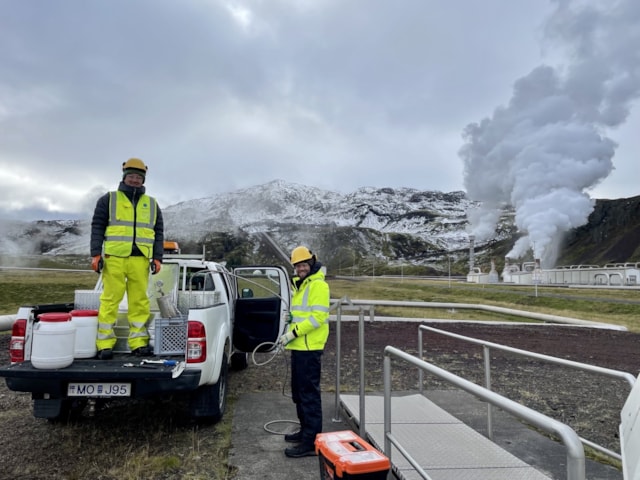
The global energy landscape is undergoing a profound transformation, driven by an imperative to decarbonize while simultaneously meeting robust energy demand. For investors navigating this complex environment, identifying technologies that offer both environmental efficacy and economic viability is paramount. A recent scientific validation out of Iceland, focusing on the permanent storage of captured CO2 within volcanic basalt, presents a significant step forward in the carbon capture, utilization, and storage (CCUS) ecosystem. This breakthrough doesn’t just advance the science; it fundamentally shifts the risk profile and investment attractiveness of large-scale carbon removal, particularly for hard-to-abate industries, by proving a simpler, more verifiable, and cost-effective monitoring approach.
De-Risking Carbon Storage: The Icelandic Breakthrough and Investor Confidence
The core challenge for widespread adoption of Carbon Capture and Storage (CCS) has always been proving permanence and ensuring cost-effective monitoring, reporting, and verification (MRV). The latest research, building on work by mineralisation operator Carbfix, directly addresses this by demonstrating that injected CO2 can be successfully locked away as stable carbonate minerals within basalt rock. Crucially, the study confirms that natural chemical “fingerprints” within the CO2 and water itself can be used to track this transformation from gas to solid. This eliminates the need for expensive artificial tracers, simplifying the MRV process and significantly reducing operational costs as projects scale. For investors, this is a game-changer. It offers a robust, low-intervention method to demonstrate regulatory compliance and long-term security, bolstering confidence in the permanence of CO2 removal. This permanence is also expected to elevate the value of associated carbon removal credits, potentially commanding higher prices than more transient, nature-based solutions that often promise storage for only a century or less.
Navigating Volatility: Traditional Oil Markets and CCS Investment
While the long-term promise of CCS is clear, investors are simultaneously grappling with the immediate dynamics of traditional energy markets. As of today, Brent Crude trades at $93.9 per barrel, showing a modest increase of 0.71% within a day range of $93.52 to $94.21. WTI Crude follows suit at $90.38, up 0.79% in a range of $89.71 to $90.7. However, this recent stability masks significant volatility experienced over the last two weeks. Brent, for instance, saw a sharp decline from $118.35 on March 31st to $94.86 on April 20th, representing a substantial 19.8% drop. This kind of rapid fluctuation keeps investors on edge, evidenced by the frequent queries we observe regarding price direction, such as “is WTI going up or down?” and “what do you predict the price of oil per barrel will be by end of 2026?” This volatility in traditional oil and gas markets has a dual impact on CCS investment. On one hand, sustained high oil prices can generate significant free cash flow for major energy companies, enabling them to fund diversification into decarbonization technologies like CCS. On the other hand, price uncertainty can lead to capital expenditure conservatism, making projects that offer clear de-risking and cost reduction, like the validated Icelandic method, even more attractive. Investors are increasingly seeking assets that offer both environmental benefit and a resilient financial profile, irrespective of short-term commodity swings, underscoring the growing appeal of proven CCS solutions.
Scaling Solutions for Hard-to-Abate Industries
The implications of this simplified MRV approach extend directly to the scaling of CCS projects, particularly for “hard-to-abate” sectors. Industries like cement and steel production, which are critical to global infrastructure but notoriously emissions-intensive, desperately need viable decarbonization pathways. The enhanced ability to prove permanent CO2 storage, coupled with reduced monitoring costs, makes CCS a more compelling solution for these industries. This validation comes at a crucial time as global climate targets necessitate aggressive emissions reductions across all sectors. Major energy players, often asked about their long-term strategic shifts and diversification efforts – similar to investor interest in the performance of companies like Repsol – are increasingly allocating capital towards such solutions. The ability to offer a credible, permanent, and cost-efficient carbon removal service will be a key competitive advantage, not only for pure-play carbon tech firms but also for integrated energy companies looking to green their portfolios and provide solutions to their industrial clients. This technological leap provides a much-needed boost to the economic case for industrial CCS hubs, accelerating deployment and attracting further private investment.
Forward Outlook: Upcoming Catalysts and Long-Term Investment Signals
Looking ahead, while direct CCS-specific events are not on the immediate calendar, the broader energy market will provide crucial signals influencing the trajectory of carbon capture investments. Investors will closely monitor the OPEC+ JMMC Meeting on April 21st, as any supply adjustments will impact global oil prices and, by extension, the capital allocation strategies of major producers. The EIA Weekly Petroleum Status Reports (April 22nd and April 29th) and API Weekly Crude Inventory data (April 28th and May 5th) will offer insights into demand trends and inventory levels, feeding into short-term price expectations. Perhaps most pertinent for long-term strategic planning is the EIA Short-Term Energy Outlook on May 2nd. This report provides crucial forecasts on energy demand, supply, and policy, which can indirectly shape the regulatory environment and incentive structures for CCS. A clearer understanding of future energy mixes and governmental support for decarbonization will significantly influence investor decisions on capital deployment into carbon removal technologies. The validation of the Carbfix method, making CCS more transparent and economically viable, suggests that future policy frameworks are likely to increasingly favor such robust, verifiable solutions, thereby creating a more stable and attractive investment landscape for carbon sequestration for the rest of 2026 and beyond.