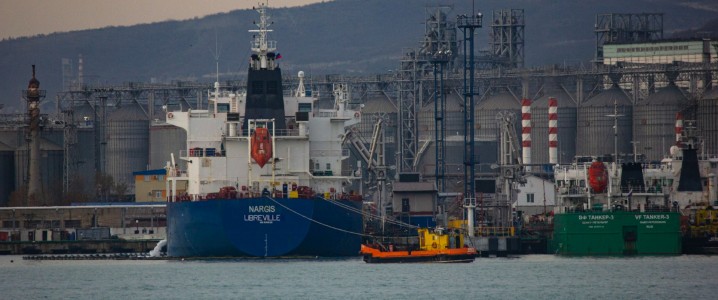
The recent drone strike on the Transneft Sheskharis loading terminal at Russia’s Novorossiysk port marks another critical escalation in the ongoing conflict’s impact on global energy infrastructure. This incident, which reportedly set a depot ablaze, immediately reignites concerns over Black Sea oil export stability. As a pivotal hub for Russian Urals and Siberian Light crude, as well as Kazakhstan Export Blend Crude Oil (KEBCO) via the nearby Caspian Pipeline Consortium (CPC) terminal, Novorossiysk’s disruption carries significant weight for global supply. For investors navigating volatile energy markets, understanding the ripple effects of such geopolitical events is paramount, particularly as these attacks become a recurring feature of the supply landscape.
Immediate Market Reaction and Persistent Black Sea Vulnerabilities
The attack on Novorossiysk’s oil infrastructure sends a clear signal of continued supply risk in a critical export corridor. This isn’t an isolated event; the Sheskharis terminal was struck in November last year, alongside other regional energy facilities like Tuapse and Temryuk. These incidents, compounded by severe winter storms in recent months, have repeatedly delayed loadings for key crude grades originating from the Black Sea, sometimes for weeks. As of today, Brent crude trades at $93.83, registering a 0.63% increase, while WTI crude stands at $90.43, up 0.85% for the day. This immediate upward price pressure suggests a market reacting to the fresh uncertainty, despite a broader trend where Brent has declined significantly from $118.35 on March 31st to $94.86 on April 20th. This daily uptick underscores how quickly geopolitical events can inject a risk premium, even against a backdrop of wider market adjustments.
Escalating Geopolitical Risk and Supply Chain Resilience
The intensification of strikes on Russian oil refineries, depots, and export terminals since the latter half of 2025 highlights a deliberate strategy to disrupt energy infrastructure. This tit-for-tat escalation also sees Russia targeting Ukraine’s gas-producing facilities and distribution networks. For investors, this pattern is not merely a series of isolated events but a systemic risk that must be integrated into long-term outlooks. The repeated targeting of strategic assets like Novorossiysk and the CPC terminal demonstrates a persistent vulnerability in a major global supply chain. While immediate physical damage might be contained, the psychological impact on traders and the increased insurance premiums for shipments from the region add tangible costs and uncertainty. Assessing the resilience of these supply chains against sustained pressure is crucial, as even short-term outages can ripple through the market, tightening prompt supplies and exacerbating price volatility.
Addressing Investor Sentiment and Future Price Trajectories
Our proprietary reader intent data from OilMarketCap.com reveals a clear investor focus on market direction, with common queries such as “is WTI going up or down?” frequently surfacing. This immediate concern over price movement is entirely understandable in the wake of events like the Novorossiysk strike. While specific price predictions for the end of 2026 remain complex, the persistent geopolitical risk highlighted by this incident suggests a resilient floor under crude prices, potentially countering some of the bearish sentiment observed in recent weeks. Investors are actively seeking clarity on how such disruptions, alongside broader macroeconomic factors, will shape the future value of their energy holdings. The sustained targeting of key export infrastructure introduces an inherent uncertainty that fuels hedging activity and prompts a re-evaluation of risk premiums across the crude complex. Understanding these underlying investor concerns is key to interpreting market reactions.
Navigating Upcoming Catalysts and Strategic Positioning
Beyond the immediate headlines, investors must closely monitor a series of upcoming energy events that will provide further clarity on market fundamentals and potential price shifts. The OPEC+ Joint Ministerial Monitoring Committee (JMMC) Meeting, scheduled for April 21st, is a critical near-term catalyst. Any signals from this meeting regarding production quotas, particularly in light of current supply disruptions, could significantly influence market sentiment. Following this, the EIA Weekly Petroleum Status Reports on April 22nd and April 29th will offer vital insights into U.S. crude inventories, which can either amplify or mitigate the impact of Black Sea supply concerns depending on their trajectory. Further insights into North American supply will come from the Baker Hughes Rig Count reports on April 24th and May 1st. Looking slightly further ahead, the EIA Short-Term Energy Outlook on May 2nd will provide a comprehensive forecast that will likely integrate the latest geopolitical developments and offer a revised global supply-demand balance. Astute investors will use these data points, combined with an ongoing assessment of geopolitical risk, to strategically position their portfolios in a market increasingly defined by unpredictable external shocks.


