The global oil market is currently navigating a complex confluence of geopolitical maneuvering and shifting trade dynamics, creating a significant oversupply in Asian waters. A burgeoning price war between two major producers, Russia and Iran, for critical market share in China is driving down crude values for specific grades and presenting both challenges and opportunities for investors. This deep dive will explore the factors contributing to this glut, its immediate market ramifications, and what upcoming events might signal for the future trajectory of oil prices and investment strategies.
The Anatomy of Asia’s Deepening Crude Discounts
The immediate catalyst for the current oversupply situation stems from a significant recalibration in Indian crude imports. India, a historically major buyer of Russian oil, is projected to reduce its uptake by as much as 40% from January levels, potentially bringing imports down to approximately 600,000 barrels per day. This substantial shift has unleashed a wave of displaced Russian cargoes onto the market, primarily redirecting them eastward into China. This redirection has intensified direct competition with Iranian crude suppliers, who have traditionally held a strong position with China’s independent refiners.
The result is a noticeable widening of discounts for these specific crude grades. Russian Urals is reportedly trading at around $12 per barrel below the ICE Brent benchmark, a significant increase from the $10 discount observed just last month. Similarly, Iranian Light crude is now being offered at discounts as deep as $11 per barrel below Brent, widening from the $8 to $9 range seen in December. As of today, Brent Crude trades at $93.86, showing a modest increase of 0.66% within a daily range of $89.11 to $95.53. This modest rebound, however, follows a pronounced downward trend, with Brent having dropped nearly 20% from $118.35 on March 31st to $94.86 on April 20th. This broader market weakness only amplifies the pressure on producers already forced into offering steep discounts to secure buyers for their specific crudes.
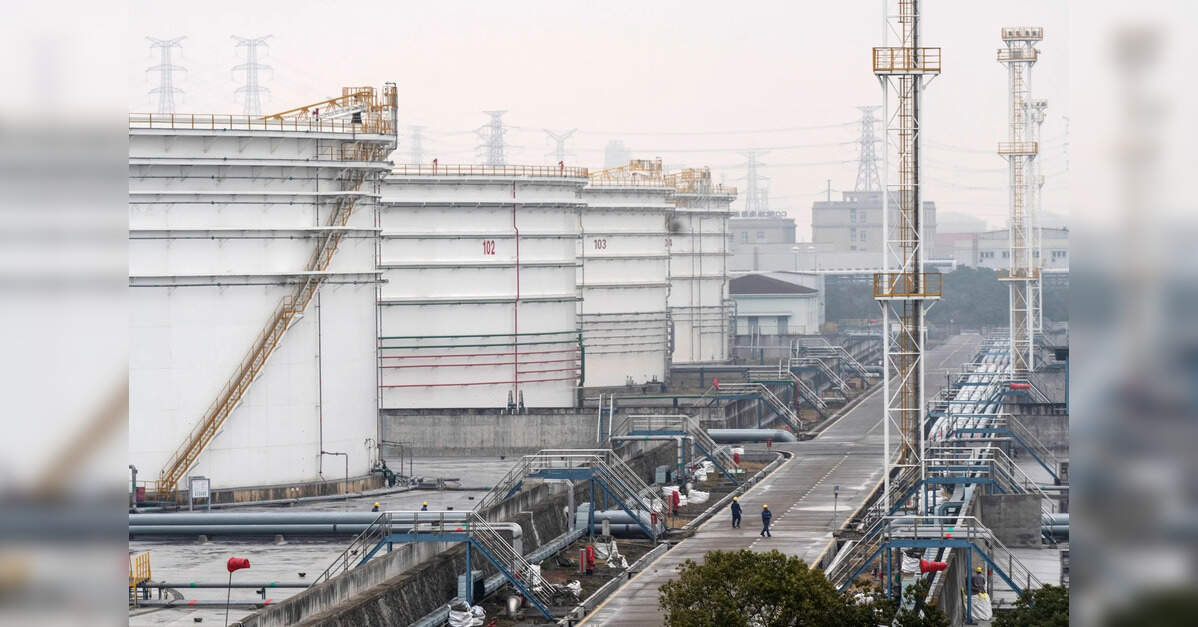
China’s independent refiners, colloquially known as “teapots,” have historically played a crucial role in absorbing barrels shunned by other buyers. However, their capacity is finite, accounting for roughly a quarter of China’s total processing capacity and operating under government-imposed import quotas. Analysts indicate that these private refiners are likely maxed out, struggling to fully absorb the influx of discounted crude. Consequently, significant volumes of unsold oil are now accumulating in Asian waters, highlighting the limited options remaining for both Russia and Iran.
Navigating Forward: Upcoming Catalysts and Strategic Shifts
The current oversupply dynamic has profound implications for the producing nations involved. Russia, already grappling with the economic demands of its conflict, has been compelled to curb output, directly impacting its revenue streams. Iran, meanwhile, is pushing to maximize its oil shipments, a strategy underscored by heightened geopolitical tensions and the looming possibility of further action from the United States. Neither nation can afford prolonged market share erosion or deep, sustained discounts.
Looking ahead, investors must closely monitor several key upcoming events that could significantly influence market sentiment and price direction. The OPEC+ Joint Ministerial Monitoring Committee (JMMC) Meeting on April 21st is a critical juncture. While not a full policy meeting, the JMMC’s commentary could signal the bloc’s stance on current production levels in the face of this localized glut. Any indication of further supply adjustments, or conversely, a steadfast commitment to existing quotas, will directly impact global benchmarks.
Beyond OPEC+, the weekly data releases will provide crucial insights into supply-demand balances. The EIA Weekly Petroleum Status Reports on April 22nd and April 29th will offer fresh data on U.S. crude inventories. Significant builds in these reports could exacerbate concerns about a global oversupply, even if the immediate problem is concentrated in Asia. Furthermore, the EIA’s Short-Term Energy Outlook on May 2nd will present updated forecasts for global supply, demand, and prices, providing a vital macro perspective on how long this “glut” might persist and its potential for broader market impact. These events will offer essential data points for investors assessing the durability of current price levels and the potential for a market rebalancing.
Investor Focus: Price Direction and Strategic Positioning
Our proprietary intent data reveals a clear preoccupation among investors: predicting future price direction. Queries such as “is WTI going up or down?” and “what do you predict the price of oil per barrel will be by end of 2026?” are consistently among the most frequent, underscoring significant uncertainty regarding oil’s trajectory. This heightened focus is particularly relevant given the nearly 20% decline in Brent prices over the last 14 days, from $118.35 on March 31st to $94.86 on April 20th, despite today’s minor recovery.
For investors, this environment demands a nuanced approach. Producers heavily reliant on selling discounted grades like Urals or Iranian Light will likely continue to experience severe margin compression, impacting their profitability and potentially their valuation. Conversely, refiners with the capacity and political leeway to access these cheaper feedstocks could see an uplift in their refining margins. However, even integrated majors, while more diversified, cannot remain entirely immune to sustained downward pressure on global benchmarks like Brent and WTI, which currently trades at $90.22.
The geopolitical dimension, particularly concerning Iran and potential U.S. actions, adds another layer of risk and uncertainty. Any escalation could disrupt supply or, paradoxically, create further opportunities for sanctioned barrels to find buyers at aggressive discounts. Investors should prioritize companies with robust balance sheets, diversified asset portfolios, and a clear strategy for navigating both price volatility and geopolitical risks. The ongoing tussle for market share in Asia is not merely a regional phenomenon; it is a powerful indicator of underlying supply imbalances that could shape the broader investment landscape for the remainder of the year.


