Geopolitical Tensions Drive Oil Volatility as Iran Strike Looms
The global oil market is once again gripped by geopolitical uncertainty as U.S. President Donald Trump publicly stated he is considering limited military strikes against Iran over its nuclear program. This revelation comes with a critical timeline: President Trump indicated a decision would be made within the next 10 to 15 days. Such a prospect immediately elevates the risk premium across energy markets, particularly given the strategic importance of the Middle East to global oil supply. For investors, understanding the nuanced market reactions, the potential impact on key chokepoints, and the upcoming data catalysts is paramount to navigating the heightened volatility that now defines the crude landscape.
Immediate Market Reaction: A Sharp Rebound Amidst Escalating Risk
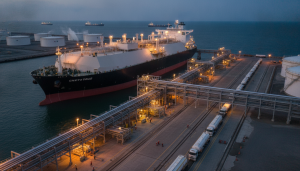
Our live market feeds paint a clear picture of today’s immediate reaction to the escalating tensions. As of today, April 21, 2026, Brent Crude is trading at $93.86 per barrel, marking a significant increase of +3.79% within the day’s range of $89.11-$95.53. Similarly, WTI Crude has seen a robust surge to $90.63 per barrel, up +3.67% and fluctuating between $85.50 and $92.23. This stands in stark contrast to the relative stability observed just prior to these recent announcements, and it’s a telling indicator of how quickly geopolitical fears can reprice risk. This daily rally also provides crucial context to the broader trend: our proprietary data shows Brent Crude had been on a downward trajectory, shedding nearly 20% from $118.35 on March 31 to $94.86 on April 20. Today’s upward swing, therefore, isn’t just a reaction to the news but potentially an amplified bounce from a recent dip, now supercharged by the sudden reintroduction of a significant geopolitical premium. The underlying concern for the market remains the potential for disruption in the Strait of Hormuz, a critical maritime chokepoint through which over 14 million barrels per day of oil and condensates flowed in 2025, representing roughly one-third of total worldwide seaborne oil exports.
Investor Focus: Pricing in Uncertainty and Seeking Direction
Our first-party reader intent data highlights a common sentiment among energy investors this week: a palpable desire for clarity on market direction. Questions like “Is WTI going up or down?” and “What do you predict the price of oil per barrel will be by end of 2026?” underscore the deep uncertainty surrounding current and future price movements. The ongoing military buildup in the Middle East, including the USS Abraham Lincoln aircraft carrier already stationed and the USS Gerald Ford en route, further amplifies these concerns. Investors are actively trying to quantify the risk of a potential conflict, which could severely impact the flow of crude from a region vital to global supply chains. The fact that approximately three-quarters of the oil passing through the Strait of Hormuz typically heads to major Asian economies like China, India, Japan, and South Korea means any disruption would have far-reaching economic consequences, moving beyond just the immediate price of crude. The next 10-15 days, leading up to President Trump’s decision, will be a period of intense speculation and potential volatility, demanding vigilant analysis of every market signal.
Upcoming Catalysts: Navigating Fundamental Data in a Geopolitical Storm
While geopolitical headlines dominate, investors cannot afford to overlook the scheduled fundamental data releases and events that will continue to shape market dynamics. The confluence of these factors presents both challenges and opportunities for strategic positioning. This week, the **OPEC+ JMMC Meeting** on April 21 (today) will be particularly significant. Against a backdrop of rising tensions and a sharp daily price increase, any signals from this meeting regarding production policy or market stability could either calm or further agitate investor sentiment. Following this, the **EIA Weekly Petroleum Status Reports** on April 22 and April 29 will provide crucial insights into U.S. crude inventories, refining activity, and demand indicators. In an environment where supply security is paramount, these reports will be scrutinized for any signs of tightness or surplus that could exacerbate or mitigate the geopolitical risk premium.
Looking further ahead, the **Baker Hughes Rig Count** on April 24 and May 1 will offer a glimpse into future production trends, especially in North America. For those investors asking about the long-term outlook for oil prices by the end of 2026, the **EIA Short-Term Energy Outlook** on May 2 will be a pivotal release. This comprehensive report provides forecasts for supply, demand, and prices, offering a valuable reference point for building long-term investment theses. Finally, the **API Weekly Crude Inventory** reports on April 28 and May 5 will serve as early indicators ahead of the official EIA data. Collectively, these upcoming events will provide critical data points that, when interpreted through the lens of heightened geopolitical risk, will be instrumental in making informed investment decisions in the weeks to come.
Strategic Considerations for Energy Portfolios
In this environment of elevated geopolitical risk, energy investors must consider how potential conflict scenarios could impact their portfolios beyond simple price movements. Upstream exploration and production (E&P) companies, particularly those with significant exposure to regions perceived as stable, could see increased valuations as higher crude prices boost revenue. However, companies with assets in or near conflict zones might face heightened operational risks and insurance premiums. Midstream operators, responsible for transportation and storage, could experience shifts in trade routes and increased demand for secure storage solutions. Downstream refiners might see their margins impacted by volatile crude input costs and potential disruptions in product distribution. Furthermore, the possibility of a diplomatic resolution, which President Trump has left open, presents an alternative outcome that could quickly unwind the current geopolitical risk premium. Investors should evaluate their current holdings for sensitivity to Middle Eastern supply disruptions, assess hedging strategies, and consider diversifying across different segments of the energy value chain to mitigate exposure to this unfolding situation. The coming days will be critical, demanding agile responses and a deep understanding of both geopolitical currents and fundamental market drivers.