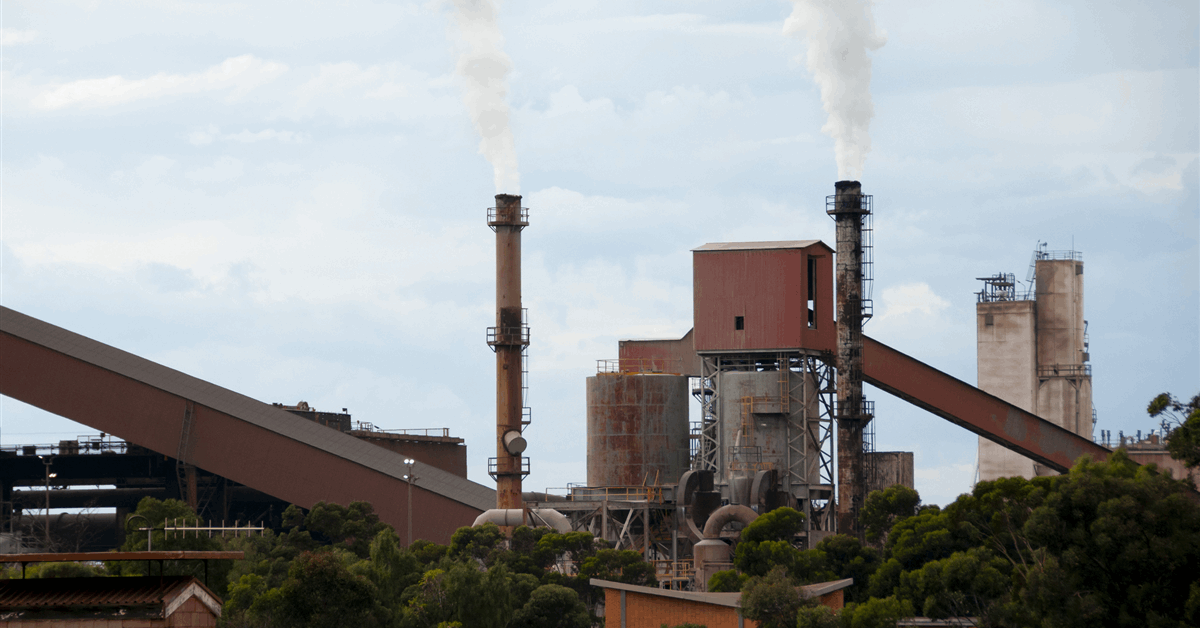
Santos Ltd said Friday it had signed a binding term sheet with the state government of South Australia to supply 20 petajoules (PJ) a year of natural gas for 10 years to Whyalla Steelworks.
“Santos gas will be used to enable Whyalla to deploy direct reduced iron technology that can process local magnetite ore to produce low-carbon iron”, Santos managing director and chief executive Kevin Gallagher said in a statement on the company’s website.
According to Gallagher, gas substitution would cut emissions by about 50 percent compared to the plant’s coal-fired blast furnace operations. Whyalla has a declared capacity of 1.2 million metric tons per annum (MMtpa).
The South Australian government, in the process of selling the plant after placing the owner GFG Alliance under administration last year, aims to progressively transform Whyalla into a green plant. Future plans could involve solar and wind power, according to information on the state government’s website.
On Tuesday federal Industry and Innovation Minister Tim Ayres and South Australian Premier Peter Malinauskas jointly announced the start of geotechnical drilling for a mining project bankrolled by the federal and state governments to secure the plant’s future. The Magnetite Expansion Project in the Middleback Ranges aims to produce up to 2.5 MMtpa of magnetite, “critical for future ambitions to transition to green iron and steel”, the statement said.
Gas deliveries by Santos are to start March 2030. The prospective deal would use indexed pricing with a prepayment arrangement, according to Santos’ statement.
“The annual contract quantity of 20PJ represents around 30 percent of Santos’ current gas production from the Cooper Basin and is able to be supplied from the Moomba Central Area fields development”, Santos said. The basin contributed 12 million barrels of oil equivalent to Santos’ production last year, according to the company’s annual report.
“Santos will benefit from a long-term contract with a top-tier counterparty and fixed price indexation, diversifying its gas sales portfolio and providing a natural hedge against oil-linked pricing elsewhere”, Friday’s statement added.
“The prepayment structure will assist Santos to invest in infrastructure and upstream optimization as part of the planned Moomba Central Optimization project in the Cooper Basin, delivering operational efficiencies, higher productivity wells and significantly lower operating costs”.
Gallagher said, “Our agreement today is great news for the Upper Spencer Gulf and South Australia because industries like the Whyalla Steelworks rely on affordable energy combined with decarbonization to grow into the future – keeping jobs, skills and business opportunities here in the region to support vibrant local communities for decades to come”.
In 2024 Santos put into service the Moomba Carbon Capture and Storage (CCS) project. The project injects into depleted reservoirs near the Moomba oil and gas gathering and processing complex, which serves the onshore Cooper and Eromanga basins. Moomba CCS can store up to 1.7 MMtpa of carbon dioxide emissions, according to Santos, which operates the project with a 66.7 percent stake.
To contact the author, email [email protected]
What do you think? We’d love to hear from you, join the conversation on the
Rigzone Energy Network.
The Rigzone Energy Network is a new social experience created for you and all energy professionals to Speak Up about our industry, share knowledge, connect with peers and industry insiders and engage in a professional community that will empower your career in energy.
element
var scriptTag = document.createElement(‘script’);
scriptTag.src = url;
scriptTag.async = true;
scriptTag.onload = implementationCode;
scriptTag.onreadystatechange = implementationCode;
location.appendChild(scriptTag);
};
var div = document.getElementById(‘rigzonelogo’);
div.innerHTML += ” +
‘ ‘ +
‘ +
”;
var initJobSearch = function () {
////console.log(“call back”);
}
var addMetaPixel = function () {
if (-1 > -1 || -1 > -1) {
/*Meta Pixel Code*/
!function(f,b,e,v,n,t,s)
{if(f.fbq)return;n=f.fbq=function(){n.callMethod?
n.callMethod.apply(n,arguments):n.queue.push(arguments)};
if(!f._fbq)f._fbq=n;n.push=n;n.loaded=!0;n.version=’2.0′;
n.queue=[];t=b.createElement(e);t.async=!0;
t.src=v;s=b.getElementsByTagName(e)[0];
s.parentNode.insertBefore(t,s)}(window, document,’script’,
‘https://connect.facebook.net/en_US/fbevents.js’);
fbq(‘init’, ‘1517407191885185’);
fbq(‘track’, ‘PageView’);
/*End Meta Pixel Code*/
} else if (0 > -1 && 93 > -1)
{
/*Meta Pixel Code*/
!function(f,b,e,v,n,t,s)
{if(f.fbq)return;n=f.fbq=function(){n.callMethod?
n.callMethod.apply(n,arguments):n.queue.push(arguments)};
if(!f._fbq)f._fbq=n;n.push=n;n.loaded=!0;n.version=’2.0′;
n.queue=[];t=b.createElement(e);t.async=!0;
t.src=v;s=b.getElementsByTagName(e)[0];
s.parentNode.insertBefore(t,s)}(window, document,’script’,
‘https://connect.facebook.net/en_US/fbevents.js’);
fbq(‘init’, ‘1517407191885185’);
fbq(‘track’, ‘PageView’);
/*End Meta Pixel Code*/
}
}
// function gtmFunctionForLayout()
// {
//loadJS(“https://www.googletagmanager.com/gtag/js?id=G-K6ZDLWV6VX”, initJobSearch, document.body);
//}
// window.onload = (e => {
// setTimeout(
// function () {
// document.addEventListener(“DOMContentLoaded”, function () {
// // Select all anchor elements with class ‘ui-tabs-anchor’
// const anchors = document.querySelectorAll(‘a .ui-tabs-anchor’);
// // Loop through each anchor and remove the role attribute if it is set to “presentation”
// anchors.forEach(anchor => {
// if (anchor.getAttribute(‘role’) === ‘presentation’) {
// anchor.removeAttribute(‘role’);
// }
// });
// });
// }
// , 200);
//});


