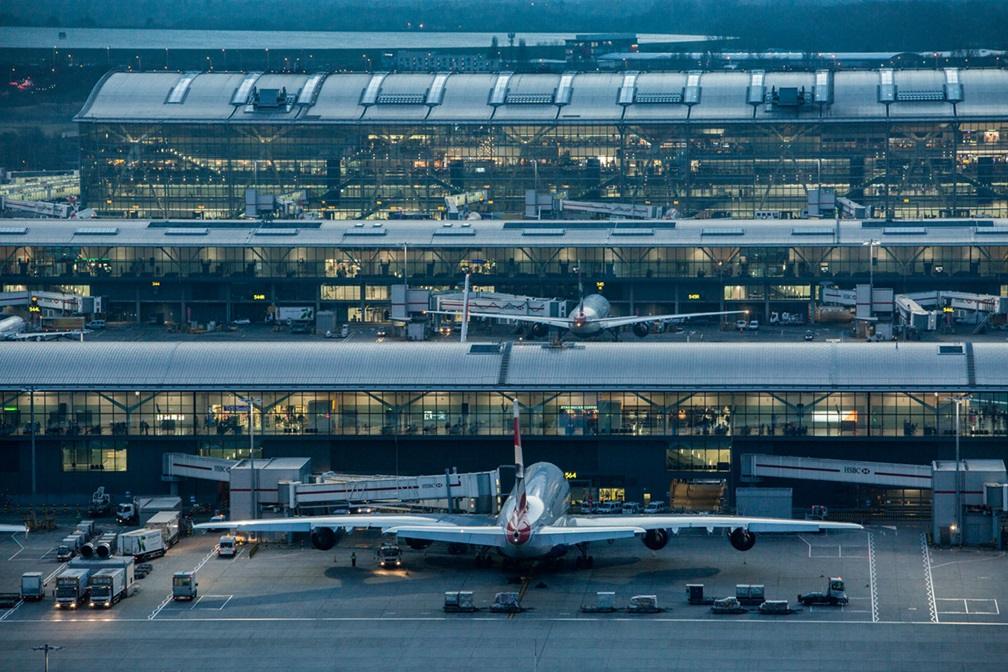
London’s Heathrow airport announced a new increase in its Sustainable Aviation Fuel (SAF) incentive scheme, with plans to make £80 million (USD$108 million) available to airlines to help cut the price gap between SAF and traditional jet fuel, and to scale the use of SAF at the airport to 5.6% in 2026.
Fuel accounts for the vast majority of the aviation sector’s emissions. Generally produced from sustainable resources, like waste oils and agricultural residues, SAF is seen as one of the key tools to help decarbonize the aviation industry in the near- to medium-term. SAF producers estimate the fuels can result in lifecycle GHG emissions reductions of as much as 85% relative to conventional fuels. Efforts to meaningfully increase the use of SAF by airlines face significant challenges, however, including the low supply currently available on the market, and prices well above those of conventional fossil-based fuels. Globally, SAF currently represents less than 0.1% of jet fuel volumes.
The announcement marks the fifth year of Heathrow’s SAF incentive program for airlines. Launched in 2022, the scheme’s incentive is designed to cut the price gap between conventional jet fuel and SAF in half. The scheme works through an SAF incentive “pot” funded by the airport’s fees for aeronautical services – specifically, its NOx aeronautical charges – with airlines bidding to the pot to receive a rebate, in order to make SAF more affordable.
According to Heathrow, the 2026 incentive scheme aims to increase the use of SAF to 350,000 tons in 2026, up significantly from 187,000 tons in 2025 – resulting in an anticipated 600,000 ton lifecycle carbon emissions reduction, based on a 70% emissions reduction from the use of SAF.
The UK’s SAF mandate, which took effect in 2025, requires the introduction of SAF in the UK’s jet fuel mix, starting at 2% in 2025, and ramping up to 10% by 2030, and 22% by 2040. Heathrow noted that its 2026 target of 5.6% would exceed the UK’s SAF mandate by 2%, and that its 2030 target of 11% SAF also exceeds the UK mandated level by 1%.
Matt Gorman, Heathrow’s Director of Sustainability, said:
“Heathrow is leading the way globally, with 17% of the world’s SAF supply in 2024 used at the airport. SAF is a key lever on aviation’s journey to net zero by 2050, and a key element of Heathrow’s Net Zero Plan.”


