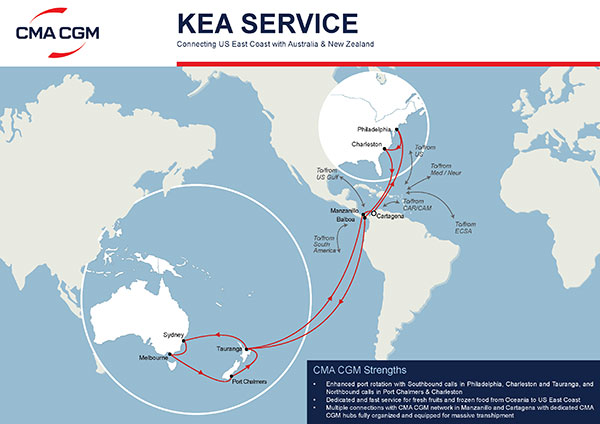
The global energy landscape is a complex web of production, consumption, and logistics. When a major player like CMA CGM introduces a new ocean service, particularly one connecting key economic regions, the ripple effects can extend far beyond simple freight movement. The launch of the KEA service, linking the U.S. East Coast with Australia and New Zealand, represents more than just an additional shipping option; it signifies a strategic enhancement to the broader supply chain architecture that underpins global trade, including critical energy flows. For oil and gas investors, understanding these foundational infrastructure improvements is crucial. This new route, leveraging a slot charter agreement with Maersk, aims to bolster reliability and open new transshipment pathways, indirectly fortifying the supply chain for industrial goods and equipment vital to the energy sector at a time when market stability is paramount.
Navigating Volatility: The Strategic Value of Supply Chain Resilience
In an energy market characterized by persistent volatility, the efficiency and resilience of global supply chains are more critical than ever. As of today, Brent Crude trades at $89.99, reflecting a -0.49% shift within a day range of $93.87 to $95.69, while WTI Crude stands at $86.4, down 1.17% with a daily range of $85.5 to $87.49. These figures come on the heels of a significant downturn, with Brent having fallen from $118.35 on March 31st to $94.86 by April 20th, representing a nearly 20% decline in just over two weeks. This sharp correction underscores the imperative for energy companies to optimize every aspect of their operations, from exploration to delivery, including the often-overlooked logistics of equipment and refined products.
The KEA service directly addresses this need by providing increased dependability and routing options between the U.S. East Coast and Oceania. While the service primarily handles agricultural products, consumer goods, and general industrial freight, the latter category is particularly relevant to the energy sector. Reliable shipping ensures the timely delivery of specialized drilling equipment, pipeline components, or renewable energy infrastructure from manufacturing hubs in North America to projects in Oceania, or vice-versa. Moreover, CMA CGM’s strategy of utilizing a space charter agreement with Maersk highlights a capital-efficient approach to expanding network reach. This flexibility allows carriers to adapt to shifting trade patterns without the significant upfront investment of new vessels, a model that minimizes risk and optimizes capacity utilization across the industry. Such strategic adjustments by logistics providers contribute to overall economic efficiency, indirectly supporting the operational stability and cost-effectiveness of energy projects globally.
Unpacking the US-Oceania Corridor: Indirect Energy Sector Catalysts
The KEA service, with its calls at ports like Philadelphia, Charleston, Sydney, and Melbourne, establishes a more robust trade artery whose benefits extend to the energy sector in several indirect but impactful ways. The “industrial freight” mentioned as a key cargo type for this lane can encompass a wide array of goods crucial for energy projects, from heavy machinery for mining and extraction to specialized components for LNG facilities or offshore platforms. Enhanced shipping reliability and increased frequency—moving to two weekly sailings between the U.S. East Coast and Oceania for CMA CGM—translate directly into reduced lead times and greater predictability for these vital supplies. This is especially pertinent for projects requiring just-in-time delivery or those in remote locations like parts of Australia or New Zealand, where logistics can significantly impact project timelines and budgets.
Furthermore, the service’s design to create new transshipment paths connecting Oceania and Europe via the U.S. East Coast represents a significant logistical upgrade. This wider network integration could facilitate more efficient movement of refined petroleum products, specialty chemicals, or even renewable energy technologies between these continents. For instance, European manufacturers of high-tech equipment for hydrogen production or carbon capture projects could leverage this route to access the growing markets in Oceania more efficiently. By tightening network connections and offering more dependable sailing options, CMA CGM is not just moving boxes; it’s enabling smoother, more predictable flows of goods that are foundational to the global energy transition and the ongoing operations of traditional oil and gas. This logistical backbone helps cushion against supply chain shocks, a persistent concern for energy investors.
Forward Momentum: Upcoming Events and Long-Term Outlook
The enhanced supply chain reliability offered by services like KEA takes on particular significance when viewed against the backdrop of upcoming energy market events. Investors are keenly watching the OPEC+ JMMC Meeting scheduled for April 21st, which could signal shifts in global crude supply. This will be followed by critical data releases such as the EIA Weekly Petroleum Status Reports on April 22nd and April 29th, offering fresh insights into U.S. inventory levels and demand trends. Further down the calendar, the Baker Hughes Rig Count on April 24th and May 1st will provide a snapshot of drilling activity, while the EIA Short-Term Energy Outlook on May 2nd will offer projections that shape market expectations for months to come.
For investors focused on the long-term price of oil, such as those asking about the “price of oil per barrel by end of 2026,” these logistical improvements contribute to market stability. If the EIA’s outlook points to sustained demand growth, or if OPEC+ decisions tighten supply, the ability to efficiently move essential industrial goods and energy infrastructure components becomes even more valuable. A resilient supply chain helps energy companies meet demand targets, execute projects on schedule, and mitigate cost overruns, all of which contribute positively to the overall market sentiment and the foundational economics underpinning future oil prices. The KEA service, while not directly impacting crude flows, represents a strengthening of the arteries through which the global industrial economy pulses, a critical factor for sustained energy sector performance.
Investor Sentiment and the Broader Picture: What Our Readers Are Asking
Our proprietary intent data reveals that investors are frequently grappling with fundamental questions about market direction, with queries like “is wti going up or down” and “How well do you think Repsol will end in April 2026” dominating discussions. While a new shipping route might seem distant from these immediate concerns, it’s a vital piece of the intricate puzzle that influences energy market dynamics and corporate performance. The efficiency and reliability of global trade lanes directly impact the operational costs and delivery schedules for energy companies, affecting everything from exploration project timelines to the supply of refined products to end-users.
A more robust U.S.-Oceania corridor means less friction in the movement of goods required by energy producers and consumers alike. This contributes to the overall health of the global economy, which in turn drives energy demand. For a company like Repsol, whose diversified operations span upstream, downstream, and renewables, predictable and cost-effective logistics are foundational to maintaining margins and executing strategic initiatives. By reducing uncertainties in the supply chain, the KEA service helps create a more stable operating environment. This enhanced stability, while not a direct catalyst for daily price swings, underpins the long-term investment thesis for energy companies, making their earnings more predictable and their projects more viable. Investors understand that reliable infrastructure, even for general cargo, ultimately supports the sustained economic activity that fuels energy consumption and, by extension, the performance of their energy holdings.