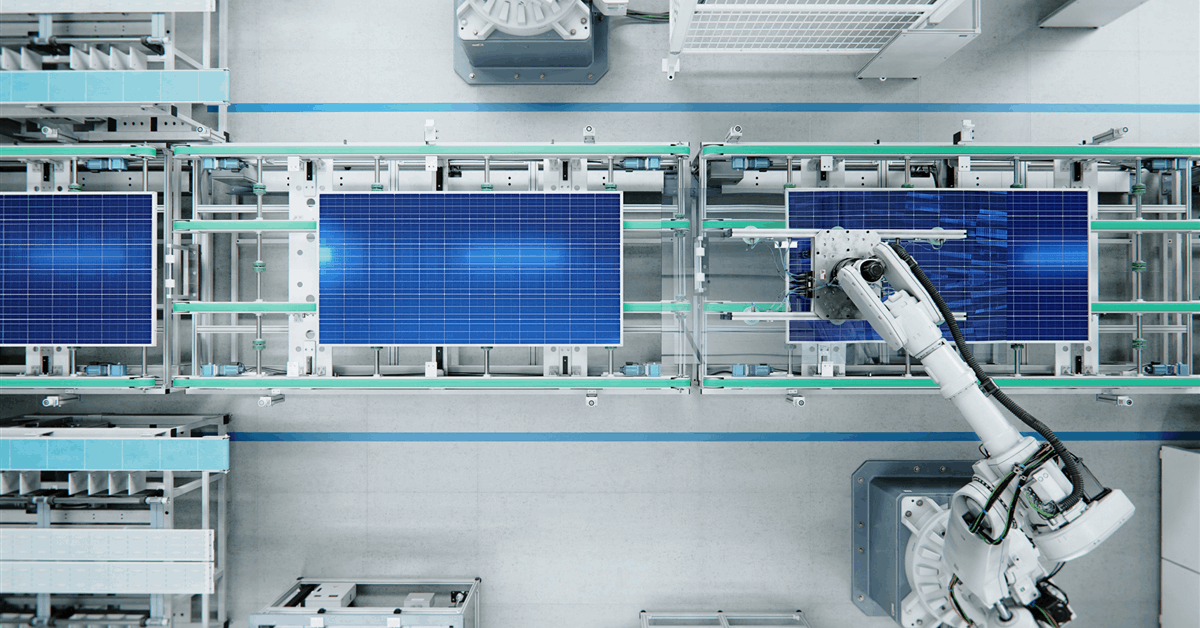
According to Wood Mackenzie’s poll of top-performing global solar module manufacturers for the first half of 2025, all non-Chinese companies within the top 10 remained profitable while the group suffered a collective net loss of $2.2 billion for January-June 2025.
The ranking covered 38 “well-known” manufacturers of crystalline silicon modules across nine countries. The companies accounted for 62 percent of global production capacity and 75 percent of global exports during the period, WoodMac said in a press release.
The ranking included criteria that represented “the buyers’ perspective, contingent on thorough research of what buyers look for when assessing module manufacturers”, WoodMac said.
“Despite dominating 62 percent [ 224 gigawatts] of global shipments, the world’s leading solar manufacturers are feeling the squeeze of a difficult market”, said Yana Hryshko, WoodMac head of global solar supply chain. “The top 10 manufacturers reported a collective $2.2 billion net loss in H1 2025, a result of steep price declines that have impacted even the industry’s largest players.
“In sharp contrast, all non-Chinese players in our top 10 remained profitable by focusing on premium and protected markets. This year’s results clearly show that financial discipline and operational excellence are the true separators in a difficult market”.
WoodMac added, “Rising challengers from India, South Korea, Singapore and the U.S. confirm that the competitive landscape is diversifying beyond China, driven by tightening trade policies”.
JA Solar and Trinasolar, both headquartered in China, jointly claimed the top spot.
The top 10 averaged 70 percent in utilization during H1, compared to 43 percent for the rest. India-based Adani Solar and China-based DMEGC Solar logged 100 percent utilization.
WoodMac gave 29 of the companies in the ranking a “Grade A” rating, “a fresh standard for operational excellence and bankability”. Grade A criteria were capacity utilization, technology maturity, ESG and CSR adherence, third-party certification, financial conditions, module manufacturing experience in production, module manufacturing experience in years, supply chain resilience, vertical integration, and research and development.
In 2026-27, WoodMac expects “industry consolidation, deeper vertical integration and regionalization of manufacturing”.
“Wafer-to-module control is becoming the new competitive frontier, as many of the top 20 manufacturers expand into the MENA [Middle East and North Africa] region for tariff-resilient production”, it said.
“The next efficiency leap, driven by TOPCon 3.0 and back-contact technologies, will push mainstream module performance above 25 percent, accelerating the retirement of lower-grade manufacturing lines”, WoodMac added.
“Weaker suppliers will face shutdowns or mergers as leading manufacturers sustain utilization rates of 60-75 percent”, it said. “As global demand strengthens and pricing stabilizes from 2026 onward, the industry will shift from survival mode to strategic investment, with Grade A manufacturers best positioned to capture the next growth cycle”.
To contact the author, email [email protected]
What do you think? We’d love to hear from you, join the conversation on the
Rigzone Energy Network.
The Rigzone Energy Network is a new social experience created for you and all energy professionals to Speak Up about our industry, share knowledge, connect with peers and industry insiders and engage in a professional community that will empower your career in energy.
element
var scriptTag = document.createElement(‘script’);
scriptTag.src = url;
scriptTag.async = true;
scriptTag.onload = implementationCode;
scriptTag.onreadystatechange = implementationCode;
location.appendChild(scriptTag);
};
var div = document.getElementById(‘rigzonelogo’);
div.innerHTML += ” +
‘ ‘ +
‘ +
”;
var initJobSearch = function () {
//console.log(“call back”);
}
var addMetaPixel = function () {
if (-1 > -1 || -1 > -1) {
/*Meta Pixel Code*/
!function(f,b,e,v,n,t,s)
{if(f.fbq)return;n=f.fbq=function(){n.callMethod?
n.callMethod.apply(n,arguments):n.queue.push(arguments)};
if(!f._fbq)f._fbq=n;n.push=n;n.loaded=!0;n.version=’2.0′;
n.queue=[];t=b.createElement(e);t.async=!0;
t.src=v;s=b.getElementsByTagName(e)[0];
s.parentNode.insertBefore(t,s)}(window, document,’script’,
‘https://connect.facebook.net/en_US/fbevents.js’);
fbq(‘init’, ‘1517407191885185’);
fbq(‘track’, ‘PageView’);
/*End Meta Pixel Code*/
} else if (0 > -1 && 84 > -1)
{
/*Meta Pixel Code*/
!function(f,b,e,v,n,t,s)
{if(f.fbq)return;n=f.fbq=function(){n.callMethod?
n.callMethod.apply(n,arguments):n.queue.push(arguments)};
if(!f._fbq)f._fbq=n;n.push=n;n.loaded=!0;n.version=’2.0′;
n.queue=[];t=b.createElement(e);t.async=!0;
t.src=v;s=b.getElementsByTagName(e)[0];
s.parentNode.insertBefore(t,s)}(window, document,’script’,
‘https://connect.facebook.net/en_US/fbevents.js’);
fbq(‘init’, ‘1517407191885185’);
fbq(‘track’, ‘PageView’);
/*End Meta Pixel Code*/
}
}
// function gtmFunctionForLayout()
// {
//loadJS(“https://www.googletagmanager.com/gtag/js?id=G-K6ZDLWV6VX”, initJobSearch, document.body);
//}
// window.onload = (e => {
// setTimeout(
// function () {
// document.addEventListener(“DOMContentLoaded”, function () {
// // Select all anchor elements with class ‘ui-tabs-anchor’
// const anchors = document.querySelectorAll(‘a .ui-tabs-anchor’);
// // Loop through each anchor and remove the role attribute if it is set to “presentation”
// anchors.forEach(anchor => {
// if (anchor.getAttribute(‘role’) === ‘presentation’) {
// anchor.removeAttribute(‘role’);
// }
// });
// });
// }
// , 200);
//});


