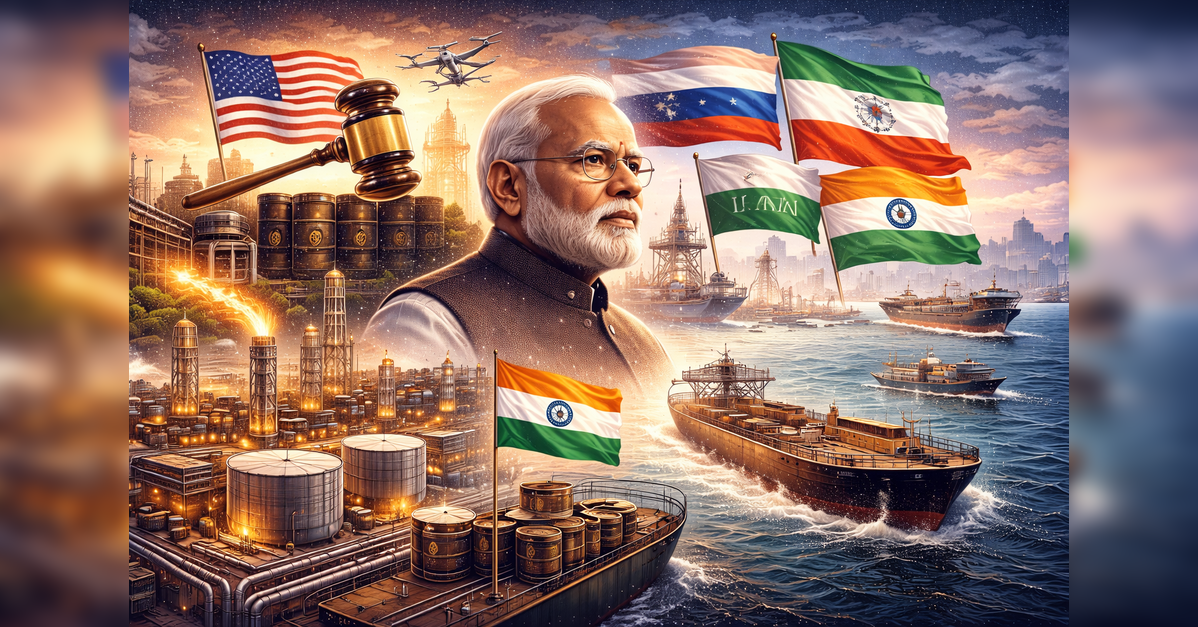
In 2025, US oil sanctions ceased to be a distant foreign policy tool and became a defining force shaping India’s energy choices, inflation management, and diplomatic positioning. What unfolded over the year was not merely another round of restrictions on Russian and Iranian oil, but a broader reordering of how energy, geopolitics and national interest intersect in a fragmented global order.
As Washington tightened enforcement mechanisms and widened the scope of scrutiny around oil trade, the consequences rippled far beyond sanctioned nations. For large importing economies like India, oil sanctions became a real-time test of energy security — one that demanded constant recalibration between economic pragmatism and geopolitical optics.
Exerting systemic pressure
US oil sanctions were not new in 2025. What changed was the intensity and credibility of enforcement. The focus shifted decisively from announcing restrictions to policing them. Greater attention was paid to compliance with the $60-per-barrel Russian oil price cap, monitoring vessel ownership, tracking shipping movements, and scrutinising insurance and financial transactions.
Secondary sanctions emerged as a sharper instrument, aimed at discouraging third-country entities from facilitating sanctioned oil flows.
The stated objective was to curtail revenue streams financing adversarial geopolitical actions, particularly in the context of the Ukraine conflict and continuing instability in the Middle East. However, rather than removing oil from the market, the sanctions reshaped its pathways. Crude continued to flow, but increasingly through shadow fleets, alternative insurers, non-dollar settlements and opaque trading structures, injecting uncertainty into global oil markets.
Why 2025 became a watershed
The sanctions of 2025 landed in an energy market already operating under strain. Global oil demand crossed an estimated 103 million barrels per day, driven largely by Asia. OPEC+ spare capacity remained constrained, while geopolitical flashpoints — from the Red Sea to Eastern Europe — overlapped with critical energy transit routes.In this context, oil sanctions no longer functioned as isolated policy instruments. They influenced inflation trajectories, trade balances, fiscal stability and even electoral narratives. Energy became a front-line geopolitical issue, and decisions taken in Washington reverberated directly through domestic economies thousands of miles away.
Walking the tightrope
Few countries felt these pressures as acutely as India. Since 2022, India’s crude import basket had undergone a dramatic transformation. By 2025, Russian crude accounted for roughly 35–40 per cent of India’s total imports, compared to less than 2 per cent before the Ukraine war. India emerged as the largest buyer of Russian seaborne oil, drawn by sustained discounts of $5–10 per barrel compared to Brent.These discounted supplies played a critical role in India’s domestic energy management. They helped cushion consumers from global price volatility, supported refinery margins, and allowed the government to maintain relative stability in retail fuel prices during a politically sensitive period.
Balancing energy security and geopolitics
Publicly, India’s position remained consistent throughout the year. Officials reiterated that oil purchases were driven by commercial considerations, that India complied with UN-mandated sanctions, and that ensuring affordable energy for 1.4 billion people was a sovereign priority.
Behind the scenes, however, the balancing act was delicate. Indian refiners were forced to adapt to changing shipping arrangements, alternative insurance structures and non-dollar payment mechanisms. Compliance teams grew more cautious as the risk of secondary sanctions rose.
Yet India’s importance to global oil markets also gave it leverage. As one of the fastest-growing sources of demand, India could not be easily sidelined without risking broader market disruption. This reality tempered pressure and underscored a shifting power dynamic in global energy geopolitics.
Refining gains and strategic caution
India’s refining sector emerged as a significant beneficiary of the sanctions-driven realignment. Refineries processing discounted crude exported large volumes of diesel and aviation fuel, particularly to Europe and parts of Asia and Africa. Refining margins remained elevated for much of the year, reinforcing India’s status as a critical refining hub in a disrupted global market.
However, the success also highlighted structural risks. Policymakers became increasingly aware of the dangers of over-concentration on a single source, the reputational exposure associated with shadow trade, and logistical vulnerabilities linked to opaque shipping networks.
This reality renewed urgency around expanding strategic petroleum reserves and enhancing supply flexibility.
More fundamentally, the sanctions episode strengthened the strategic rationale for India’s energy transition. Renewable energy, biofuels and ethanol blending were no longer framed solely as climate initiatives, but as instruments of national resilience. In an increasingly weaponised energy landscape, diversification became synonymous with sovereignty.
For India, the year demonstrated that energy choices are inseparable from foreign policy — and that strategic autonomy requires constant negotiation, not rigid alignment.
Looking ahead
As 2026 approaches, several trends appear entrenched. Sanctions will remain a favoured geopolitical instrument for the US. India is likely to continue diversifying its crude basket without abandoning discounted supplies entirely. Energy markets are set to remain fragmented, and large demand centres will increasingly chart independent paths.
The lesson of 2025 is not that sanctions are irrelevant, but that their power is constrained in a multipolar energy system. For India, the challenge ahead lies in sustaining growth, protecting consumers and preserving its strategic autonomy in a world where oil remains as political as it is economic.
The story of US oil sanctions in 2025 is ultimately a story about limits — of power, of enforcement and of control over global energy flows. Sanctions reshaped trade routes but did not halt them. They exposed vulnerabilities while revealing new centres of demand-driven influence.
As the world moves into 2026, oil remains far more than a commodity. It is a geopolitical signal — and for India, a continuing test of how to secure energy without surrendering autonomy.