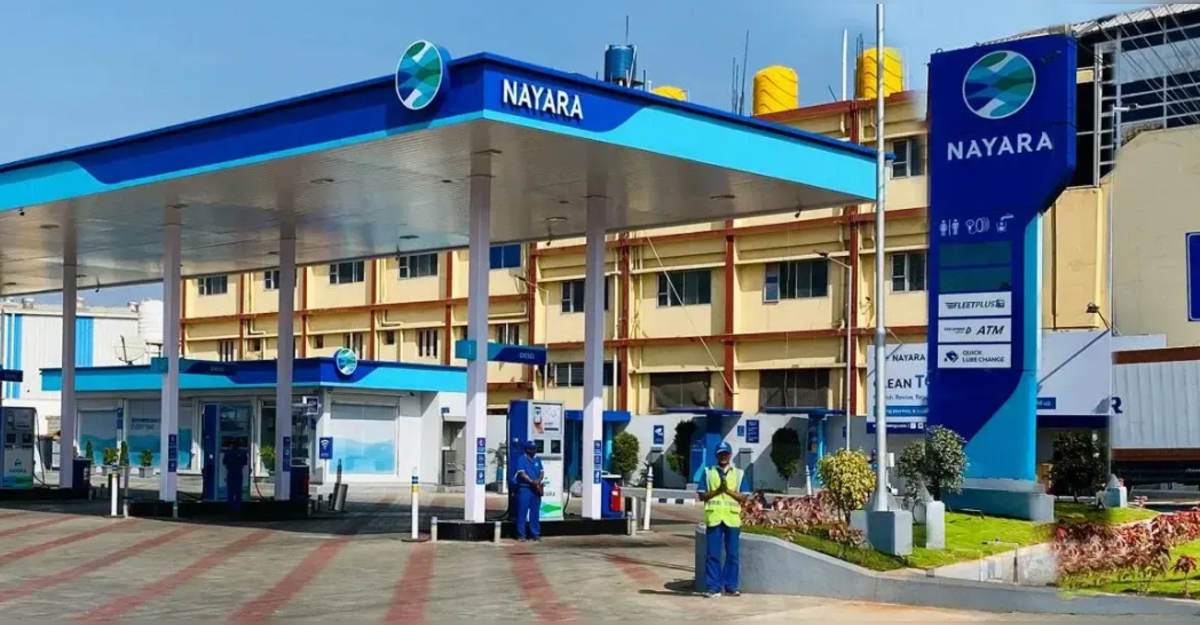
The Geopolitical Squeeze on Vadinar: Investment Implications of Nayara’s Maintenance Delay
The strategic decision by Nayara Energy Ltd. to postpone critical maintenance at its 400,000 barrels-a-day Vadinar refinery from February until April 2026 sends a potent signal through the global oil and gas investment landscape. This isn’t merely an operational tweak; it’s a direct consequence of European sanctions targeting the Russian-backed entity, revealing the tangible impact of geopolitical tensions on vital energy infrastructure. For investors, this deferral carries immediate implications for refined product supply, operational risk, and the long-term viability of assets caught in the crossfire of international policy. Our analysis delves into how this situation reshapes market dynamics, considering current price trends and upcoming market catalysts.
Sanctions’ Chilling Effect on Critical Refinery Operations
Nayara’s Vadinar complex, a cornerstone of India’s refining capacity, finds itself in a precarious position due to European sanctions imposed in July for alleged funding of Russia’s war efforts. This blacklisting has directly led to the withdrawal of crucial European contractors, including Germany’s Siemens AG and Denmark’s Topsoe A/S, who previously provided essential equipment, technology, and catalyst support. The ripple effect is profound: the planned major overhaul, initially scheduled for February, has been pushed back to April 2026 because the Mumbai-based refiner has yet to secure alternative providers for these specialized services. This situation also mirrors the stalling of Nayara’s planned petrochemical project at the same site, with suppliers like France’s Technip Energies and Japan’s Toyo Engineering Corp. withdrawing. While Indian refiners typically coordinate maintenance cycles every four years to prevent supply disruptions, prolonged deferrals introduce heightened safety concerns and operational risks. Investors should recognize that while this immediate delay means continued output from Vadinar, bypassing a February shutdown, it trades short-term supply stability for increased long-term operational vulnerability.
Market Backdrop: Volatility and Supply Considerations
Against a backdrop of significant market volatility, the Nayara situation adds another layer of complexity. As of today, Brent crude trades at $89.95, reflecting a 0.53% decline, with its day range between $93.87 and $95.69. WTI crude similarly saw a dip, currently at $86.28, down 1.3%, after trading between $85.5 and $87.47. This recent downward pressure on crude prices comes after a notable 14-day trend where Brent crude fell from $118.35 on March 31st to $94.86 on April 20th, a substantial decrease of nearly 20%. Meanwhile, gasoline prices stand at $3.03, down 0.33%. The continued operation of Nayara’s 400,000 b/d refinery through what would have been a maintenance period means more refined product supply in the market than initially anticipated for early 2026. However, this is tempered by the refinery’s reliance on Russia’s Urals crude, following disruptions from traditional suppliers like Saudi Arabia and Iraq and halted overseas payment financing. This pivot highlights the evolving trade flows and supply chain reconfigurations in response to geopolitical pressures, influencing regional product balances and global arbitrage opportunities.
Investor Sentiment and Forward-Looking Catalysts
Our proprietary reader intent data reveals that investors are acutely focused on the future direction of oil prices, frequently asking about the trajectory of WTI and what to predict for oil per barrel by the end of 2026. This reflects a broader market anxiety that the Nayara maintenance delay, while temporarily adding supply, underscores the fragility of global refining capacity under sanction regimes. Looking ahead, several key calendar events will significantly shape the market’s response. The OPEC+ JMMC Meeting on April 21st will be closely watched for any signals on production policy, which could either exacerbate or alleviate supply concerns. This will be followed by critical insights from the EIA Weekly Petroleum Status Reports on April 22nd and April 29th, offering a snapshot of U.S. crude inventories and refined product demand. Further guidance on supply will come from the Baker Hughes Rig Count reports on April 24th and May 1st, alongside the EIA Short-Term Energy Outlook on May 2nd. These events, particularly in light of the Nayara delay, could influence refining margins and the competitive positioning of other refiners who might benefit from tightened global product markets if operational risks at Vadinar eventually materialize.
Strategic Implications for Global Energy Portfolios
The situation at Nayara’s Vadinar refinery serves as a stark reminder of the increasing intersection between geopolitics and operational stability in the energy sector. For investors, this necessitates a critical re-evaluation of exposure to entities operating under sanction regimes or heavily reliant on specific geopolitical alignments. The challenges faced by Nayara in securing specialized contractors underscore a broader trend of supply chain fragmentation and the potential for “bloc-based” sourcing, where technology and services become increasingly constrained by political affiliations. This could lead to higher operational costs, reduced efficiency, and delayed project timelines across the global energy landscape. Investing in companies with diversified supply chains, robust geopolitical risk mitigation strategies, and access to a broader pool of technical expertise becomes paramount. While the immediate concern is the deferred maintenance, the long-term implications for global refining capacity, technology transfer, and the resilience of energy infrastructure warrant careful consideration in constructing a robust and adaptable energy investment portfolio.


