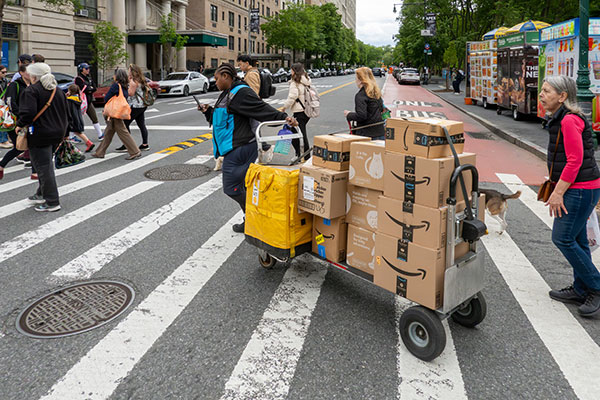
The relentless pace of e-commerce has fundamentally reshaped urban landscapes, and nowhere is this more evident than in New York City. While consumers enjoy unprecedented convenience, a deep dive into the logistics infrastructure powering this boom reveals significant implications for the oil and gas sector. The sheer volume of daily package deliveries has surged, creating localized demand pressures for transport fuels, even as broader market dynamics fluctuate. For astute oil and gas investors, understanding these micro-trends and their potential to catalyze policy shifts is crucial for navigating future market opportunities and risks.
The Unseen Fuel Bill of Urban Convenience
New York City’s e-commerce explosion isn’t just about faster delivery; it’s a direct accelerator of fuel consumption. Before the pandemic, the city saw an average of 1.8 million package deliveries daily. By 2024, that figure has soared to 2.5 million, representing a staggering 38% increase in daily last-mile logistics activity. This surge means millions more miles driven by delivery vans and trucks across the city each day, directly translating into significantly higher demand for gasoline and diesel. The fact that roughly one in three New Yorkers now receives a package every single day underscores the ingrained nature of this delivery culture. This sustained, localized demand pressure for refined products stands as a quiet but potent driver for a segment of the energy market, often overlooked amidst global supply-side narratives.
Regulatory Crossroads: Pollution, Safety, and the Energy Transition
The convenience of rapid delivery comes with a mounting societal cost, and this is where potential regulatory headwinds emerge for the energy sector. A recent report highlights severe consequences: a 78% increase in injury crashes near last-mile delivery facilities, with truck-related crashes jumping 146%. Furthermore, 68% of these warehouses are situated in Environmental Justice areas, where truck traffic exacerbates already poor air quality. Such stark findings are a clear precursor to legislative action, with calls for a “Delivery Protection Act,” stricter warehouse emission regulations, and expanded “clean truck programs.” For investors, this signals an accelerating push towards electric vehicles (EVs) or alternative, lower-carbon fuels within urban logistics fleets. While immediate fuel demand rises, the long-term trajectory for traditional internal combustion engine vehicles in last-mile delivery faces an increasingly challenging regulatory environment, potentially creating significant opportunities in EV charging infrastructure and alternative fuel supply chains.
Market Snapshot: Local Demand Contrasting Global Price Swings
The localized demand surge for transport fuels in major metropolitan areas like NYC offers an interesting counterpoint to broader crude market movements. As of today, Brent crude trades at $90.7, marking an 8.74% decline from yesterday’s close, with WTI crude similarly down 8.84% at $83.11. Gasoline prices have also dipped, standing at $2.94, a 4.85% drop. This recent volatility follows a two-week trend where Brent crude decreased by $14, or 12.4%, from $112.57 on March 27th to $98.57 on April 16th. While these macro price adjustments often reflect global supply-demand balances, geopolitical developments, or economic outlooks, the consistent and growing demand from urban logistics, as seen in NYC’s 2.5 million daily packages, provides a fundamental floor for refined product consumption. Investors should distinguish between the immediate impact of global crude price movements and the persistent, structural demand for diesel and gasoline in high-density urban centers, which continues to grow despite broader market corrections.
Investor Outlook: Navigating Future Demand and Policy Shifts
For investors keenly focused on the future of oil and gas, the NYC delivery boom is a microcosm of a larger trend that will influence long-term demand and policy. Many in our community are currently asking about the trajectory of oil prices by the end of 2026, and how significant localized demand drivers like urban delivery growth might factor into these predictions. While the upcoming OPEC+ Ministerial Meeting on April 18th will be critical for understanding near-term supply management, the increasing scrutiny on last-mile logistics emissions and safety will inevitably influence future policy. The potential for widespread “clean truck programs” and stringent emissions regulations could accelerate the electrification of delivery fleets, impacting future demand for refined products. Investors should consider how refiners are positioned to adapt to a changing fuel mix, and evaluate opportunities in companies that are either leading the charge in developing cleaner fuels or investing in EV charging and logistics solutions. The ongoing API and EIA inventory reports (scheduled for April 21st/22nd and April 28th/29th) and the Baker Hughes Rig Count (April 24th and May 1st) will provide further insights into supply, but the demand-side evolution in urban centers, driven by e-commerce, warrants increasingly careful consideration in long-term investment strategies.