The global oil market is signaling a decisive shift, with persistent geopolitical uncertainties, a strengthening U.S. dollar, and waning demand expectations converging to dampen bullish sentiment. After a period of relative resilience, crude prices are experiencing significant downward pressure, forcing investors to reassess their positions and future outlooks. This dynamic environment demands a meticulous analysis of both immediate market movements and upcoming catalysts that could further shape the trajectory of energy investments.
Geopolitical Headwinds Reshape Supply Risk Perceptions
Recent developments on the geopolitical front are significantly influencing crude pricing, particularly the evolving dialogue around potential peace arrangements. While a definitive resolution remains elusive, signals from Ukrainian President Volodymyr Zelenskiy indicating a willingness to collaborate on a peace plan have introduced a new layer of complexity, chipping away at the supply risk premium that has buoyed oil prices. The market initially registered a degree of relief, yet analysts remain cautious, highlighting Kyiv’s past rejections of Moscow’s demands and the unpredictable timeline for any genuine agreement. This ongoing uncertainty means that while the immediate fear of escalating supply disruptions may have eased slightly, the underlying instability persists.
Concurrently, the latest round of U.S. sanctions targeting major Russian oil entities, Rosneft and Lukoil, has been met with skepticism regarding their immediate efficacy. Notably, Lukoil has been granted an extension until December 13th to divest its international portfolio, providing a substantial window that could dilute the short-term impact on global supply. This perceived leniency further complicates the market’s assessment of true supply-side constraints. The combination of tentative peace talks and the phased implementation of sanctions has undoubtedly reduced some supply-risk concerns, but the market’s fundamental uncertainty about their ultimate effect continues to prevail.
Macroeconomic Pressures Intensify, Driving Down Crude Valuations
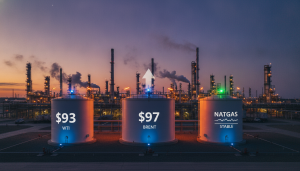
The macroeconomic landscape is exerting considerable downward force on oil prices, most notably through a strengthening U.S. dollar. As of today, April 17th, 2026, Brent Crude trades at $90.93 per barrel, marking an 8.51% decline over the session, with its day range spanning from $86.08 to $98.97. WTI Crude has seen an even steeper decline, trading at $83.17, down 8.77%, after moving between $78.97 and $90.34. Gasoline prices have also fallen, currently at $2.94, a 4.85% drop. This significant daily depreciation is not an isolated event; our proprietary data indicates Brent Crude has been on a downward trajectory, shedding $14 or 12.4% from $112.57 on March 27th to $98.57 by April 16th, setting the stage for today’s sharper fall.
This broader trend of weakening crude prices is heavily influenced by a robust U.S. dollar, which is on track for its strongest weekly performance in over a month. The primary driver behind the dollar’s surge is a notable shift in Federal Reserve rate cut expectations. A month ago, market participants projected roughly a 90% chance of a December rate cut; however, CME FedWatch now indicates only a 35% probability. This recalibration signals a more hawkish Fed stance than previously anticipated, boosting the dollar’s appeal. For crude oil, a stronger dollar translates to higher costs for non-U.S. buyers, effectively dampening international demand and reinforcing the prevailing downside momentum in commodity markets.
Investor Focus: Navigating Technical Levels and Long-Term Outlooks
Against this backdrop of softening prices, investors are keenly focused on key technical levels and broader market trajectories. WTI futures are currently trading below the critical 61.8% retracement support and last week’s swing low, signaling a reinforced bearish bias in the near term. Should the market fail to reclaim the $58.44 and $59.23 levels, or mount a push toward the 50-day moving average at $60.52, a further test of the main bottoms at $55.91 and $55.22 appears increasingly likely. These technical markers provide crucial guideposts for traders assessing entry and exit points in a volatile market.
Our direct engagement with investors reveals a pronounced interest in both the immediate impact of market shifts and the longer-term implications. A recurring question asks what the price of oil per barrel will be by the end of 2026, highlighting a desire for clarity beyond the current short-term volatility. Furthermore, investors are scrutinizing the resilience of individual companies, with queries about the performance of specific players like Repsol by the end of April 2026. This indicates a dual investment strategy: understanding the overarching macro-level oil price forecast while simultaneously evaluating how specific energy producers are positioned to navigate these challenging market conditions. The underlying concern for many is how sustainable the current bearish pressures are and which companies are best equipped to absorb potential shocks.
Upcoming Catalysts: OPEC+ Decisions and Inventory Data
The immediate horizon is dotted with critical events that could significantly influence the crude oil market’s direction. The upcoming OPEC+ Joint Ministerial Monitoring Committee (JMMC) meeting on April 17th, followed by the full Ministerial meeting on April 18th, stands as the most prominent near-term catalyst. With crude prices experiencing notable declines and investors actively inquiring about current OPEC+ production quotas, the market will be hyper-focused on any signals regarding the group’s supply policy. Any indication of maintaining current output levels could be interpreted as a lack of urgency to support prices, potentially exacerbating bearish sentiment. Conversely, hints of future cuts or a commitment to tighter supply could provide a much-needed floor.
Beyond OPEC+, the energy market will closely monitor a series of inventory reports. The API Weekly Crude Inventory reports on April 21st and April 28th, alongside the EIA Weekly Petroleum Status Reports on April 22nd and April 29th, will offer crucial insights into demand health and supply-side dynamics within the U.S. Larger-than-expected inventory builds would reinforce concerns about weakening demand and contribute to further price erosion. Additionally, the Baker Hughes Rig Count on April 24th and May 1st will provide a glimpse into future U.S. production activity, impacting perceptions of global supply. These scheduled events will collectively provide the market with essential data points, either confirming the prevailing bearish outlook or introducing new variables that could spark a recovery.