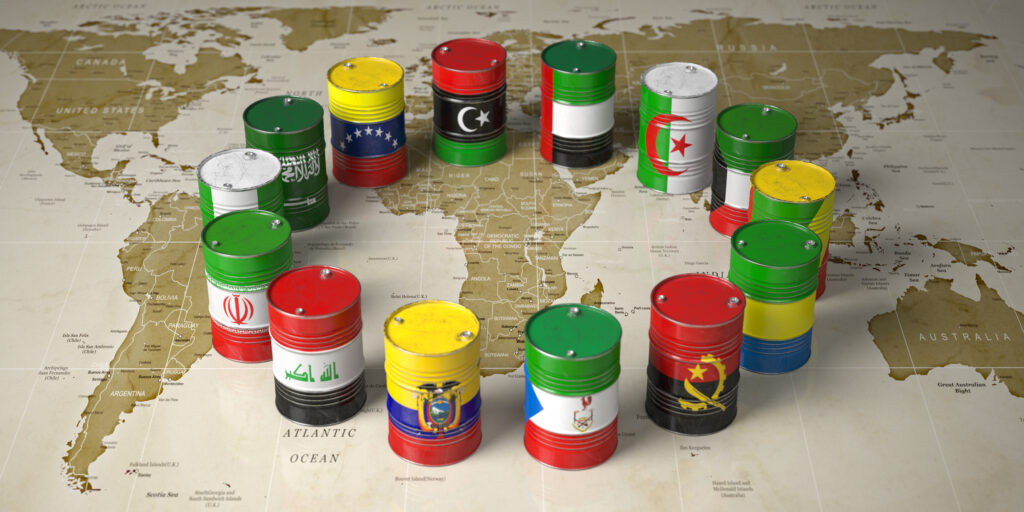
The global crude market is facing significant headwinds, evidenced by a sharp downturn in prices today, pushing benchmarks significantly lower. As of today, Brent Crude trades at $90.38, marking a substantial 9.07% decline within the day’s range of $86.08 to $98.97. Similarly, U.S. West Texas Intermediate (WTI) Crude has seen a steep fall, now at $82.59, down 9.41% from a daily high of $90.34. This aggressive correction follows a broader trend; our proprietary data reveals Brent has shed nearly 20% over the last 14 days, plummeting from $112.78 on March 30th to its current level. This market recalibration is a complex interplay of evolving supply dynamics, persistent demand concerns, and a resurgent U.S. dollar, demanding a refined investment strategy from energy sector participants.
OPEC+ Decisions and Emerging Supply Glut Concerns
The recent decision by the Organization of the Petroleum Exporting Countries and its allies, collectively known as OPEC+, has cast a long shadow over the market. While the group agreed to a modest output increase for December, the critical detail for investors lies in their commitment to pause further increases in the first quarter of next year. This move, intended to stabilize prices, is now being viewed through the lens of a potential supply glut, especially as other factors weigh on demand. The fading impact of previously imposed U.S. sanctions on Russian energy companies is also contributing to this narrative. What was once a significant bullish factor for crude prices is now largely evaporated, removing a key support mechanism. Investors are keenly watching the delicate balance OPEC+ aims to strike, particularly as our readership data indicates frequent inquiries regarding current OPEC+ production quotas and their future trajectory.
Macroeconomic Headwinds: Demand Erosion and Dollar Dominance
Beyond the direct supply-side adjustments, the global macroeconomic landscape is presenting formidable challenges to crude demand. Recent manufacturing Purchasing Managers’ Index (PMI) data from key economic regions, including Asia and the U.S. ISM, have painted a concerning picture of weakening industrial activity. Japan, for instance, reported its fastest manufacturing contraction in 19 months in October, driven by a slump in critical sectors like automotive and semiconductors. This widespread slowdown in manufacturing output translates directly into reduced energy consumption, dampening the overall demand outlook for oil. Concurrently, a strengthening U.S. dollar is applying additional downward pressure on crude prices. The dollar has recently hovered near a three-month high, largely due to a divided Federal Reserve struggling with whether to implement further rate cuts in December. A stronger dollar makes dollar-denominated commodities like crude oil more expensive for holders of other currencies, thereby reducing their effective purchasing power and further suppressing demand.
Navigating Upcoming Events: A Roadmap for Energy Investors
For investors positioning themselves in the current volatile environment, the next fortnight presents several critical junctures that could significantly influence market direction. Our proprietary event calendar highlights key dates to watch. The OPEC+ Joint Ministerial Monitoring Committee (JMMC) Meeting on Sunday, April 19th, followed immediately by the full OPEC+ Ministerial Meeting on Monday, April 20th, will be paramount. These meetings will offer crucial insights into the group’s commitment to their stated Q1 output pause and their broader strategy in response to current market weakness. Any deviation or reinforcement of the existing plan will be closely scrutinized. Furthermore, the market will be keenly awaiting the latest U.S. inventory data. The American Petroleum Institute (API) Weekly Crude Inventory report on Tuesday, April 21st, and its official counterpart, the EIA Weekly Petroleum Status Report on Wednesday, April 22nd, will provide real-time indicators of U.S. crude stockpiles. Preliminary polls already suggest an expected rise, which, if confirmed, would further exacerbate oversupply concerns. These reports will be repeated on April 28th and 29th, offering continuous updates on U.S. storage levels. Additionally, the Baker Hughes Rig Count on April 24th and May 1st will provide a snapshot of North American drilling activity, hinting at future production trends. These data points are vital for assessing the true extent of the supply-demand imbalance.
Strategic Outlook: What Drives Oil Prices in the Near-Term
In this challenging environment, the focus for energy investors must shift from short-term reactions to a more strategic understanding of underlying drivers. The confluence of OPEC+’s supply management decisions, the health of global manufacturing, and the strength of the U.S. dollar will dictate crude’s trajectory. Our internal investor sentiment analysis reveals a prevalent question this week: “what do you predict the price of oil per barrel will be by end of 2026?” While precise predictions are inherently speculative, the factors outlined above will be the primary determinants. Sustained weakness in global economic indicators, coupled with persistent dollar strength, could anchor prices at lower levels. Conversely, any signs of a manufacturing rebound or a more aggressive supply cut by OPEC+ could provide a much-needed floor. The fading impact of geopolitical events, such as the Russian sanctions, underscores that fundamentals are reasserting their dominance. Investors should monitor earnings calls from major integrated oil companies and E&P firms for their outlooks on capital expenditure and production guidance, as these will reflect how the industry is adapting to current market conditions. The current sharp decline, including a 5.18% drop in Gasoline prices to $2.93 today, signals that the downstream sector is already feeling the impact of this broader market revaluation. Vigilance and a data-driven approach remain essential for navigating the complex energy market in the coming months.