The global oil market is undergoing a significant re-evaluation, with Brent crude prices facing a substantial correction that has brought key technical and psychological support levels into sharp focus. After a period of robust upward momentum that saw prices climb above $110, the market has abruptly shifted gears, shedding nearly 20% from its recent highs. This rapid descent is now testing the resilience of bulls, with traders and investors keenly watching whether current price action represents a healthy pullback within a larger uptrend or the beginning of a more prolonged downturn. Our proprietary data indicates a pronounced bearish sentiment in the short term, pushing crude towards critical Fibonacci retracement zones that could dictate the market’s trajectory for weeks to come.
Oil’s Steep Correction: Current Market Snapshot and Technical Battlegrounds
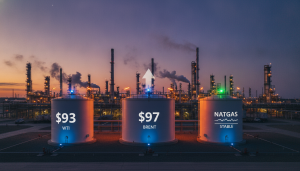
The severity of the current market correction is undeniable. As of today, Brent Crude is trading at $90.38 per barrel, marking a sharp 9.07% decline within the day, with an intraday range spanning $86.08 to $98.97. WTI Crude mirrors this weakness, standing at $82.59, down 9.41% for the session. This daily rout extends a broader trend, as Brent has now corrected a staggering $22.40, or 19.9%, from its recent peak of $112.78 observed on March 30, 2026. Gasoline prices are also feeling the pressure, currently at $2.93, down 5.18%.
This dramatic pullback places crude at a pivotal technical juncture. While specific absolute price targets from earlier analyses relate to a different market context, the underlying principles of technical support and resistance remain critically relevant. The market is actively battling to maintain its short-term moving average support. A sustained breach below immediate levels, particularly around the current trading price, would signal a loss of short-term bullish control and could accelerate selling pressure. Investors are now closely eyeing deeper Fibonacci retracement levels for potential floors. Analyzing the recent significant rally from a hypothetical base near $80 to the March 30 peak of $112.78, the 61.8% Fibonacci retracement level sits around $92.51. Brent has already pierced this level, indicating a strong bearish momentum. The next critical Fib support, the 78.6% retracement, is projected around $87.02. A sustained move below today’s intraday low of $86.08 would likely confirm a test of this deeper psychological and technical anchor, potentially signaling further downside towards the lower end of the recent trading range if buyers fail to materialize.
Navigating the Next Fortnight: OPEC+ and Inventory Data in Focus
The immediate future for oil prices will be heavily influenced by a confluence of scheduled events, particularly from OPEC+ and key inventory reports. Our proprietary event calendar highlights crucial upcoming dates that demand investor attention. The OPEC+ Joint Ministerial Monitoring Committee (JMMC) is slated to meet on Sunday, April 19, followed swiftly by the full OPEC+ Ministerial Meeting on Monday, April 20. Given the nearly 20% decline in Brent crude over the past three weeks, these meetings take on heightened significance. Investors are keenly asking about “OPEC+ current production quotas” and whether the alliance will intervene to stabilize prices amidst the current weakness. Any indication of further production cuts, or even a strong commitment to maintaining existing discipline, could provide a much-needed bullish catalyst. Conversely, a lack of decisive action or signals of internal discord could exacerbate the current downtrend.
Beyond OPEC+, the market will process weekly inventory data. The API Weekly Crude Inventory report on Tuesday, April 21, and the EIA Weekly Petroleum Status Report on Wednesday, April 22, will offer crucial insights into the supply-demand balance in the United States. Elevated inventory builds could reinforce bearish sentiment, while unexpected drawdowns might offer some support. Further out, the Baker Hughes Rig Count on April 24 will provide a snapshot of North American drilling activity, influencing longer-term supply expectations. These events collectively form a high-stakes environment where any divergence from expectations could trigger significant price swings.
Investor Concerns: Long-Term Outlook and Company Performance
Our reader intent data reveals a growing preoccupation among investors with the longer-term trajectory of oil prices and its implications for industry players. A dominant question this week is, “What do you predict the price of oil per barrel will be by end of 2026?” This underscores the market’s current uncertainty, as investors grapple with the volatility and seek clarity on future valuations. Forecasting end-of-year prices involves weighing numerous variables, including global economic growth, geopolitical stability, energy transition policies, and crucially, OPEC+’s sustained commitment to market management. While the current correction suggests a tempering of demand expectations, the underlying structural tightness in global supply, coupled with potential for renewed geopolitical tensions, could still provide a floor and eventual rebound.
The impact of current price movements on individual companies is also a key concern, as evidenced by questions like, “How well do you think Repsol will end in April 2026?” The profitability of exploration and production (E&P) companies is directly tied to crude prices. A sustained period of lower prices, particularly if Brent settles below the $85-$90 range, could pressure margins, impact capital expenditure decisions, and potentially lead to downward revisions in earnings forecasts for energy firms. Investors are looking for robust balance sheets, efficient operations, and diversified portfolios as shields against market volatility.
Upside Potential and Lingering Risks
Despite the current bearish momentum, the oil market’s inherent volatility means upside potential remains, contingent on key technical holds and fundamental shifts. If Brent crude can successfully defend its deeper Fibonacci support levels, particularly around the $87.00-$88.00 range, a rebound could be on the cards. A sustained move back above the $92.50 level, which aligns with the 61.8% retracement from the recent high, would signal a potential recovery. The next significant overhead resistance would then be the 50-day moving average, a level that would need to be convincingly cleared to re-