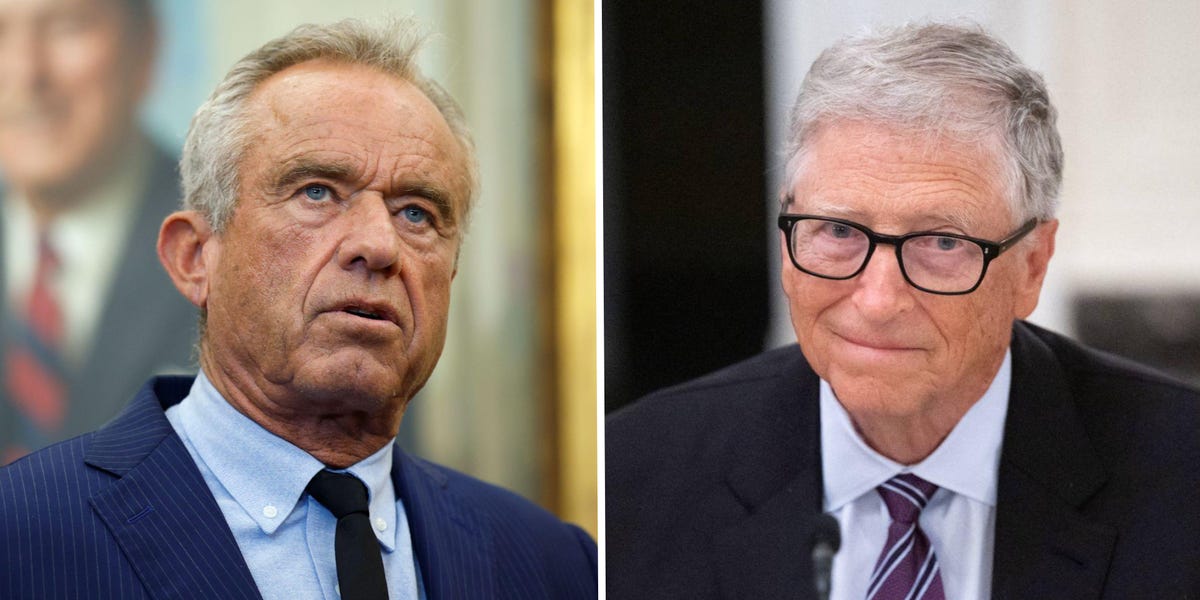
The political landscape, often fraught with unexpected turns, frequently offers subtle yet crucial signals for savvy energy investors. A historical interaction from 2017, recently illuminated by a new book, reveals former President Donald Trump’s consideration of Robert F. Kennedy Jr. for a significant role within his administration. While the initial discussions centered on public health policy — specifically, a “commission on vaccine safety and scientific integrity” and later a task force on autism and vaccines — the mere fact of these high-level engagements, subsequently influenced by figures like Bill Gates, serves as a fascinating bellwether. For those charting the volatile waters of oil and gas investments, this anecdote isn’t just a political footnote; it’s a potential indicator of how unconventional thinking or unexpected alliances might shape future policy, particularly as Kennedy Jr. now navigates his own independent presidential bid. Understanding the dynamics of such past considerations can offer predictive power for navigating the complex interplay between Washington, global energy markets, and investor sentiment.
The 2017 Overture: A Glimpse into Policy Formation
In early 2017, then President-elect Trump engaged in a series of meetings with Robert F. Kennedy Jr., exploring the possibility of Kennedy leading a panel focused on vaccine-related issues. Initial reports from Kennedy indicated an offer to chair a commission on vaccine safety, a concept later refined to a task force on autism and vaccines following a second meeting at the White House after Trump’s inauguration. This dialogue reflected Trump’s long-standing interest in the topic, having previously raised concerns about vaccine administration schedules during a 2015 GOP primary debate. However, these plans never materialized, largely due to external influence, specifically from billionaire philanthropist Bill Gates, who reportedly cautioned against the appointment. Gates’s intervention led to a deferral, with Trump suggesting Kennedy discuss his views with top National Institutes of Health officials, including Anthony Fauci.
From an investment perspective, this historical interaction provides valuable insight into the decision-making processes within a potential future Trump administration. It highlights a willingness to engage with figures holding views outside traditional political lines and an openness to policy discussions that might be considered unconventional. For the energy sector, this suggests a landscape where policy formation could be influenced by a broader, less predictable array of voices. While the 2017 discussions were not energy-centric, they illustrate a political leader’s readiness to consider alternative approaches, a trait that could translate into significant shifts in environmental regulations, drilling permits, or support for specific energy technologies in a second term. Investors must consider how such flexibility, or susceptibility to external persuasion, could introduce both opportunities and risks to established energy plays.
Navigating Market Volatility Amidst Political Headwinds
The energy markets are currently exhibiting considerable volatility, a situation exacerbated by a confluence of geopolitical tensions and economic uncertainties. As of today, Brent Crude trades at $90.38 per barrel, marking a significant 9.07% decline within the day, with prices fluctuating between $86.08 and $98.97. Similarly, WTI Crude has fallen to $82.59, down 9.41%, navigating a daily range of $78.97 to $90.34. Gasoline prices have also dipped to $2.93, a 5.18% decrease. This downward pressure is part of a broader trend; over the past two weeks, Brent has seen a substantial drop of $22.4, or 19.9%, from its $112.78 perch on March 30th. Such sharp movements underscore the market’s sensitivity to perceived risks and future policy directions.
For oil and gas investors, this market instability is amplified by the political unknowns surrounding upcoming elections. A potential second Trump administration, or the rising influence of an independent candidate like RFK Jr., introduces variables that could drastically alter the regulatory and operational environment for energy companies. Trump’s past pro-fossil fuel stance contrasts sharply with Kennedy Jr.’s known environmental advocacy and skepticism towards traditional energy infrastructure. The market’s current bearish sentiment, reflected in today’s price movements, suggests a cautious approach from traders, who are keenly aware that policy shifts could either unleash domestic production or impose stricter environmental hurdles, directly impacting supply, demand, and ultimately, profitability for energy firms. Navigating this environment requires a keen eye not just on supply-demand fundamentals, but on the evolving political narrative and its potential implications for long-term energy strategy.
RFK Jr.’s Energy Stance: A Potential Disruptor?
The ongoing dialogue among our readers highlights a significant concern for clarity regarding future oil price trajectories and global supply management. Questions like “what do you predict the price of oil per barrel will be by end of 2026?” and “What are OPEC+ current production quotas?” underscore an investor base grappling with profound uncertainty. This demand for forward-looking price predictions and insights into cartel policy is directly impacted by the evolving political landscape, particularly the re-emergence of figures like Robert F. Kennedy Jr. on the national stage.
While the 2017 discussions centered on public health, Kennedy Jr.’s well-documented positions on environmental policy and climate change are highly relevant to the energy sector. His past advocacy often aligns with stricter environmental regulations and a transition away from fossil fuels, a stark contrast to the deregulation agenda typically associated with a Republican administration. Should Kennedy Jr. gain any measure of influence, whether through his independent candidacy or a potential future advisory role, his perspective could inject significant uncertainty into the long-term outlook for oil and gas. This isn’t merely about who occupies the Oval Office; it’s about the ideological currents shaping future energy policy. For investors asking about 2026 oil prices, the potential for a more environmentally focused policy framework could mean increased pressure on domestic production, slower permitting for new projects, and greater incentives for renewable energy. This dynamic could either tighten global supply, pushing prices higher, or dampen demand for fossil fuels, leading to downward pressure, depending on the specifics and implementation of such policies. Understanding the nuances of these political figures’ historical and current stances is critical for forecasting market movements.
Upcoming Events and Future Policy Indicators
The next two weeks are packed with critical energy events that will provide further data points for investors, all while the broader political narrative continues to unfold. These scheduled events gain an additional layer of significance when viewed through the lens of potential policy shifts emanating from Washington. This Sunday, April 19th, the OPEC+ Joint Ministerial Monitoring Committee (JMMC) convenes, immediately followed by the full OPEC+ Ministerial Meeting on Monday, April 20th. These gatherings are crucial for investors seeking answers to questions about “OPEC+ current production quotas,” as any adjustments could significantly impact global supply. A perception of political instability or an anticipated shift in U.S. energy policy, perhaps influenced by unconventional political figures, could lead OPEC+ to maintain or even tighten production to stabilize prices, reacting to the market’s heightened uncertainty.
Domestically, the API Weekly Crude Inventory report on Tuesday, April 21st, and the EIA Weekly Petroleum Status Report on Wednesday, April 22nd, will offer fresh insights into U.S. supply and demand dynamics. These will be followed by the Baker Hughes Rig Count on Friday, April 24th, providing an indicator of future drilling activity. Identical reports are scheduled for the following week: API on April 28th, EIA on April 29th, and Baker Hughes on May 1st. These regular data releases, while fundamental, could see amplified market reactions if coupled with increasingly clear signals regarding future energy policy. For instance, any indication of an administration favoring rapid shifts away from fossil fuels could cause the market to interpret these inventory and rig count figures with a heightened sense of long-term risk for conventional energy producers. Investors must meticulously track these events, understanding that their impact could be magnified by the ongoing political discourse and the potential for non-traditional policy influences.
The historical interaction between Donald Trump and Robert F. Kennedy Jr., even on a seemingly unrelated topic like vaccine policy, serves as a powerful reminder for oil and gas investors: political signals, however subtle, can foreshadow significant shifts in policy and market dynamics. The willingness to engage with unconventional thinkers, as demonstrated in 2017, suggests a potential for unpredictability in future administrations that demands close scrutiny. As the energy market navigates current volatility, with Brent crude down sharply today, and as key OPEC+ meetings and domestic inventory reports loom, understanding these political undercurrents is paramount. The questions our readers are asking about future oil prices and OPEC+ quotas directly reflect this pervasive uncertainty. Ultimately, successful energy investing requires not only an acute awareness of market fundamentals and upcoming events but also a proactive analysis of the evolving political landscape, anticipating how diverse voices and unexpected alliances could reshape the future of the global energy sector.


