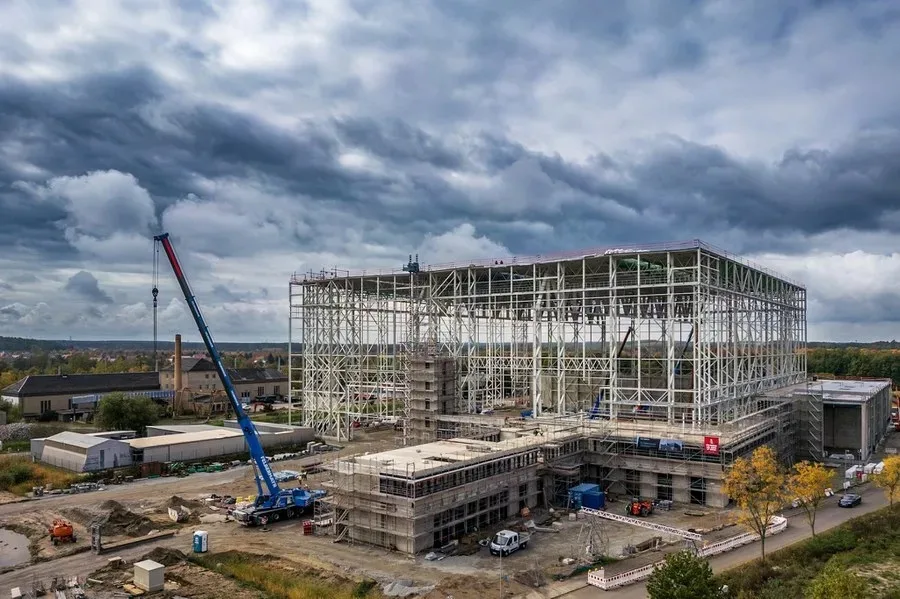
The energy landscape is undergoing a profound transformation, and while daily headlines often focus on immediate price volatility, savvy investors are keenly observing the foundational shifts that will redefine global energy demand for decades to come. A recent development out of Germany, the topping-out ceremony for the Smart Mobility Lab (SML) at TU Dresden’s Lausitz Research Campus, serves as a powerful signal of this impending future. This ambitious €86 million initiative, primarily funded by the German federal government and the state of Saxony, is far more than just a new research facility; it’s a tangible commitment to a future of zero-emission, connected, and automated mobility across road, air, and even agriculture. For oil and gas investors, understanding the implications of such projects is crucial for long-term portfolio resilience and strategic positioning in an evolving market.
The Dawn of Zero-Emission Mobility: A Long-Term Demand Threat
The Smart Mobility Lab is a testament to Europe’s aggressive push towards decarbonization and technological innovation in transportation. With operations slated to commence in January 2027 following its late 2026 completion, SML will house a massive 42-meter-high testing hall covering 100 x 100 meters, alongside extensive outdoor test areas and advanced laboratories. Researchers at SML will focus on pioneering technologies for automated road traffic, autonomous flight systems, and robotics-based agricultural applications. Key initiatives like SivaS (Safety of connected and automated road traffic), TAFAS (Test centre for automated flight and autonomous systems), and FarmingSwarm-Cobots (Automated agriculture with autonomous machinery and mixed field swarms) directly target sectors historically reliant on fossil fuels. This concentrated effort to develop practical, scalable zero-emission solutions represents a clear and present long-term threat to petroleum product demand, particularly gasoline, diesel, and jet fuel. The scale of investment and the institutional backing highlight a deep governmental commitment to accelerating this transition, signaling a future where internal combustion engines play a progressively diminished role.
Navigating Current Volatility Amidst Structural Shifts
While long-term trends like those embodied by the SML are critical, the oil and gas market remains highly sensitive to immediate supply-demand dynamics and geopolitical events. As of today, Brent Crude trades at $90.38, marking a significant 9.07% decline within the day, following a broader 14-day trend that saw prices drop from $112.78 on March 30th to today’s level. Similarly, WTI Crude stands at $82.59, down 9.41%, and gasoline prices have fallen to $2.93, a 5.18% decrease. This recent downward pressure, reflecting a turbulent market range (Brent $86.08-$98.97, WTI $78.97-$90.34), underscores the inherent volatility in energy commodities. Investors are grappling with these rapid price movements, often driven by a complex interplay of macro-economic indicators, inventory reports, and supply-side decisions. However, it is vital to contextualize this immediate market noise against the backdrop of fundamental, structural shifts like the SML, which actively work to reshape future energy consumption patterns. The challenge for investors lies in balancing the need for tactical responses to current market conditions with strategic positioning for the profound changes on the horizon.
Upcoming Catalysts and Investor Concerns for 2026
The question of oil prices by the end of 2026 is a dominant theme among our readers, reflecting a keen interest in forward-looking market direction. This near-term outlook will be heavily influenced by a series of critical events in the coming weeks. The OPEC+ Joint Ministerial Monitoring Committee (JMMC) meeting on April 19th, followed by the full OPEC+ Ministerial Meeting on April 20th, will be closely watched for any adjustments to current production quotas. These decisions are paramount, as they directly impact global supply levels. Further insights into market balance will come from the API Weekly Crude Inventory reports on April 21st and April 28th, and the authoritative EIA Weekly Petroleum Status Reports on April 22nd and April 29th. These inventory data points provide real-time snapshots of demand and supply dynamics in the crucial U.S. market. Additionally, the Baker Hughes Rig Count on April 24th and May 1st will offer an indication of North American production activity. While these events dictate short-term price fluctuations and supply narratives, the long-term trajectory indicated by projects like SML suggests that even robust supply management may eventually face headwinds from sustained demand erosion. Investors asking about specific company performance, such as Repsol’s outlook for April 2026, are implicitly acknowledging the need to understand both the immediate market environment and the strategic direction companies are taking in response to the broader energy transition.
Investment Strategy: Adapting to a Changing Mobility Paradigm
For oil and gas investors, the Smart Mobility Lab serves as a potent reminder of the need for adaptive investment strategies. The creation of over 300 new jobs at the SML and the subsequent SCART Institute highlights a significant diversion of economic resources and talent towards new energy and mobility sectors. This shift underscores a broader trend where capital is increasingly flowing into innovation that reduces reliance on traditional fossil fuels. Companies that continue to solely focus on upstream exploration and production without a clear diversification strategy risk being caught flat-footed. Instead, investment portfolios should consider companies actively developing or integrating sustainable technologies, investing in carbon capture solutions, or pivoting towards renewable energy generation and infrastructure. The €86 million investment in SML, backed by federal and state governments, indicates strong policy support for these emerging sectors, which could translate into regulatory advantages or further incentives. Observing how major oil and gas players respond to these structural changes – whether through strategic acquisitions in new energy, significant R&D investments, or ambitious decarbonization targets – will be key to identifying resilient opportunities in a market increasingly shaped by the pursuit of zero-emission mobility.