Close Menu
  • Home
  • Market News
    • Crude Oil Prices
    • Brent vs WTI
    • Futures & Trading
    • OPEC Announcements
  • Company & Corporate
    • Mergers & Acquisitions
    • Earnings Reports
    • Executive Moves
    • ESG & Sustainability
  • Geopolitical & Global
    • Middle East
    • North America
    • Europe & Russia
    • Asia & China
    • Latin America
  • Supply & Disruption
    • Pipeline Disruptions
    • Refinery Outages
    • Weather Events (hurricanes, floods)
    • Labor Strikes & Protest Movements
  • Policy & Regulation
    • U.S. Energy Policy
    • EU Carbon Targets
    • Emissions Regulations
    • International Trade & Sanctions
  • Tech
    • Energy Transition
    • Hydrogen & LNG
    • Carbon Capture
    • Battery / Storage Tech
  • ESG
    • Climate Commitments
    • Greenwashing News
    • Net-Zero Tracking
    • Institutional Divestments
  • Financial
    • Interest Rates Impact on Oil
    • Inflation + Demand
    • Oil & Stock Correlation
    • Investor Sentiment

Subscribe to Updates

Subscribe to our newsletter and never miss our latest news

Subscribe my Newsletter for New Posts & tips Let's stay updated!

What's Hot

Israel halts Leviathan, Karish gas fields after Iran strikes

March 2, 2026

How ChatGPT, Claude, and Gemini Features Compare

March 2, 2026

UK slashes climate aid programmes for developing countries | Climate crisis

March 2, 2026
Facebook X (Twitter) Instagram Threads
Oil Market Cap – Global Oil & Energy News, Data & Analysis
  • Home
  • Market News
    • Crude Oil Prices
    • Brent vs WTI
    • Futures & Trading
    • OPEC Announcements
  • Company & Corporate
    • Mergers & Acquisitions
    • Earnings Reports
    • Executive Moves
    • ESG & Sustainability
  • Geopolitical & Global
    • Middle East
    • North America
    • Europe & Russia
    • Asia & China
    • Latin America
  • Supply & Disruption
    • Pipeline Disruptions
    • Refinery Outages
    • Weather Events (hurricanes, floods)
    • Labor Strikes & Protest Movements
  • Policy & Regulation
    • U.S. Energy Policy
    • EU Carbon Targets
    • Emissions Regulations
    • International Trade & Sanctions
  • Tech
    • Energy Transition
    • Hydrogen & LNG
    • Carbon Capture
    • Battery / Storage Tech
  • ESG
    • Climate Commitments
    • Greenwashing News
    • Net-Zero Tracking
    • Institutional Divestments
  • Financial
    • Interest Rates Impact on Oil
    • Inflation + Demand
    • Oil & Stock Correlation
    • Investor Sentiment
Oil Market Cap – Global Oil & Energy News, Data & Analysis
Home » Millions more homes in Great Britain at risk of flooding, investigation finds | Environment
Climate Commitments

Millions more homes in Great Britain at risk of flooding, investigation finds | Environment

omc_adminBy omc_adminOctober 14, 2025No Comments7 Mins Read
Share
Facebook Twitter Pinterest Threads Bluesky Copy Link


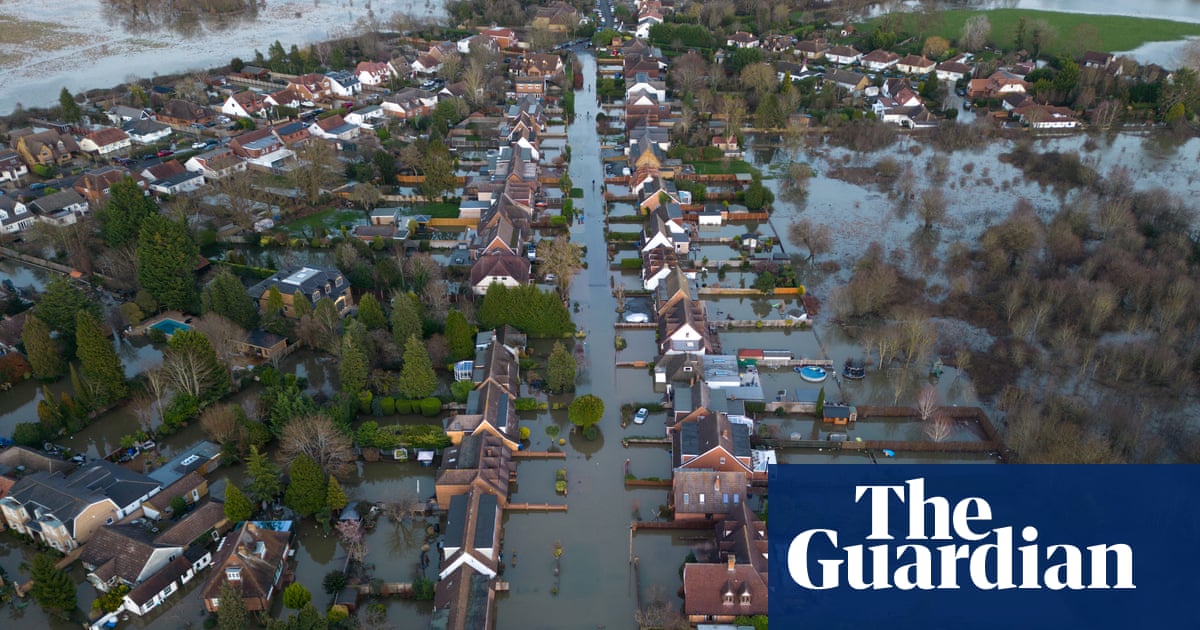
Millions more homes in England, Scotland and Wales face devastating floods, and some towns may have to be abandoned as climate breakdown makes many areas uninsurable, a Guardian investigation has found.

New analysis from the insurance industry, seen by the Guardian, reveals the extent of concern in the sector, with bosses warning that large swathes of housing and commercial property in densely populated areas will be at greater risk.

Separately, experts have said that some towns may need to be abandoned as homes and businesses struggle to get insurance in areas repeatedly battered by storms and rising sea levels.

Densely populated areas including London, Manchester and parts of north-east England, are likely to be worst hit. Experts also say London’s flood defences need to be updated urgently to protect the capital from devastating floods.

“The findings are stark,” said Jason Storah, chief executive for UK & Ireland general insurance at Aviva, which published the analysis. “Millions more properties will be at risk from flooding, with rising temperatures, increased urbanisation and inadequate drainage.”

Tenbury Wells, a market town in Worcestershire, has become the first in the country to find that its public buildings are uninsurable. The town has historically suffered damaging floods about once a decade, but in the past six years people there have been hit four times.

“We do feel abandoned,” said Lesley Davies, the deputy mayor of Tenbury council. “We are the blueprint for what could happen in the future – there may be other towns getting towards that situation, there are a lot of vulnerable towns on rivers all over.”

Aviva’s report highlights growing concern within the insurance industry about the impact of severe weather events that are being driven by the climate crisis.

Storah said: “We are not talking about this because we are waving a flag about climate or sustainability – it’s nothing to do with that, our business is totally correlated with what happens in the environment … we are in this and we cannot avoid it.”

Public buildings in Tenbury Wells, Worcestershire, have been rendered uninsurable after an increase in the number of floods so far this decade. Photograph: Oli Scarff/AFP/Getty Images

Aviva analysed every parliamentary constituency in England, Scotland and Wales to assess how vulnerable they were to flooding. In England, it found the number of properties at risk from flooding was expected to increase by more than a quarter (27%), from 6.3 million to 8 million, with the number of properties in high-risk areas for flash flooding – which are harder to predict and protect against – likely to increase by up to 66% by mid-century.

It also found:

Every constituency in Great Britain is projected to have increased flood risk in future. In England, 69% of constituencies are likely to have an increase of more than 25% in the number of properties facing flood risk by mid-century. In Wales and Scotland, every area is projected to have a similar rise with many being much worse hit.

Bermondsey and Old Southwark in London and Boston and Skegness in Lincolnshire are projected to have about 90% of homes at risk from river and coastal flooding by 2050 – the highest proportions in the country.

Overall London and Yorkshire and the Humber collectively represent more than half of the top 20 constituencies affected by river and coastal flooding, highlighting that the east of England could be most negatively affected.

Surface-water flood risk is likely to be particularly acute in dense urban areas, with 14 London constituencies ranked in the top 20

Bournemouth East shows the largest projected increase in surface-water flood risk, with its low-lying topography and inadequate drainage making it particularly susceptible.

Over the past decade, 110,000 new homes were built in the highest risk flood zones, equivalent to one in 13 of the new homes built. Aviva calculates that if this trend were to continue, 115,000 of the government’s planned 1.5m new homes would also be in the highest-risk flood zones.

Speaking to the Guardian, Emma Boyd, the former chair of the Environment Agency, said it may be too expensive to build the flood protections needed to save some areas.

She said some may have to be abandoned as it becomes too costly to protect houses and businesses. “I think particularly when money is constrained, resources are constrained, some of those very difficult decisions are going to have to be made by government to make sure that the money that is available for flood prevention is having the most impact given fiscal constraints, but that is a very difficult political decision for our leaders to make,” she said.

Boyd warned London was also at high risk and that the government should be working urgently to improve current defences.

“A lot of people think that they are protected because of the Thames Barrier and the range of different mechanisms along the embankments that protect London from sea level rise and river flooding, [but] a great project needs to happen in terms of funding, raising the embankment along the River Thames and building a new barrier.”

Operational since 1982, current defences such as the Thames Barrier are increasingly inadequate at meeting the challenge of severe weather. Photograph: anthurren/Getty Images/iStockphoto

There is some protection for households in frequently flooded areas; in a joint government and industry scheme called Flood Re, insurers pay a levy to pool the risks of flooding, which enables them to offer services to more at-risk households. This scheme applies to individual homes rather than business or commercial properties and is due to end in 2039, when climate-related flooding is projected to be more severe.

Dr Mark Andrew, from the Bayes Business School, said insurance was likely to become more prohibitive, adding: “These pressures will intensify after the expiry of the Flood Re scheme in 2039, when market-based pricing is expected to prevail. For residential properties, this creates a pronounced distributional challenge, as lower-income households are disproportionately concentrated in flood-exposed areas and risk being priced out of adequate cover.”

Climate adaptation experts say this highlights why flood insurance needs to be addressed at scale, rather than for individual properties.

Dr Carola Koenig at the Centre for Flood Risk and Resilience at Brunel University in London said: “Insurance needs to be tackled collectively as a nation. Schemes like Flood Re’s ‘build back better’ initiative allow businesses and dwellings to be better prepared for the future.”

She said homeowners and businesses should check their existing flood risk, and “adapt their buildings, for instance by installing flood doors, tiling floors or raising electric sockets at ground level”.

Dr Jess Neumann, associate professor of hydrology at the University of Reading, said the government was not doing enough to protect people and businesses from flooding. “The future will demand more investment, more support, and more communication from the government to help prepare people for flooding, and to manage the impacts when the worst happens.”

She said traditional “hard engineering” approaches such as seawalls, river defences and flood barriers that were still favoured in many places needed to be supplemented by more nature-based solutions.

“We can’t keep building defences taller and higher to deal with larger and more frequent floods. Working with natural processes, such as reconnecting rivers to their floodplains, restoring wetlands, and planting woodlands to intercept rainfall have the benefits of improving our natural environment alongside reducing flood risk.”


Source link

Share. Facebook Twitter Pinterest Bluesky Threads Tumblr Telegram Email
omc_admin
  • Website

Related Posts

UK slashes climate aid programmes for developing countries | Climate crisis

March 2, 2026

Winter getting shorter in 80% of major US cities, new data shows | US weather

February 27, 2026

Trump officials move to kill system that protects US from chemical disasters | US Environmental Protection Agency

February 27, 2026
Add A Comment
Leave A Reply Cancel Reply

Top Posts

Federal Reserve cuts key rate for first time this year

September 17, 202513 Views

Inflation or jobs: Federal Reserve officials are divided over competing concerns

August 14, 20259 Views

Oil tanker rates to stay strong into 2026 as sanctions remove ships for hire – Oil & Gas 360

December 16, 20258 Views
Don't Miss

Israel halts Leviathan, Karish gas fields after Iran strikes

By omc_adminMarch 2, 2026

(Bloomberg) – Israel ordered the temporary shutdown of some natural gas fields after launching an…

Gas prices soar as Iranian attacks force shutdown of Qatari production

March 2, 2026

Oil surges as Strait of Hormuz traffic nearly halts amid Middle East war

March 2, 2026

Oil Could Pass $100 as Strait of Hormuz Traffic Halts

March 2, 2026
Top Trending

UK slashes climate aid programmes for developing countries | Climate crisis

By omc_adminMarch 2, 2026

Datamaran Launches New ESG Regulation Monitoring Solution

By omc_adminMarch 2, 2026

California Sets August 2026 Deadline for First Corporate Climate Reports

By omc_adminMarch 2, 2026
Most Popular

The 5 Best 65-Inch TVs of 2025

July 3, 202515 Views

AI’s Next Bottleneck Isn’t Just Chips — It’s the Power Grid: Goldman

November 14, 202514 Views

The Layoffs List of 2025: Meta, Microsoft, Block, and More

May 9, 202510 Views
Our Picks

Equinor Discovers More Oil around Snorre offshore Norway

March 2, 2026

Hopes for Suez Canal Revival Dashed

March 2, 2026

Petronas Posts Lower Annual Profit

March 2, 2026

Subscribe to Updates

Subscribe to our newsletter and never miss our latest news

Subscribe my Newsletter for New Posts & tips Let's stay updated!

Facebook X (Twitter) Instagram Pinterest
  • Home
  • About Us
  • Advertise With Us
  • Contact Us
  • DMCA
  • Privacy Policy
  • Terms & Conditions
© 2026 oilmarketcap. Designed by oilmarketcap.

Type above and press Enter to search. Press Esc to cancel.


