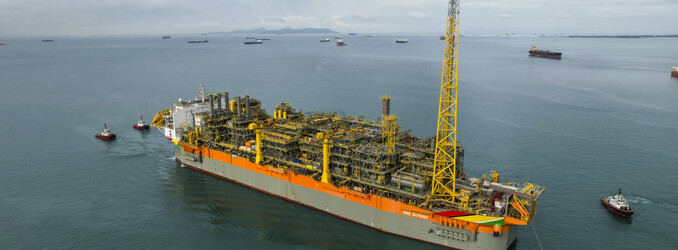
ExxonMobil’s final investment decision (FID) on the Hammerhead development offshore Guyana marks another significant milestone in one of the world’s most watched oil provinces. This $6.8 billion commitment underscores the company’s unwavering confidence in the prolific Stabroek block, projecting a robust long-term production profile that will shape global energy markets for decades. As the seventh project sanctioned on the block, Hammerhead is a powerful signal to investors about the strategic importance and economic viability of Guyana’s burgeoning oil industry, even as broader market dynamics present a complex picture for crude prices.
Hammerhead: Fueling Guyana’s Ascent to Global Oil Power
The Hammerhead development, slated for first oil in 2029, is set to deploy a new Floating Production, Storage, and Offloading (FPSO) vessel with a formidable capacity of 150,000 barrels of oil per day (bopd). This addition will be instrumental in propelling the Stabroek block’s total installed capacity to an impressive 1.5 million bopd once all sanctioned projects are online. The project design includes 18 production and injection wells, ensuring efficient recovery from the vast offshore reserves. ExxonMobil, in partnership with Hess Guyana Exploration (30%) and CNOOC Petroleum Guyana (25%), currently extracts approximately 650,000 bopd from the block. With the recent commissioning of the ONE GUYANA FPSO, this output is expected to surge past 900,000 bopd by the close of the year. Beyond Hammerhead, two other substantial projects, Uaru (targeting 2026 startup) and Whiptail (expected 2027), remain actively under development. This systematic buildout highlights not just the resource potential, but also the operational efficiency and aggressive development pace that characterize the Stabroek consortium’s strategy in Guyana.
Navigating Volatility: XOM’s Long-Term Vision Amidst Current Market Shifts
ExxonMobil’s multi-billion dollar commitment to Hammerhead demonstrates a profound long-term perspective, even as the immediate crude oil market shows significant volatility. As of today, Brent Crude is trading at $90.38 per barrel, experiencing a sharp 9.07% decline within the day, with its range fluctuating between $86.08 and $98.97. Similarly, WTI Crude stands at $82.59 per barrel, down 9.41%. This recent downturn follows a notable trend over the past two weeks, where Brent prices have fallen by 18.5%, from $112.78 on March 30 to $91.87 just yesterday. The price of gasoline has also seen a daily dip of 5.18% to $2.93. Despite these short-term fluctuations and downward price pressures, the Hammerhead FID underscores that projects with strong economics and low breakeven costs, such as those in Guyana, remain highly attractive. ExxonMobil’s investment of over $60 billion across the seven sanctioned Stabroek projects reinforces this view, indicating that the long-term demand fundamentals and the basin’s high-quality resource base are compelling enough to warrant continued aggressive development.
Forward Momentum: Key Events Shaping the Energy Landscape
While the Hammerhead project has a 2029 production target, the near-term energy calendar holds critical events that will undeniably influence investor sentiment and the broader price environment in which these long-cycle projects operate. Tomorrow, April 18, the OPEC+ Joint Ministerial Monitoring Committee (JMMC) meets, followed by the full OPEC+ Ministerial Meeting on April 19. The outcomes of these meetings, particularly regarding production quotas, could significantly impact global supply levels and crude price stability. Investors are keenly watching for any signals that might address the current price weakness, with many asking about OPEC+’s current production quotas and their potential future adjustments. Furthermore, the upcoming API Weekly Crude Inventory report on April 21 and the EIA Weekly Petroleum Status Report on April 22 will provide fresh insights into U.S. supply and demand dynamics, offering immediate market reactions. These weekly reports, alongside the Baker Hughes Rig Count on April 24, cumulatively paint a picture of the global supply-demand balance. For a project like Hammerhead, which represents a massive capital allocation, the long-term policy and market signals derived from these regular events are crucial for ensuring a predictable and profitable operating environment.
Addressing Investor Focus: De-risking Future Returns in Guyana
Our proprietary reader intent data reveals that investors are intensely focused on future oil price trajectories, with a prominent question being, “What do you predict the price of oil per barrel will be by end of 2026?” While Hammerhead’s production is years away, the decision to sanction such a substantial project in today’s volatile market is a testament to ExxonMobil’s confidence in the long-term sustainability of oil demand and prices. The Guyana projects are known for their highly competitive breakeven costs, which inherently de-risk investments against future price uncertainty. Moreover, ExxonMobil has already contributed over $7.8 billion to Guyana’s Natural Resource Fund since first oil in 2019, demonstrating a strong, collaborative partnership with the host nation. This consistent investment and significant economic contribution not only builds a “thriving new oil-and-gas industry” in Guyana but also fosters a stable and predictable regulatory environment, which is paramount for attracting and sustaining such large-scale capital projects. For investors, this robust partnership, coupled with the resource quality, mitigates many of the geopolitical and operational risks typically associated with frontier developments, solidifying Guyana’s appeal as a top-tier investment destination in the global energy landscape.