The global oil market is grappling with a deepening bearish outlook, caught between the persistent weight of ample supply and a faltering demand stimulus from recent monetary policy shifts. Investors are navigating a complex landscape where traditional catalysts for price appreciation are proving ineffective, leading to a significant re-evaluation of short-term energy sector prospects. This analysis delves into the dual pressures currently shaping crude prices and highlights key indicators and upcoming events that will dictate market direction.
Persistent Supply Overhang Defies Expectations
Despite ongoing efforts by major producers to manage output, global supply channels remain robust, creating a significant overhang that continues to pressure prices. The market has observed consistent resilience in U.S. production, while Russian crude volumes have maintained a steady flow, largely unaffected by international sanctions. This confluence of factors has effectively neutralized the impact of reduced output curbs by the Organization of the Petroleum Exporting Countries and its allies (OPEC+), preventing any meaningful tightening of the supply-demand balance.
Adding to the supply narrative, recent data revealed a notable 4 million-barrel build in U.S. distillate stocks. This unexpected accumulation points directly to slack diesel demand, a critical indicator of industrial and economic activity, within an already well-supplied market. Investors are closely scrutinizing production figures, asking about current OPEC+ production quotas and their true effectiveness given the persistent global supply. With the Joint Ministerial Monitoring Committee (JMMC) and the full Ministerial OPEC+ meetings scheduled for April 17th and 18th respectively, market participants will be keenly observing any statements or adjustments to production policy that could signal a shift in this dynamic.
Monetary Policy’s Limited Impact on Demand
Hopes for an immediate demand uplift from monetary easing have largely fallen flat. While the Federal Reserve delivered its first rate cut of the year this week, a 25 basis-point reduction, the anticipated boost to economic activity and, consequently, oil consumption has not materialized. Market participants express skepticism that future rate cuts, if not substantial, could merely weaken the U.S. dollar without providing material support to oil demand. Analysts suggest a more decisive move, such as a 50 basis-point reduction, might be necessary to meaningfully stimulate consumption.
The broader macroeconomic environment offers little encouragement for energy growth. Recent economic indicators, including softer jobs data and a notable decline in U.S. homebuilding activity, paint a picture of an economy struggling to gain momentum. This subdued economic backdrop suggests that lower borrowing costs alone are insufficient to ignite the robust demand needed to absorb the current excess crude supply, leaving oil prices vulnerable to downward pressure.
Market Sentiment and Technical Indicators Signal Further Downside
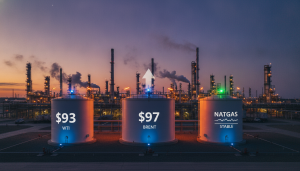
The prevailing bearish sentiment is clearly reflected in current market pricing and technical indicators. As of today, April 17th, Brent crude trades at $98.1 per barrel, marking a 1.3% decline for the session, having oscillated within a daily range of $97.92 to $98.67. Similarly, West Texas Intermediate (WTI) crude has seen a significant pullback, settling at $89.58 per barrel, a 1.74% drop, with its daily range spanning $89.52 to $90.26. This recent daily weakness compounds a more profound downtrend observed over the past two weeks, during which Brent crude has shed over 12% of its value, falling from $112.57 on March 27th to $98.57 by April 16th. Investors, keenly focused on current pricing, are frequently inquiring about the real-time value of Brent crude and the underlying models that power such responses, underscoring the importance of transparent and timely market data in this volatile environment.
Beyond the immediate price action, technical analysis reinforces the downside bias. The inability of crude to reclaim key moving averages or sustain levels above the pivotal $64.21 mark, which previously served as a significant resistance point, suggests that any rallies are likely to be short-lived and meet strong selling pressure. Should the current downward momentum intensify, market strategists point to the $60.77 level as the next critical support target, indicating potential for further significant declines if fundamental pressures persist.
Upcoming Events: Catalysts for Volatility or Confirmation of Trends?
The immediate future holds several key events that could either exacerbate the current bearish sentiment or provide an unexpected shift in market dynamics. The aforementioned OPEC+ meetings on April 17th and 18th are paramount. Any indication of further production cuts or a stronger commitment to existing targets could offer some relief, but a reaffirmation of current strategy without addressing the supply glut might deepen market pessimism.
Beyond OPEC+, the weekly inventory reports from the American Petroleum Institute (API) on April 21st and 28th, followed by the official Energy Information Administration (EIA) Weekly Petroleum Status Reports on April 22nd and 29th, will provide crucial insights into U.S. crude and product stock levels. These reports will confirm whether the recent distillate build was an anomaly or part of a broader trend of slack demand and ample supply. Furthermore, the Baker Hughes Rig Count on April 24th and May 1st will offer forward-looking indicators of U.S. drilling activity and potential future production growth. Investors should monitor these dates closely, as each data point will contribute to shaping the short-to-medium term trajectory of oil prices and provide clarity amidst the current market uncertainty.