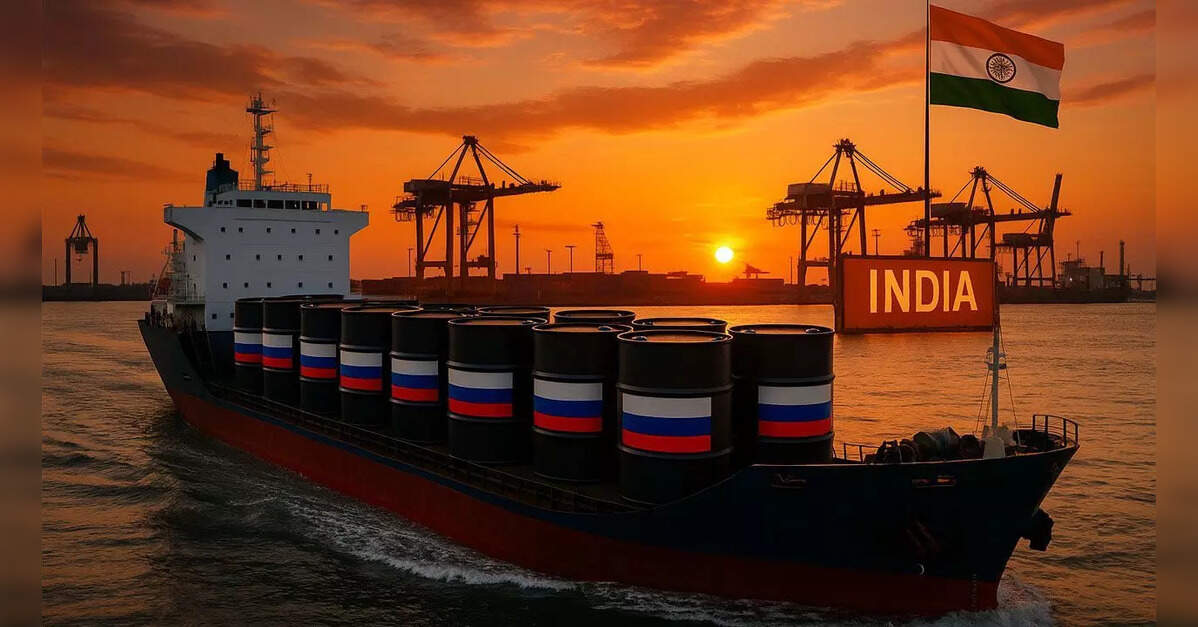
India’s Growing Appetite for Russian Crude Reshapes Global Energy Dynamics
The global oil market is undergoing a significant structural shift, with India rapidly emerging as a pivotal player in the redirection of Russian crude flows. Recent data reveals India imported €2.9 billion worth of crude oil from Russia in August, a notable increase from €2.7 billion in July. This surge positions India nearly on par with China, which imported €3.1 billion in the same month, albeit marking a decline from its July figure of €4.1 billion. This evolving landscape is not merely a statistical anomaly but a powerful indicator of how geopolitical tensions are reshaping traditional trade routes and influencing market dynamics, compelling investors to reassess long-term supply and demand fundamentals.
India’s Ascent Reshapes Global Crude Flows Amid Price Volatility
The sustained increase in India’s Russian crude purchases underscores a strategic realignment in global energy procurement. As of today, Brent crude trades at $98.27, reflecting a modest -1.13% dip within a day range of $97.92-$98.67, while WTI crude sits at $89.88, down 1.41% in its range of $89.57-$90.26. This recent price stability follows a significant period of volatility, with Brent having declined from $112.57 just three weeks prior to $98.57 yesterday, representing a substantial drop of over 12%. India’s consistent demand provides a crucial outlet for Russian crude, acting as a potential floor for prices that might otherwise face sharper declines amidst broader market uncertainties. For investors, understanding the elasticity of this demand and its impact on global tanker rates and arbitrage opportunities is paramount, especially as traditional Western buyers continue to pivot away from Russian supplies. The sustained flow of crude to new markets inherently alters shipping routes, insurance premiums, and the overall efficiency of the global oil supply chain, warranting careful consideration in portfolio construction.
Geopolitical Pressures and Investor Scrutiny on Supply Chains
India’s growing reliance on Russian crude has not gone unnoticed by Western powers, leading to palpable geopolitical pressures. The United States has openly expressed concerns, arguing that these purchases indirectly finance Moscow’s ongoing conflict. This pressure escalated with the imposition of a 25% additional tariff on a range of Indian exports to the US, effective August 27th, explicitly as a penalty for buying Russian oil. Furthermore, US President Donald Trump recently urged the European Union to consider imposing tariffs of up to 100% on Chinese and Indian goods to further curb their energy trade with Russia. Despite this, India has firmly pushed back, asserting the unfairness of being singled out when other major economies, including China and several EU nations, continue to purchase significant volumes of Russian energy. Investors are keenly asking about the stability of current supply chains and the potential for geopolitical maneuvering to disrupt market equilibrium, exemplified by recent inquiries into market data reliability and the effectiveness of energy sanctions. The risk of escalating trade disputes and their potential to reroute or constrain global energy flows remains a key concern for those evaluating long-term investment strategies in the oil and gas sector.
A Deeper Dive into Russia’s Diversified Energy Export Portfolio
While crude oil dominates headlines, a broader examination of Russia’s energy exports reveals a diversified portfolio that continues to find markets globally. India’s total fossil fuel imports from Russia reached €3.6 billion in August, with coal (€510 million) and refined products (€282 million) supplementing its massive crude purchases. China, despite its slight dip in crude imports, remains Russia’s largest overall fossil fuel buyer, with total imports amounting to €5.7 billion. This comprehensive figure includes €553 million in oil products, €855 million in coal, and €676 million in pipeline gas, showcasing Beijing’s multi-faceted energy relationship with Moscow. Turkiye ranked third, importing €3 billion of Russian fossil fuels, comprising €1.2 billion of pipeline gas, €1 billion of oil products, €596 million of crude, and €225 million of coal. Even the European Union, a vocal critic, imported €1.2 billion, predominantly €773 million in LNG and pipeline gas, alongside €379 million in crude. South Korea also featured as a significant buyer, led by €413 million of coal and €118 million of LNG. This comprehensive picture highlights Russia’s robust ability to diversify its energy exports across various products and geographies, complicating any singular effort to diminish its energy revenues and creating a complex web of interconnected energy dependencies for global investors to unravel.
Ahead of the Curve: Navigating Upcoming Market Catalysts
For discerning investors, the evolving dynamics of Russian energy trade, coupled with geopolitical pressures, necessitate a keen eye on upcoming market catalysts. With OPEC+ set to convene its Joint Ministerial Monitoring Committee (JMMC) this Saturday, April 18th, followed by the Full Ministerial meeting on Monday, April 20th, market participants are actively seeking clarity on future production quotas. This directly addresses prevalent investor inquiries regarding OPEC+’s current production targets, which are critical for forecasting global supply. Any decision by the cartel to maintain, increase, or further cut output will have significant implications for crude prices, especially against the backdrop of shifting demand patterns from major importers like India and China. Additionally, the regular release of industry data, such as the Baker Hughes Rig Count on April 17th and 24th, along with the API Weekly Crude Inventory (April 21st, 28th) and EIA Weekly Petroleum Status Reports (April 22nd, 29th), will continue to provide vital snapshots of the immediate supply-demand balance. Investors must meticulously monitor these events, as they will define the near-term supply landscape and offer crucial insights into the resilience and adaptability of the global energy market amidst profound structural changes.


