Close Menu
  • Home
  • Market News
    • Crude Oil Prices
    • Brent vs WTI
    • Futures & Trading
    • OPEC Announcements
  • Company & Corporate
    • Mergers & Acquisitions
    • Earnings Reports
    • Executive Moves
    • ESG & Sustainability
  • Geopolitical & Global
    • Middle East
    • North America
    • Europe & Russia
    • Asia & China
    • Latin America
  • Supply & Disruption
    • Pipeline Disruptions
    • Refinery Outages
    • Weather Events (hurricanes, floods)
    • Labor Strikes & Protest Movements
  • Policy & Regulation
    • U.S. Energy Policy
    • EU Carbon Targets
    • Emissions Regulations
    • International Trade & Sanctions
  • Tech
    • Energy Transition
    • Hydrogen & LNG
    • Carbon Capture
    • Battery / Storage Tech
  • ESG
    • Climate Commitments
    • Greenwashing News
    • Net-Zero Tracking
    • Institutional Divestments
  • Financial
    • Interest Rates Impact on Oil
    • Inflation + Demand
    • Oil & Stock Correlation
    • Investor Sentiment

Subscribe to Updates

Subscribe to our newsletter and never miss our latest news

Subscribe my Newsletter for New Posts & tips Let's stay updated!

What's Hot

Chevron declares force majeure as Israel shuts Leviathan gas field – Oil & Gas 360

March 2, 2026

Petro-Victory spuds SJ-12 gas well at São João field, Brazil

March 2, 2026

Brazil offshore vessel operators OceanPact, CBO announce merger

March 2, 2026
Facebook X (Twitter) Instagram Threads
Oil Market Cap – Global Oil & Energy News, Data & Analysis
  • Home
  • Market News
    • Crude Oil Prices
    • Brent vs WTI
    • Futures & Trading
    • OPEC Announcements
  • Company & Corporate
    • Mergers & Acquisitions
    • Earnings Reports
    • Executive Moves
    • ESG & Sustainability
  • Geopolitical & Global
    • Middle East
    • North America
    • Europe & Russia
    • Asia & China
    • Latin America
  • Supply & Disruption
    • Pipeline Disruptions
    • Refinery Outages
    • Weather Events (hurricanes, floods)
    • Labor Strikes & Protest Movements
  • Policy & Regulation
    • U.S. Energy Policy
    • EU Carbon Targets
    • Emissions Regulations
    • International Trade & Sanctions
  • Tech
    • Energy Transition
    • Hydrogen & LNG
    • Carbon Capture
    • Battery / Storage Tech
  • ESG
    • Climate Commitments
    • Greenwashing News
    • Net-Zero Tracking
    • Institutional Divestments
  • Financial
    • Interest Rates Impact on Oil
    • Inflation + Demand
    • Oil & Stock Correlation
    • Investor Sentiment
Oil Market Cap – Global Oil & Energy News, Data & Analysis
Home » ‘Everything is gone’: Punjabi farmers suffer worst floods in three decades | India
Climate Commitments

‘Everything is gone’: Punjabi farmers suffer worst floods in three decades | India

omc_adminBy omc_adminSeptember 6, 2025No Comments6 Mins Read
Share
Facebook Twitter Pinterest Threads Bluesky Copy Link


For days, farmers in the Indian state of Punjab watched the pounding monsoon rains fall and the rivers rise with mounting apprehension. By Wednesday, many woke to find their fears realised as the worst floods in more than three decades ravaged their farms and decimated their livelihoods.

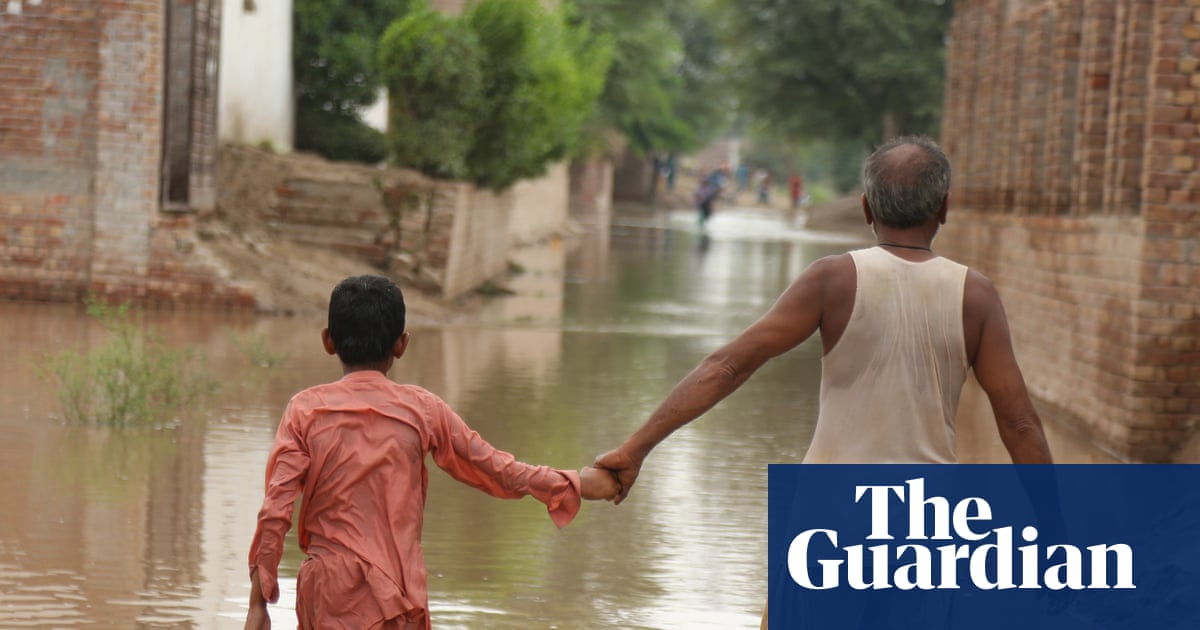
Hundreds of thousands of acres of bright green rice paddies – due to be harvested imminently – as well as crops of cotton and sugar cane were left destroyed as they became fully submerged in more than five feet of muddy brown flood waters. The bodies of drowned cattle littered the ground.

“The crops are ruined, and even our homes are in danger of collapsing,” said Parmpreet Singh, 52, a farmer from Ajnala in Amritsar district, Punjab. His family, including his elderly mother and two young children, were now living on the roof of their house to stay safe from the murky flood waters.

“My entire livelihood depends on my seven hectares of farmland, all of which has been destroyed by flood waters,” he said, despairing that his only option left would be to sell his land and abandon farming. “I had already invested most of my money into seeds and fertilisers for the previous crop. Now everything is gone.”

While monsoon season usually brings heavy rain, the extreme levels of rainfall that fell across northern India this week caused untold damage in Punjab, resulting in flash floods and swollen rivers breaching their banks and overflowing into fields and villages. So far, 43 people have lost their lives and almost 2,000 villages in the state have been affected, leaving hundreds of thousands of people without electricity and access to clean water. The stench of rotting animal carcasses hangs over many villages.

Rescue workers evacuate people affected by rising flood waters in Multan district, Punjab province, Pakistan. Photograph: Mansoor Abbas/EPA

“This is the worst time Punjab has ever faced,” said Parminder Singh Pinki, a lawmaker from Firozpur district in western Punjab, one of the areas badly hit by floods.

“I have never witnessed such devastation in my lifetime. Entire farmlands are submerged under water, now layered with mud and sand.”

India’s farmers have already faced mounting hardship, with millions saddled with high debts, low incomes and heavy crop losses in the face of increasingly extreme and unpredictable weather conditions brought on by the climate crisis.

Pinki was among those who accused the ruling Bharatiya Janata party (BJP) government, led by Narendra Modi, of negligence towards farmers and simply abandoning them to their fate during this year’s extreme monsoon.

“The government had been aware for months about the weather forecasts and should have put proper measures and emergency responses in place,” he said. “But that never happened, and this failure has led to destruction on such a massive scale.”

He was echoed by Surinder Singh, 75, a farmer from Sarala Kalan village in Patiala. For days, he had watched the canal near to their village getting higher and higher, but had been powerless to stop it.

“The government will make promises of relief, but the farmers will end up receiving nothing,” he said. “In the end, we are left to take care of ourselves.” Like many, he questioned the long-term viability of Indian agriculture, which employs half the country’s workforce and keeps food on the country’s tables.

“I cannot imagine what is left for our future generations,” he said. “Floods and extreme weather events are becoming more frequent, and the future does not look any better. If the farmers of Punjab – the food bowl of India – cannot even feed themselves, how will they feed others?”

Governments in India and Pakistan have been criticised for their inadequate response as villages across the region are submerged. Photograph: Mansoor Abbas/EPA

This crisis has not been India’s alone. Across the border, in Pakistan’s agriculture-heavy province also called Punjab, the devastation caused by floods has been even more catastrophic, with almost 2 million people evacuated and about 4,000 villages submerged in flood waters.

skip past newsletter promotion

The planet’s most important stories. Get all the week’s environment news – the good, the bad and the essential

Privacy Notice: Newsletters may contain information about charities, online ads, and content funded by outside parties. If you do not have an account, we will create a guest account for you on theguardian.com to send you this newsletter. You can complete full registration at any time. For more information about how we use your data see our Privacy Policy. We use Google reCaptcha to protect our website and the Google Privacy Policy and Terms of Service apply.

after newsletter promotion

The two countries share several major rivers and the Indian government’s decision to release water from several heavily filled dams upstream has led to further flooding on both sides of the border in the geographical region of Punjab, prompting Pakistani officials to try to blame India for the disaster.

Such was the fury of the overflowing Ravi River, which runs through the border of India into Pakistan, that on Friday it ripped down 30km of iron fencing that forms the highly militarised border between the two conflicting neighbours, and forced India’s border security force soldiers to abandon dozens of their highly sensitive posts.

Maratab Ali Gondal, a farmer from Mandi Bahauddin district in Pakistani Punjab, said the rising levels of the Chenab River, which also flows from India, had washed away 90 acres of his crops, including rice and sugar cane, causing losses of millions of rupees.

Gondal said he had spent the previous months begging local officials to build embankments along the river, which would protect farmland, but nothing had been done. “The water erosion has taken all of my land. There is flood water everywhere now. This is not the fault of India; it was [Pakistani] Punjab government negligence which swept away my farmland,” he said.

He added: “This is not only my story – our farmers have been witnessing the worst time in the country’s history.”

Pakistan’s Punjab province hit by 'biggest flood in its history' – video
Pakistan’s Punjab province hit by ‘biggest flood in its history’ – video

It was not only farmland that was affected. Residents of the highly affluent housing development Park View Society in Lahore, recently constructed just a few hundred metres away from the bank of the Ravi, also found their multimillion-rupee homes filled with murky flood water. Experts said that rapid deforestation and development along the waterways was only worsening the likelihood of floods in the area.

Umar, a resident who moved to the development this year, said his home had been filled with five feet of river water. “Many of us have invested our life savings in buying or constructing a dream house here,” he said. “But how could they be allowed to build it if it is at such risk of flooding?”

Maryam Nawaz Sharif, the chief minister of Pakistani Punjab, who is also the niece of Pakistan’s prime minister, Shehbaz Sharif, was accused of doing little to help those affected by the flooding. In a social media post, she highlighted how portable toilets were being installed at a relief camp to help the displaced – however, the image she shared was revealed to be from two years ago.


Source link

Share. Facebook Twitter Pinterest Bluesky Threads Tumblr Telegram Email
omc_admin
  • Website

Related Posts

UK slashes climate aid programmes for developing countries | Climate crisis

March 2, 2026

Winter getting shorter in 80% of major US cities, new data shows | US weather

February 27, 2026

Trump officials move to kill system that protects US from chemical disasters | US Environmental Protection Agency

February 27, 2026
Add A Comment
Leave A Reply Cancel Reply

Top Posts

Federal Reserve cuts key rate for first time this year

September 17, 202513 Views

Inflation or jobs: Federal Reserve officials are divided over competing concerns

August 14, 20259 Views

Oil tanker rates to stay strong into 2026 as sanctions remove ships for hire – Oil & Gas 360

December 16, 20258 Views
Don't Miss

Petro-Victory spuds SJ-12 gas well at São João field, Brazil

By omc_adminMarch 2, 2026

(WO) – Petro-Victory Energy Corp. has commenced drilling operations on the SJ-12 well at its…

WhiteHawk Energy to acquire 500-producing-well Haynesville mineral portfolio

March 2, 2026

Qatar shuts Ras Laffan LNG plant after Iranian drone strike

March 2, 2026

Drone strike forces shutdown of Aramco’s 550,000-bpd Ras Tanura refinery

March 2, 2026
Top Trending

BlackRock, EQT Lead $33 Billion Acquisition of AES

By omc_adminMarch 2, 2026

UK slashes climate aid programmes for developing countries | Climate crisis

By omc_adminMarch 2, 2026

Upright Launches New ESG Due Diligence Solution for Investors

By omc_adminMarch 2, 2026
Most Popular

The 5 Best 65-Inch TVs of 2025

July 3, 202515 Views

AI’s Next Bottleneck Isn’t Just Chips — It’s the Power Grid: Goldman

November 14, 202514 Views

The Layoffs List of 2025: Meta, Microsoft, Block, and More

May 9, 202510 Views
Our Picks

Brazil offshore vessel operators OceanPact, CBO announce merger

March 2, 2026

Petro-Victory spuds SJ-12 gas well at São João field, Brazil

March 2, 2026

Gas Surges as Qatar Shuts World’s Largest LNG Export Plant

March 2, 2026

Subscribe to Updates

Subscribe to our newsletter and never miss our latest news

Subscribe my Newsletter for New Posts & tips Let's stay updated!

Facebook X (Twitter) Instagram Pinterest
  • Home
  • About Us
  • Advertise With Us
  • Contact Us
  • DMCA
  • Privacy Policy
  • Terms & Conditions
© 2026 oilmarketcap. Designed by oilmarketcap.

Type above and press Enter to search. Press Esc to cancel.


